








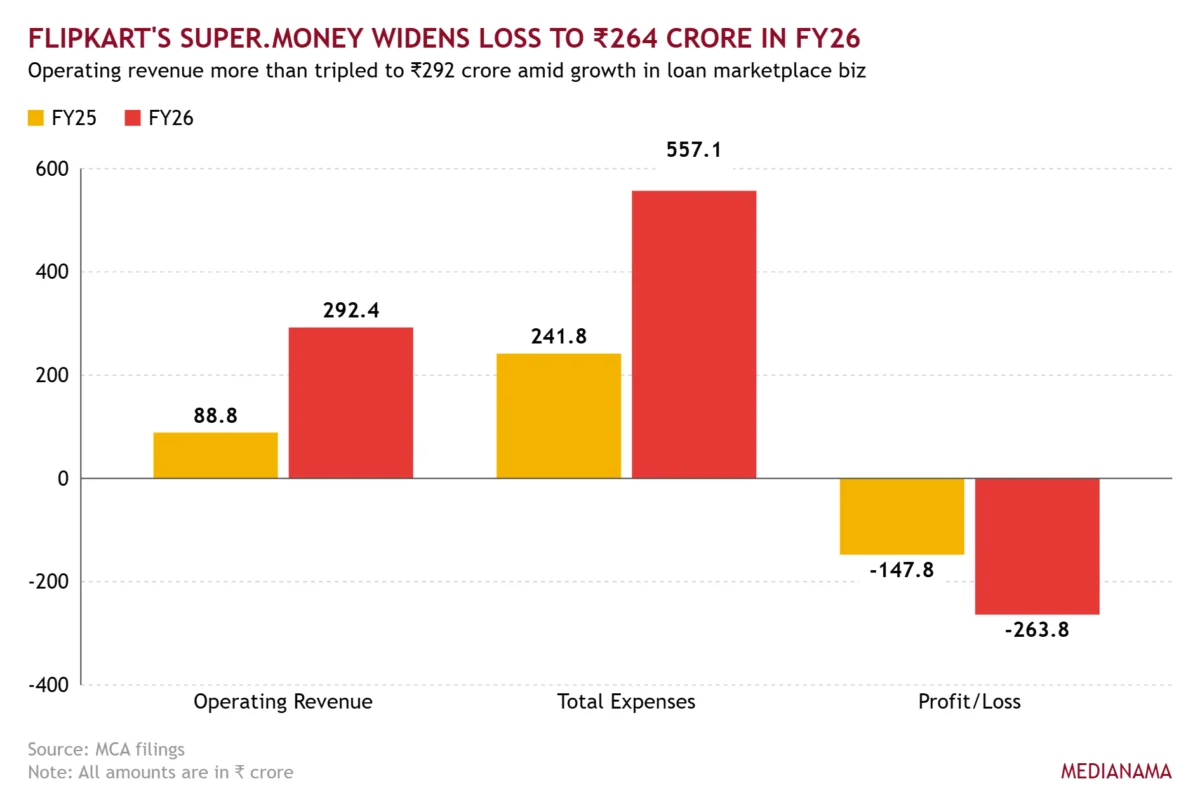
In the hyper-competitive arena of Indian digital payments, super.money—the Unified Payments Interface (UPI) app incubated under the Flipkart umbrella—has emerged as a formidable challenger. Recent financial filings with the Ministry of Corporate Affairs (MCA) for the fiscal year 2026 (FY26) reveal a company in a state of aggressive expansion. While its top-line revenue has tripled, the firm’s bottom-line reflects the heavy costs associated with capturing market share in one of the world’s most saturated fintech markets.
Main Facts: A Tripled Revenue Stream
The headline figures from super.money’s FY26 report tell a story of rapid growth. The company reported an operating revenue of Rs 292.4 crore, a staggering 229% increase from the Rs 88.8 crore recorded in FY25. This meteoric rise is primarily attributed to the app’s pivot toward a robust loan marketplace model.
However, growth in the fintech sector rarely comes without a premium. The company’s net loss widened by 78%, climbing to Rs 263.8 crore from Rs 147.8 crore in the previous fiscal year. This financial trajectory—high top-line growth coupled with expanding losses—is emblematic of the "land and expand" strategy favored by venture-backed startups looking to cement their position as market leaders before shifting focus toward long-term profitability.
Chronology: From Separation to Market Dominance
The birth of super.money was a direct consequence of the strategic decoupling of PhonePe from the Flipkart Group. Following the separation, Flipkart needed a homegrown, integrated payments solution to sustain its e-commerce dominance and capture the lucrative financial services sector.
- June 2024: super.money officially launched its beta version, entering a market dominated by incumbents like Google Pay, PhonePe, and Paytm.
- Late 2024–Early 2025: The company focused on aggressive customer acquisition, leveraging the massive user base of the Flipkart ecosystem.
- 2025: super.money made a strategic move to acquire the Y Combinator-backed startup BharatX. This acquisition was a turning point, providing the technical infrastructure to offer advanced credit products like Buy Now, Pay Later (BNPL) and consumer durable loans.
- March 2026: In a major corporate restructuring move, super.money was merged into Flipkart Internet, alongside other key subsidiaries like Myntra, eKart, and Cleartrip. This move was widely interpreted as part of a consolidation strategy ahead of a planned initial public offering (IPO).
- September 2026: Data from the National Payments Corporation of India (NPCI) confirmed that super.money had secured a spot among India’s top five UPI apps, consistently processing over 400 million transactions per month.
Supporting Data: The Anatomy of the Business Model
To understand the financial health of super.money, one must dissect its revenue engines. The company operates as a digital bridge between consumers and financial institutions.
The Loan Marketplace
The loan marketplace is the undisputed heart of the business, contributing Rs 247.8 crore—roughly 85% of total operating revenue. By facilitating loans through partnerships with banks and non-banking financial companies (NBFCs), super.money acts as a lead generator and platform provider, earning commissions on successful loan originations.
Payments and "Other" Income
While UPI payments are the hook that draws users into the app, they are generally a low-margin utility. The remaining Rs 44.6 crore of revenue is categorized under "other operating income." While the company has been opaque regarding the specifics of this segment, industry analysts suggest it likely includes data-led services, brand promotions, and platform fees from merchant services.
The Cost of Acquisition
The company’s total expenses surged 130% to Rs 557.1 crore in FY26. This reflects the high cost of customer acquisition (CAC) in the Indian digital payments space. To move users from simple P2P (peer-to-peer) payments to high-margin financial products like credit, companies must spend heavily on digital marketing, cashback incentives, and infrastructure.
Official Responses and Strategic Vision
While super.money has not issued a detailed public statement regarding its widened losses, the overarching narrative from the Flipkart Group suggests that the company is currently in a "scale-up" phase. The integration into Flipkart Internet provides super.money with a unique advantage: access to a massive data pool of consumer spending habits.

By leveraging the "Flipkart effect," the app can tailor credit offerings—such as checkout financing—directly to consumers at the point of sale. Furthermore, reports indicate that the company is exploring a foray into stock broking. If realized, this would diversify its revenue beyond lending and payments, positioning super.money as a "super app" capable of managing a user’s entire financial life, from daily groceries to long-term wealth management.
Implications: The Road to the IPO
The financial results of super.money must be viewed through the lens of the larger Flipkart Group’s goals. With the group reporting a consolidated net loss of Rs 8,468 crore against an operating revenue of Rs 1.45 lakh crore in FY26, the strategy is clearly focused on building a defensible moat of transaction volume and user data.
1. The Power of Consolidation
The merger of super.money into Flipkart Internet serves a dual purpose: it cleans up the corporate structure for public market investors and creates a cross-pollination of services. By centralizing the payments infrastructure, Flipkart reduces the friction of cross-selling financial products to its e-commerce customers.
2. The Regulatory Landscape
Operating in the UPI space brings intense scrutiny from the NPCI and the Reserve Bank of India (RBI). As super.money grows, it will need to maintain strict compliance with data localization and digital lending guidelines. Any shift toward high-risk lending or aggressive data harvesting could trigger regulatory friction, a risk that all major fintech players are currently navigating.
3. Monetization vs. Market Share
The central challenge for super.money in the coming years will be the transition from a "growth-at-all-costs" model to a sustainable one. The 78% increase in net losses highlights that the company is still heavily subsidizing its growth. To justify its valuation in a future IPO, the company will need to prove that its credit marketplace can sustain its margins even as the competitive landscape intensifies.
4. The Future of Indian Fintech
super.money’s reliance on the loan marketplace underscores a broader trend in Indian fintech: payments are the "top of the funnel," but credit is the "bottom line." As the digital economy matures, the players who can successfully convert UPI users into high-intent borrowers will win. super.money is betting that its integration with Flipkart’s logistics and retail ecosystem provides it with a competitive edge that standalone payments apps cannot replicate.
Conclusion: A Calculated Gamble
super.money is currently playing a sophisticated game of chess. By tripling its revenue, it has proven that it can scale, and by capturing 400 million monthly transactions, it has proven that it can compete with the giants of the industry. The widened losses are not necessarily a sign of weakness; rather, they are a deliberate investment in capturing the infrastructure of India’s digital economy.
As the company prepares for a potential IPO, the focus will inevitably shift toward efficiency. The next 18 to 24 months will be critical. If super.money can effectively monetize its existing user base through new verticals like wealth management or insurance, it may well justify the current spending. If it fails to lower its customer acquisition costs while maintaining growth, it may find itself in the same precarious position as many of its predecessors.
For now, the app stands as a testament to the ambitions of the Flipkart Group: to own the entire transaction journey, from the moment a user browses for a product to the final click of the "pay" button. In the fast-evolving ecosystem of Bharat, that is a position worth paying for.