











As the global technology sector moves past the supply chain bottlenecks that defined previous years, a new and more complex hurdle is emerging for the personal computer industry. According to a comprehensive market study released this week by industry research firm TrendForce, global notebook shipments could face a notable downturn by 2027.
The primary catalyst for this shift is no longer the availability of raw materials or manufacturing components, but rather a steep escalation in core hardware costs. As manufacturers grapple with persistently high prices for essential parts like CPUs, DRAM, and storage, brands will be forced to make difficult strategic compromises that could ultimately dampen consumer demand and stretch replacement cycles further than previously anticipated.
Main Facts
The core findings of the TrendForce report outline a challenging landscape for PC hardware manufacturers and consumers alike heading into 2027:
- Projected Shipment Declines: Global notebook shipments are currently forecasted to drop by a low-to-high-single-digit percentage in 2027, heavily contingent on how brands manage escalating production expenses.
- The Cost Burden: In the third quarter of 2026, core components—specifically CPUs, DRAM, and SSDs—accounted for an astounding 68% of the total bill of materials (BOM) for a standard, $900 mainstream notebook.
- The Trilemma of Brands: PC manufacturers face a compounding dilemma next year where they cannot simultaneously maintain current pricing, product specifications, and profit margins.
- Supply Chain Pressures: Driven largely by explosive data center and artificial intelligence infrastructure demand, PC DRAM supply is expected to remain severely constrained throughout the year, keeping prices elevated.
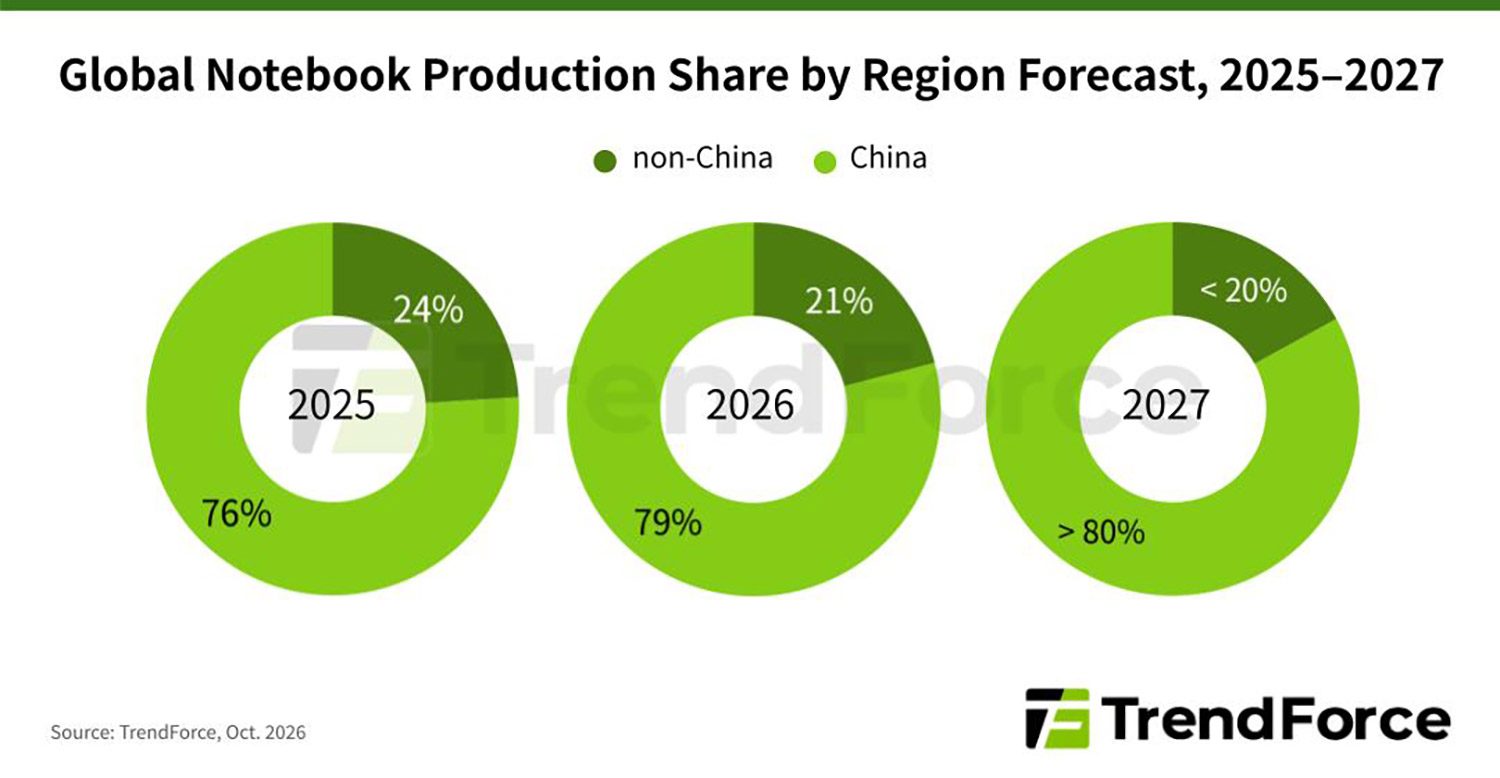
- Geographic Shifts: Assuming no sudden escalations in international trade tariffs, TrendForce estimates that production will increasingly lean back toward China, with the country’s share of global notebook production projected to rise from 76% in 2025 to 79% in 2026, and potentially clearing the 80% threshold by 2027.
Chronology: From Supply Constraints to Cost-Driven Demand Fatigue
Understanding the trajectory of the 2027 market requires examining how the notebook industry arrived at its current crossroads over the preceding years.

The 2026 Resurgence and Forward-Pulled Demand
Throughout 2026, the global notebook market experienced a period of relative relief. Manufacturers benefited significantly from improved CPU availability, which allowed them to fulfill backlogs and steady their production lines. Furthermore, anticipating future economic headwinds and potential cost adjustments, brands engaged in early purchasing strategies.
This proactive procurement, combined with accelerated replacement demand from consumers who had held onto aging hardware from the post-pandemic boom, temporarily propped up shipment figures. However, TrendForce analysts note a critical caveat: much of this purchasing momentum was artificially pulled forward from the second half of 2026 and early 2027. As a result, organic replacement demand in subsequent periods is destined to experience a cooling effect.
The Depletion of Low-Cost Inventories
As the industry progressed through late 2026, brands gradually burned through their buffers of lower-cost component inventories secured under legacy pricing agreements. By the time Q3 2026 concluded, the reality of skyrocketing hardware costs became inescapable. With CPUs, DRAM, and SSDs consuming nearly 70% of a mainstream laptop’s production budget, brands could no longer shield their balance sheets from the broader macroeconomic realities of the semiconductor market.
The 2027 Outlook: A Market at a Crossroads
Looking forward to 2027, the industry transitions from a supply-constrained environment to a demand-constrained one. With low-cost stockpiles depleted, the upcoming year will test the pricing power of major notebook vendors. If component costs fail to stabilize, consumer adoption rates are expected to stall, setting the stage for a potential high-single-digit contraction in total yearly shipments.
Supporting Data and Market Economics
The underlying data provided by TrendForce underscores just how precarious the financial margins are for modern notebook manufacturing.
The $900 Mainstream Laptop Breakdown
To understand the financial squeeze, analysts point to the bill of materials for a typical $900 mainstream notebook. In the third quarter of 2026, three primary components—central processing units (CPUs), dynamic random-access memory (DRAM), and solid-state drives (SSDs)—ate up 68% of the total manufacturing cost.
When more than two-thirds of a device’s baseline production budget is tied up in just three types of silicon and memory chips, any upward price fluctuation in those specific markets instantly threatens the viability of the product tier.
+-------------------------------------------------------+
|  Typical $900 Mainstream Notebook BOM (Q3 2026)       |
+-------------------------------------------------------+
|  [ CPU, DRAM, and SSDs ]  --->  68% of Total Cost     |
|  [ All Other Components  ]  --->  32% of Total Cost     |
+-------------------------------------------------------+
Diverging Trends in Memory and Storage
The supply and demand dynamics vary starkly depending on the specific component type:

- PC DRAM: The outlook for PC memory remains tight. The massive, insatiable demand for AI-driven hardware, enterprise data centers, and high-performance accelerators has claimed the lion’s share of semiconductor fabrication capacity. Consequently, PC DRAM faces severe limits on supply growth throughout the coming year, keeping acquisition costs high for notebook makers.
- NAND Flash: There is a silver lining on the storage front. TrendForce anticipates that NAND Flash supply constraints will begin to ease during the second half of 2027 as newly constructed manufacturing capacity comes online, potentially offering some relief to SSD pricing late in the year.
Production Consolidation in China
Amidst component cost pressures, manufacturers are continuously searching for ways to optimize operational expenses. TrendForce highlights that geographic relocation remains a primary tool for cost reduction. Provided that international tariff structures do not experience drastic, adverse escalations, brands are expected to lean further into established manufacturing hubs. China’s share of global notebook production, which sat at 76% in 2025, grew to 79% in 2026, and is projected to climb past 80% by 2027 as companies consolidate assembly lines to preserve slender profit margins.
Industry Dilemmas and Strategic Trade-Offs
Faced with these compounding fiscal pressures, notebook brands find themselves cornered by a classic industrial trilemma: they must choose how to balance retail pricing, hardware specifications, and corporate profitability. According to TrendForce, it is mathematically impossible to maintain all three simultaneously under current market conditions.
The Strategic Paths Available to Manufacturers
- Option 1: Passing Costs to the Consumer
Brands can maintain their profit margins and device specifications by raising retail prices. However, doing so risks alienating budget-conscious consumers and enterprises alike. Higher price tags inherently deter immediate purchases, leading to longer replacement cycles and a direct drop in total unit shipments—potentially dragging the annual decline into the high-single-digit territory. - Option 2: Absorbing the Price Hikes
Alternatively, companies can choose to keep retail prices stable to maintain sales volume, absorbing the inflated component costs directly onto their own balance sheets. This strategy protects market share in the short term but severely erodes gross profit margins, a risk that many publicly traded hardware vendors are reluctant to take. - Option 3: Reducing Specifications
A third, riskier path involves downgrading other hardware specifications—such as reducing base RAM capacity, utilizing lower-tier displays, or opting for smaller battery sizes—to offset the high cost of CPUs and storage. While this keeps retail prices flat and margins intact, it can make a brand’s lineup significantly less competitive against rivals offering superior value.
Broad Implications for Consumers and the Tech Ecosystem
The repercussions of TrendForce’s 2027 forecast extend far beyond the quarterly earnings reports of major PC manufacturers, directly impacting everyday consumers, IT administrators, and the broader consumer electronics market.
What This Means for Everyday Consumers
For the average buyer looking to purchase a new laptop in 2027, the market landscape may feel increasingly frustrating. Consumers will likely notice that entry-level and mainstream laptops ($700–$1,000 range) either creep up in price or arrive with stingier specifications (such as sticking with 8GB of RAM as a baseline when modern software increasingly demands more).

Furthermore, because rising prices will naturally discourage frequent upgrades, average consumers are expected to hold onto their current machines for longer periods. Households and students will treat laptops less like disposable yearly upgrades and more like long-term investments, echoing trends seen during historical hardware price spikes.
Enterprise and Institutional Purchasing
Enterprise IT departments, which rely on regular, predictable hardware refresh cycles to maintain security and performance standards, will also feel the pinch. Organizations planning large-scale fleet updates for their employees may need to adjust their capital expenditure budgets upward or stagger their deployment schedules over a longer timeline. The inability of manufacturers to guarantee stable pricing will complicate long-term IT procurement planning across both corporate and educational sectors.
A Shifting Competitive Landscape
Ultimately, the 2027 notebook market will serve as a definitive test of brand loyalty and supply chain ingenuity. Companies with diversified supply chains, massive purchasing power, and aggressive cost-management strategies will be better positioned to weather the storm. Smaller or regional brands, however, may find themselves squeezed out of profitability, leading to potential consolidation within the PC hardware industry as the true cost of the AI-driven semiconductor boom ripples down to the consumer level.



