










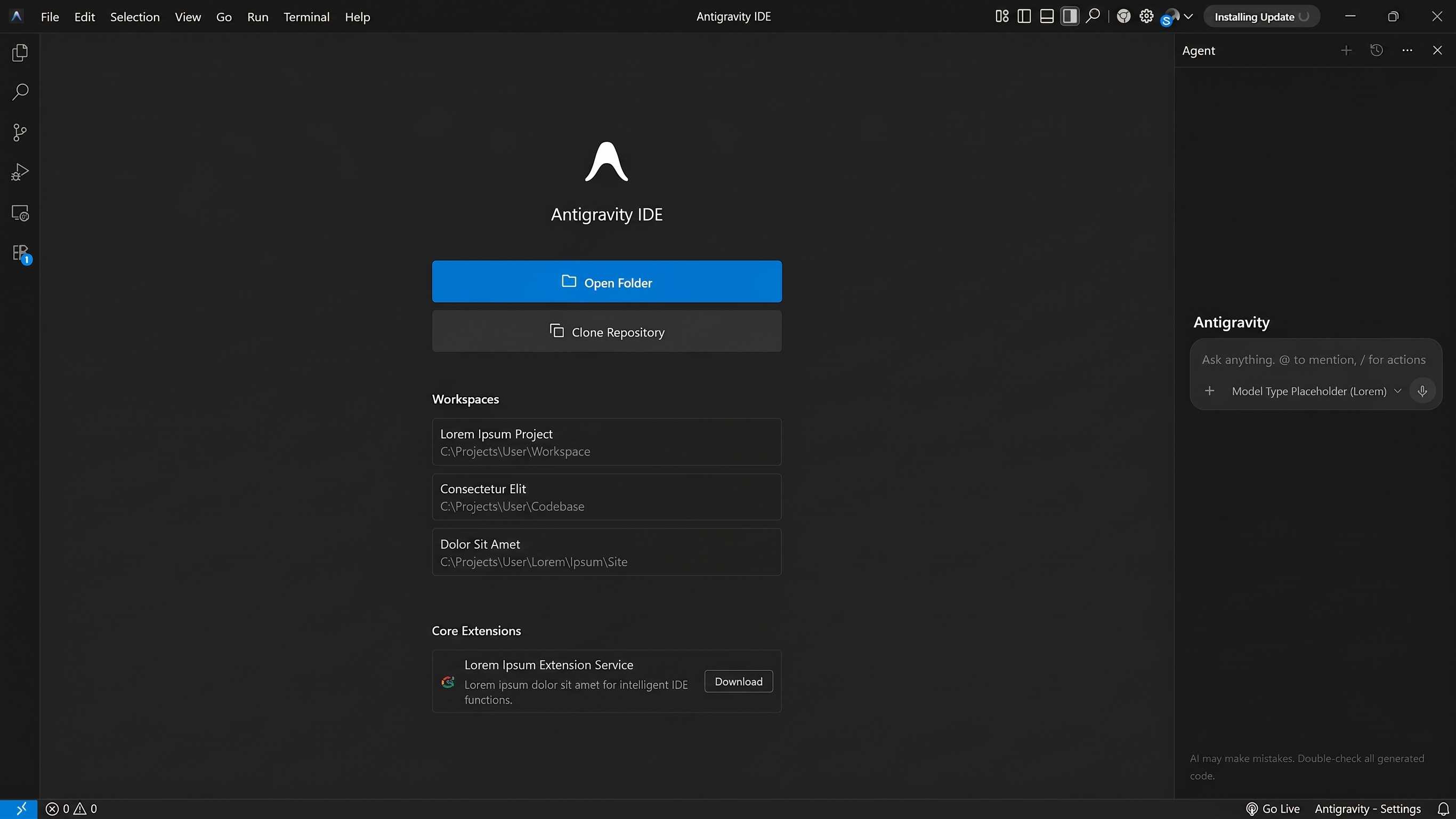
SAN FRANCISCO — The landscape of software development is undergoing a tectonic shift. For decades, the barrier to entry for creating web applications required a deep, foundational mastery of syntax, environments, dependency trees, and server architectures. Today, advanced Integrated Development Environments (IDEs) powered by frontier language models are rewriting the rules of code creation.
At the bleeding edge of this evolution is the Google Antigravity IDE—a sophisticated, multi-agent development environment designed to span the entire spectrum of engineering tasks. From basic auto-completion to autonomous multi-agent orchestration, Antigravity represents a fundamental leap forward from previous iterations like the Antigravity CLI and Antigravity 2.0.
Yet, as developers and hobbyists alike begin pushing these tools to their limits, a critical question emerges: Does the advent of agentic software engineering truly democratize coding, or does it simply trade the mechanical burden of typing for the cognitive burden of supervision?
To find out, we put Antigravity IDE to the test, building a fully functioning, local-first web application using Astro, HTMX, and SQLite. What we discovered illuminates both the breathtaking potential and the distinct architectural limits of AI-driven development.
Main Facts: What is Antigravity IDE?
Google Antigravity IDE is a next-generation development environment natively integrated with Google’s powerhouse Gemini models, alongside optional support for Anthropic’s Claude models. Unlike command-line interfaces or narrow plugin architectures, Antigravity is built from the ground up to support agentic software development.

Key Capabilities at a Glance:
- Multi-Agent Orchestration: The IDE features an advanced "Agent Manager" capable of taking complex, multi-file requests, breaking them down into granular execution plans, and executing terminal commands and code modifications across a repository.
- Inline AI Assistance: Leveraging standard keyboard shortcuts (such as
Cmd/Ctrl + I), developers can invoke targeted context-aware modifications directly within existing blocks of code. - Autonomous Error Resolution: Capable of launching integrated browsers, executing test suites, monitoring runtime errors via node environments, and self-correcting common configuration issues (such as
node-gypcompilation errors on Windows). - Flexible Autonomy Levels: Users can toggle between granular, manual diff-review modes ("Allow once") and high-autonomy execution ("Always allow") to balance speed against oversight.
Chronology: Building "Vintage Guitar Vault" in Minutes
To observe the real-world friction points between human intent and machine execution, we used Antigravity IDE to construct a lightweight web application dubbed Vintage Guitar Vault.
Phase 1: Bootstrapping and Project Initialization
We launched Antigravity IDE, opened the integrated terminal pane, and initialized a fresh project using the static-site generator Astro:
npm create astro@latest vintage-guitar-vaultFollowing the interactive wizard prompts, we spun up a clean project structure and opened the file explorer. Inside src/pages/index.astro, we deleted the placeholder markup and began writing a basic array structure:
---
const guitars = [
Here, Antigravity’s foreground auto-completion engine kicked in. However, this initial step immediately highlighted the divide between technical and non-technical users. If an operator misses the Astro "fence"—the mandatory triple-dash (---) syntax used at the head of .astro files to separate server-side execution from client-side markup—the auto-complete engine fails to trigger.
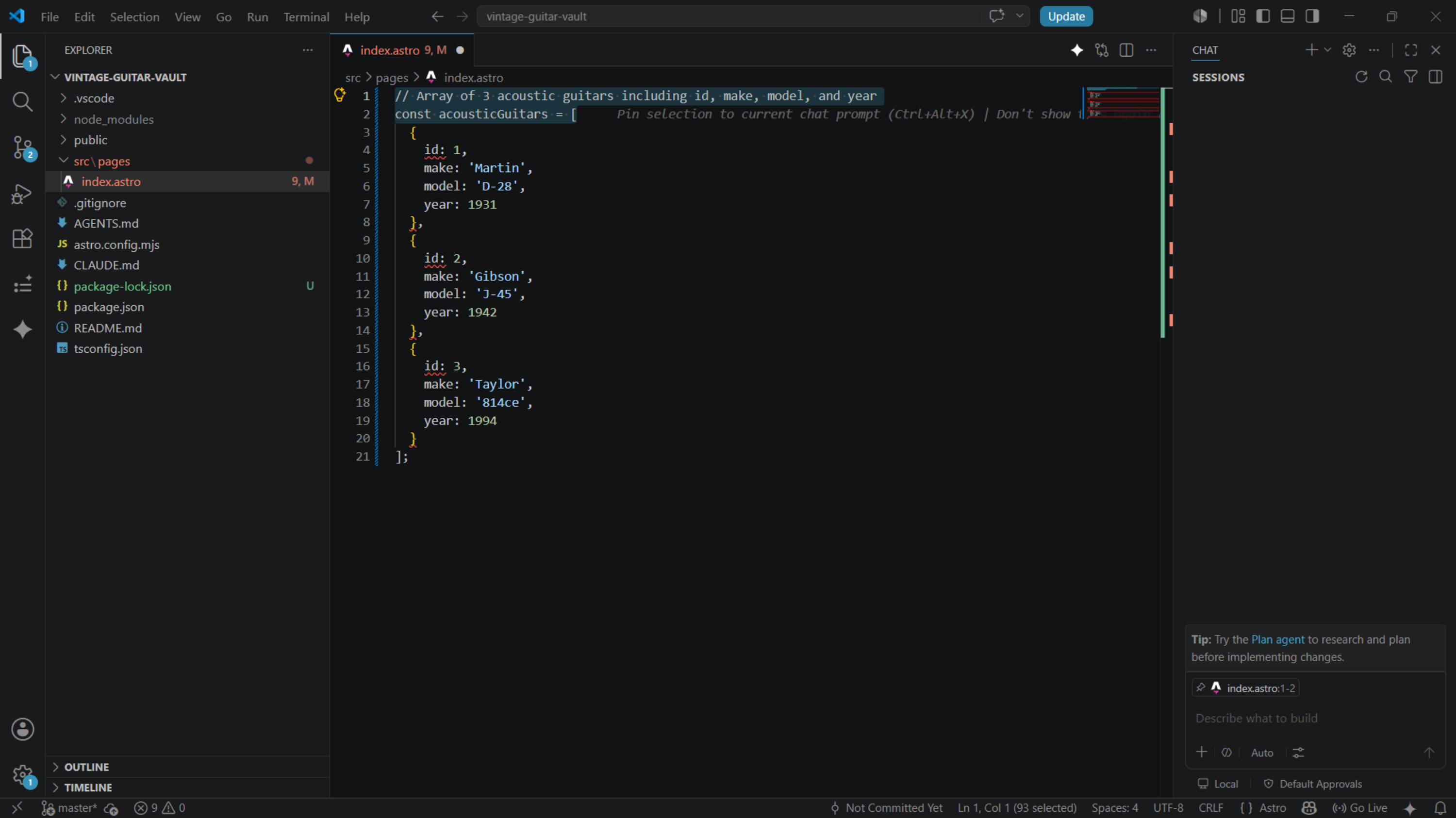
To elicit a more specific data set from the AI autocomplete, we applied a natural language comment constraint:
// Array of 3 acoustic guitars including id, make, model, and year
const acousticGuitars = [
The inline engine successfully synthesized a clean, logically sound mock dataset matching our requested schema.
Phase 2: Wiring the UI with Inline AI
Next, we rendered the structured data onto the page using native Astro mapping syntax alongside a simple interactive button:
<ul>
  acousticGuitars.map((guitar) => (
    <li>
      guitar.year guitar.make guitar.model
      <button>View Setup History</button>
    </li>
  ))
</ul>
<div id="maintenance-log"></div>
Running npm run dev produced a functional static list at http://localhost:4321/. However, clicking "View Setup History" did nothing. Rather than manually researching HTMX attributes or writing boilerplate fetch logic, we highlighted the <button> element, triggered the inline command bar (Cmd/Ctrl + I), and issued a prompt:
"Add an HTMX get request to fetch this guitar’s maintenance log from
/api/maintenance/$guitar.idand swap the response into the#maintenance-logdiv."
The inline AI correctly generated the HTMX markup attributes (hx-get, hx-target). However, because the HTMX library script had not yet been loaded, the interpolation syntax required adjustment, and no backend data store existed, the button remained non-functional. This represents the classic inflection point where syntactic AI assistance runs headfirst into architectural reality.
Phase 3: Engaging the Agent Manager
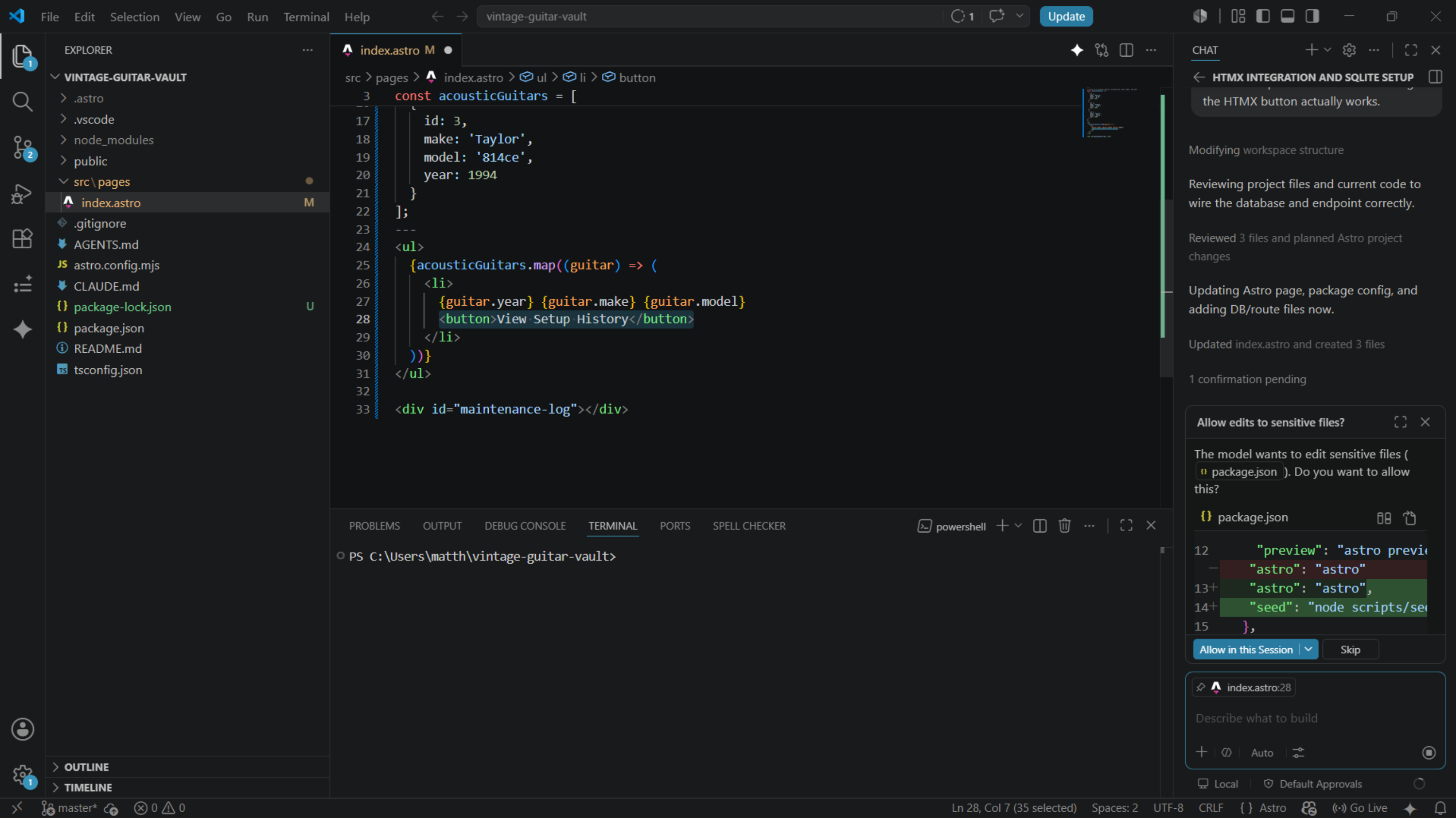
To resolve cross-file dependencies and build out a robust backend, we stepped up from inline editing to Antigravity’s high-level Agent Manager in the lower-right chat pane. We handed the multi-agent system a comprehensive prompt:
"Add the HTMX script tag to the page and fix the Astro syntax on my button so the
guitar.idevaluates correctly. Next, set up a local SQLite database usingbetter-sqlite3, create a seed script for the acoustic guitars, and updateindex.astroto fetch from the database. Finally, build the/api/maintenance/[id]endpoint to return a simple HTML maintenance log so the HTMX button actually works."
Upon submission, the agentic engine paused to formulate an architectural execution plan—listing every file it intended to alter, create, or delete, alongside necessary terminal commands.
Once approved, the agent systematically modified package.json, installed dependencies via npm install, seeded the SQLite database, generated API server endpoints, and corrected a Windows-specific node-gyp build error autonomously.
Phase 4: Autonomous Testing and Debugging
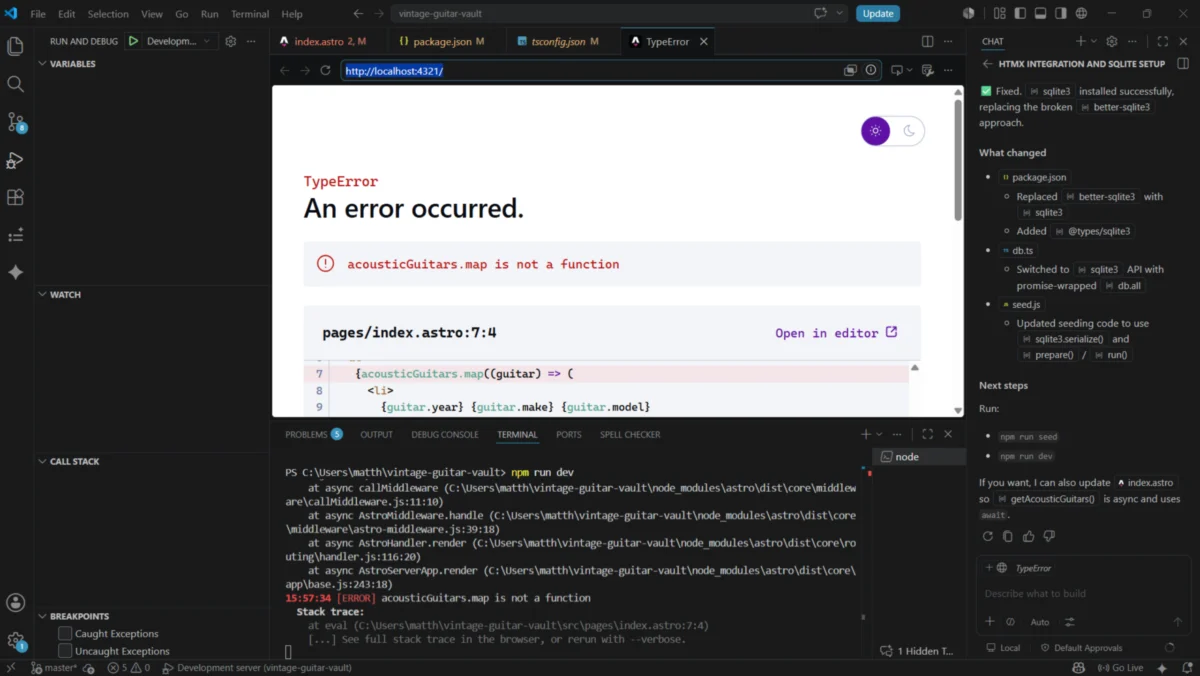
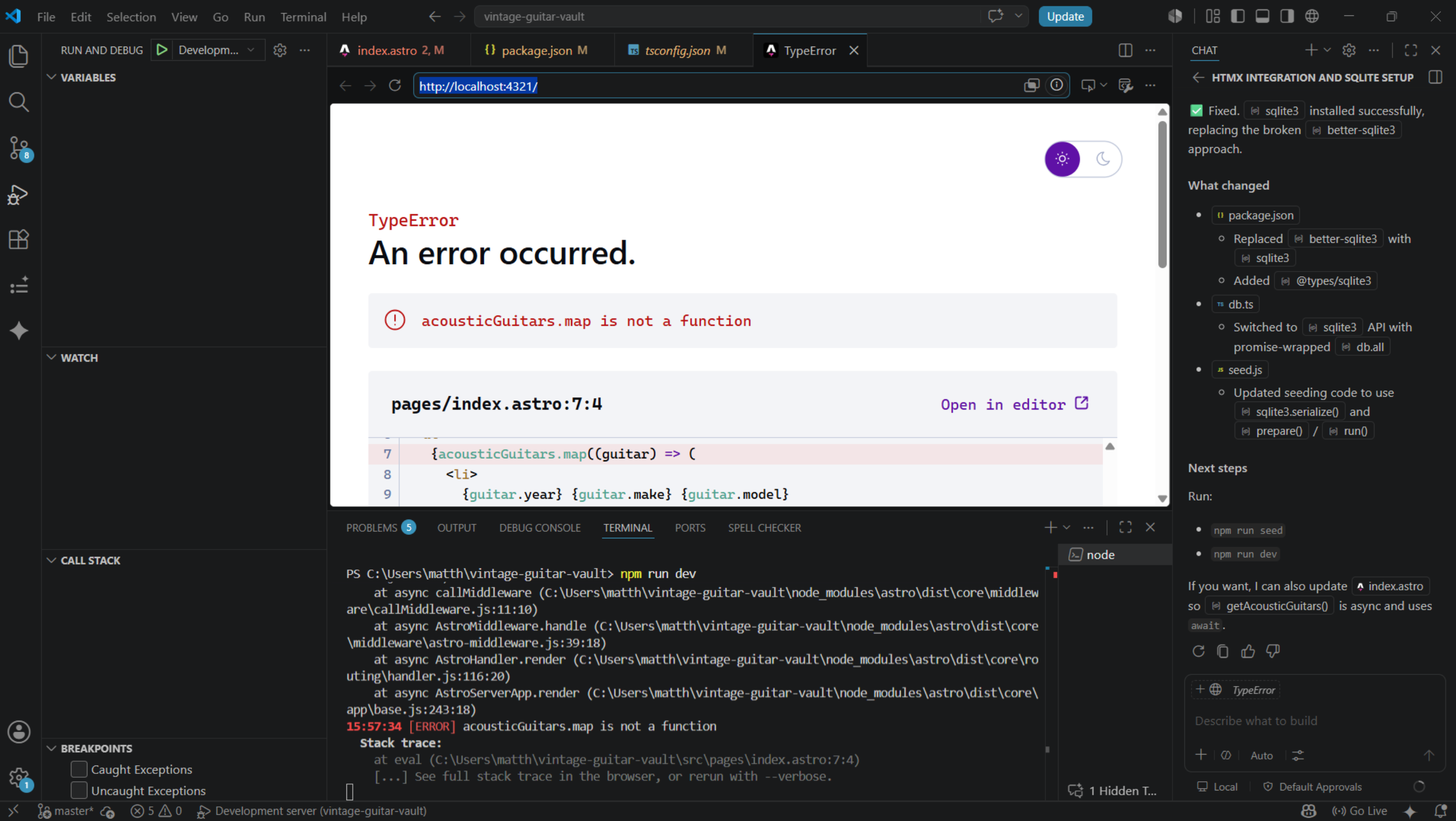
After the agent completed its routine, we re-launched the development server. Clicking the setup history button initially threw a runtime TypeError.
Instead of manually debugging the stack trace, we directed the agent to test its own work:
"Launch the built-in browser, navigate to localhost:4321, and test the HTMX search and button functionality. Find out why clicking ‘View Setup History’ is throwing a TypeError, and fix the back end."
Granting temporary browser-automation permissions, the AI watched the application render, identified the payload mismatch, updated the endpoint response handling, and successfully restored full interactivity. The application was fully operational within minutes.
Supporting Data: The Developer Divide
While tools like Antigravity IDE compress the timeline from concept to deployment from days to minutes, empirical industry data surrounding AI-assisted workflows highlights a growing tension between velocity and comprehension.
- 10x Prototyping Velocity: Surveys tracking agentic IDE adoption show that developers can scaffold complex multi-tier applications up to 80% faster than traditional manual coding methods.
- The Comprehension Bottleneck: According to recent developer experience studies on complex codebases, over 65% of engineers report spending more time auditing, reviewing, and refactoring AI-generated code than they would have spent writing foundational segments manually if they deeply understood the target stack.
- The "Citizen Developer" Myth: While natural language interfaces lower the initial barrier to entry, non-technical users ("citizen developers") routinely hit a hard architectural wall. Concepts like server routes, foreign-key relationships, asynchronous state management, and dependency trees quickly transform into impenetrable roadblocks when stochastic AI models drift from optimal design patterns.
Official Responses and Industry Perspective
Software architects and tool vendors have expressed cautious optimism regarding multi-agent IDEs, emphasizing that the bottleneck in modern software engineering has shifted permanently from writing code to comprehending systems.
"Platforms like Google’s Antigravity IDE have fundamentally eliminated the friction between conceptual intent and raw syntax," notes enterprise architecture analyst Marcus Vance. "However, they do not eliminate the need for engineering discipline. If a human operator cannot structurally evaluate what the AI agent is constructing under the hood, they are simply piloting a black box toward inevitable technical debt."
Industry leaders point out that while AI agents excel at greenfield scaffolding and localized bug fixing, long-term codebase maintenance requires rigorous human oversight. The ability to audit an agent’s diff files, understand dependency trees, and intercept systemic architectural drift remains an irreplaceable human skill.
Implications: The Future of Software Engineering
The rise of Google Antigravity IDE and its agentic peers signals a permanent paradigm shift in how digital products are built.
- The Death of Boilerplate: Repetitive setup tasks—such as configuring database schemas, initializing build pipelines, and writing repetitive API routing wrappers—are effectively automated away.
- Education as a Prerequisite: Rather than replacing the need to learn how software works, agentic IDEs make technical literacy more important. Because the AI relies on human guidance to remain aligned with intended outcomes, developers must possess higher-level systems-thinking skills to successfully manage fleets of autonomous agents.
- The Rise of "Manager Mode" Engineering: Developers are increasingly transitioning from individual contributors to architectural reviewers, spending their hours approving diffs, reviewing security implications, and steering multi-agent workflows.
Conclusion
Google Antigravity IDE is a testament to how far AI-assisted software development has evolved. It successfully bridges the gap between text prompts and running infrastructure, allowing engineers to spin up modern web stacks with Astro, HTMX, and SQLite at unprecedented speeds. Yet, it serves as a powerful reminder: while AI can write the code, human expertise remains the ultimate safety net ensuring the software actually stands the test of time.



