










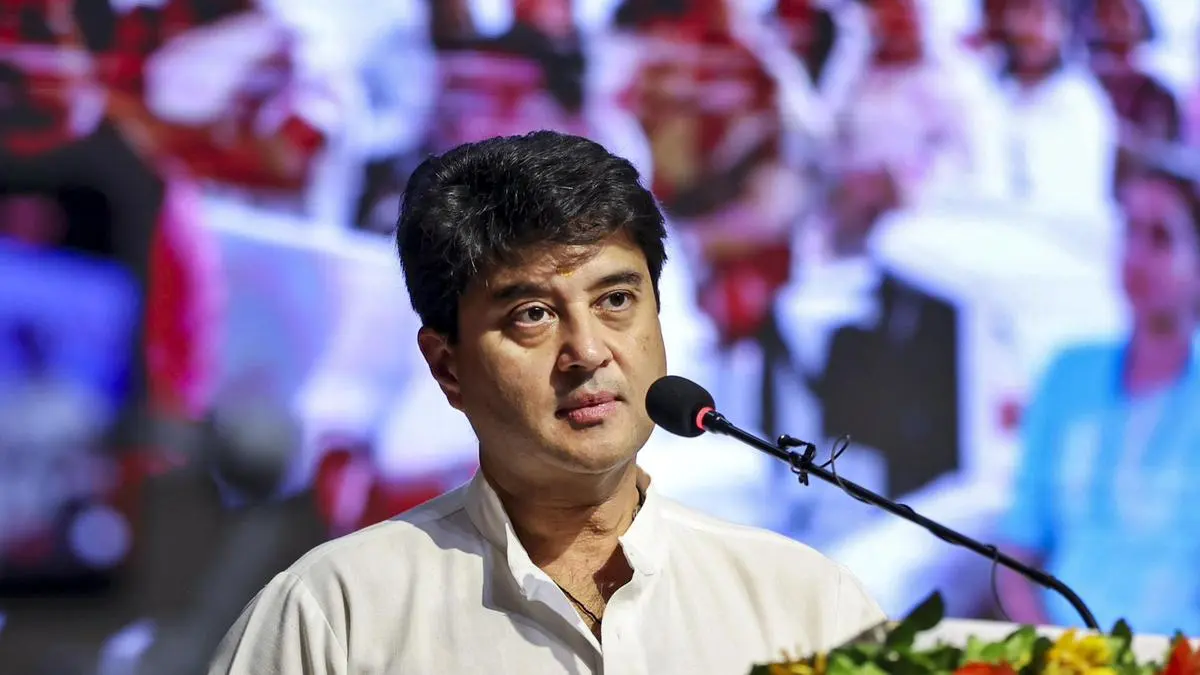
NEW DELHI: In an ambitious blueprint for the nation’s digital future, Union Communications Minister Jyotiraditya Scindia announced on Thursday that India aims to nearly double its 5G subscriber base from the current 550 million to one billion users by the year 2030. Speaking at the grand inauguration of the 10th edition of the India Mobile Congress (IMC) 2026, the Minister reflected on India’s remarkable telecommunications turnaround—transitioning from a late adopter in the 4G era to a record-setting frontrunner in 5G, with a resolute vision to command the upcoming global 6G landscape.
The landmark announcement underscores the exponential growth of India’s digital infrastructure, fueled by aggressive nationwide rollouts by telecom operators, plummeting data costs, and a rapidly expanding smartphone-literate population. As policymakers and global tech giants converge at IMC 2026, India’s telecommunications sector stands as a testament to indigenous innovation, robust public-private partnerships, and strategic policy interventions designed to bridge the digital divide and power a multi-trillion-dollar digital economy.
Main Facts
- Ambitious 2030 Target: India has officially set a target to scale its 5G subscriber base from the current 550 million to 1 billion users by 2030.
- Fastest 5G Adoption Globally: According to the Ministry of Communications, India’s 5G rollout has been recognized as the fastest-adopted 5G technology deployment anywhere in the world.
- The 6G Paradigm Shift: Acknowledging historical lags during the 4G era, the government has asserted its ambition to lead the global rollout and standardization of 6G technology.
- Bharat 6G Alliance Milestones: The collaborative alliance driving India’s 6G mission currently encompasses 90 institutions and has successfully generated 7,700 patents, out of which 4,400 hold international standing.
- Platform and Venue: The announcements were made during the high-profile inauguration of the 10th edition of the India Mobile Congress (IMC) 2026, India’s premier technology and telecommunications forum.
Chronology: From 4G Laggard to 5G Leader and 6G Pioneer
To fully comprehend the significance of Minister Scindia’s declarations at IMC 2026, it is essential to trace the evolutionary timeline of India’s telecommunications sector over the past decade.
The 4G Catch-Up Phase (2014–2018)
During the 4G era, India found itself trailing behind advanced economies and several Asian neighbors. While Western nations and parts of East Asia had already established robust LTE networks by the early part of the 2010s, India’s 4G ecosystem experienced delays due to complex spectrum auctions, financial distress within legacy telecom operators, and infrastructural bottlenecks. However, the launch of disruptive private-sector operations in 2016 served as a catalyst, sparking a data revolution that rapidly expanded 4G coverage to semi-urban and rural hinterlands, setting the stage for subsequent technological leaps.
The Historic 5G Leap (2022–2025)
Recognizing the economic imperative of next-generation connectivity, the Indian government streamlined spectrum allocation processes and fostered an enabling environment for telecom service providers. The official commercial launch of 5G in late 2022 triggered the fastest technological migration in global telecom history. Within a span of less than four years, telecom operators deployed hundreds of thousands of base stations, blanketing metropolitan areas, tier-2, and tier-3 cities. By mid-2026, the nation’s 5G user base crossed the milestone of 550 million subscribers, eclipsing adoption rates recorded in other major global markets like the United States, China, and South Korea during equivalent phases of deployment.
The 6G Vision and IMC 2026 (2023–Present)
Concurrently, anticipating the obsolescence of current technologies by the end of the decade, India initiated proactive research and development frameworks. The establishment of the Bharat 6G Alliance brought together academia, research laboratories, and industry heavyweights. Today, as India celebrates the milestone 10th edition of the India Mobile Congress in 2026, the focus has firmly shifted from catching up with global standards to authoring them, cementing the nation’s credibility as a technology exporter rather than a mere consumer.
Supporting Data and Metrics
The quantitative indicators presented by the Ministry of Communications highlight the profound scale of India’s telecommunications metamorphosis:
- 5G Penetration Growth: Starting from virtually zero in late 2022, India’s 5G subscriber count surged to 550 million by October 2026. The projected target of 1 billion users by 2030 implies an additional addition of 450 million users over the next four years, supported by falling handset prices and deeper rural fiber-optic integration.
- Intellectual Property in 6G: The Bharat 6G Alliance has anchored India’s technical sovereignty through intellectual property creation. Out of the 7,700 patents filed and established through affiliated institutions, 4,400 are international patents. This metric illustrates that India is not only designing technologies for domestic consumption but is actively contributing foundational intellectual property to global 3GPP and ITU standardization bodies.
- Collaborative Ecosystem: The 6G framework relies on a unified collaborative model involving 90 premier technological institutions, bridging the gap between theoretical academic research and commercial telecommunications manufacturing.
Official Responses and Stakeholder Perspectives
The declarations made by Communications Minister Jyotiraditya Scindia at IMC 2026 drew widespread appreciation from industry captains, policymakers, and international delegates attending the summit.

Industry leaders attending the conference echoed the Minister’s sentiment, emphasizing that the aggressive push toward 1 billion 5G users will unlock massive economic value across sectors such as smart manufacturing, automated logistics, precision agriculture, and telemedicine. Representatives from major telecom operators noted that while network densification requires continuous capital expenditure, consumer appetite for high-bandwidth applications—such as cloud gaming, immersive AR/VR, and high-definition video streaming—remains robust and unabated.
Academic partners within the Bharat 6G Alliance pointed out that international patent generation is a critical victory for the country. By securing thousands of global patents ahead of the 6G commercialization window, Indian researchers ensure that domestic enterprises will hold significant bargaining power and licensing leverage when global standards are finalized later this decade.
Implications for the Economy and Society
The dual objectives of scaling 5G to one billion users and establishing global leadership in 6G carry profound structural implications for India’s socio-economic landscape:
1. Bridging the Digital Divide
Expanding high-speed connectivity to one billion users means that nearly every digitally active citizen in India will have access to low-latency, high-capacity broadband. This ubiquity is vital for democratizing access to online education, digital governance, financial inclusion services (Fintech), and remote healthcare delivery, ensuring that rural and semi-urban populations participate equally in the digital economy.
2. Boosting Manufacturing and "Make in India"
The transition toward indigenous 6G technologies dovetails with the government’s Production-Linked Incentive (PLI) schemes for telecom and networking products. By owning intellectual property rights (IPR) and developing domestic manufacturing capabilities for radio access networks (RAN) and core infrastructure, India reduces its strategic vulnerability to external supply chain disruptions and positions itself as a trusted global hardware and software exporter.
3. Catalyzing Industrial Transformation (Industry 4.0)
The high reliability and massive machine-type communications enabled by advanced 5G networks—and eventually ultra-low latency 6G frameworks—will serve as the backbone for India’s industrial modernization. Smart factories, autonomous transport systems, intelligent power grids, and smart city infrastructure will rely heavily on the dense networks currently being engineered across the country.
4. Geopolitical and Strategic Positioning
For decades, telecommunications standards were dictated almost exclusively by Western and East Asian conglomerates. By aiming to lead the world in 6G, India is asserting strategic autonomy in critical technology domains. Active participation and leadership in international standard-setting bodies ensure that India’s security, privacy, and economic interests are embedded into the foundational architecture of next-generation global networks.
As the India Mobile Congress 2026 proceeds through its technical sessions and exhibitions, the roadmap outlined by Minister Scindia signals that India’s digital story has entered a mature, confident phase—one where the nation looks beyond domestic milestones to shape the very future of global connectivity.



