










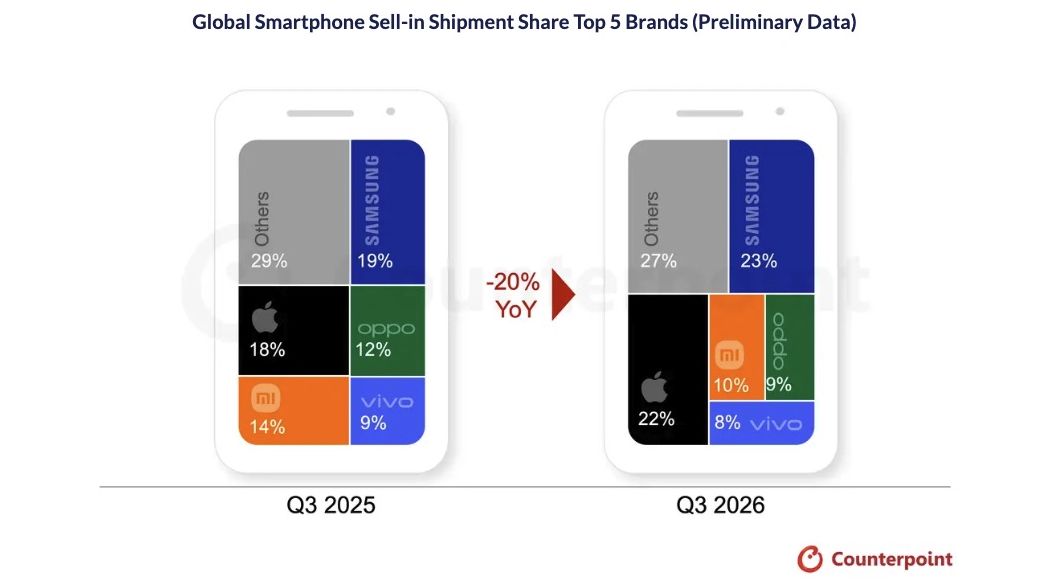
The global smartphone market, once the engine of the consumer electronics industry, is currently navigating its most turbulent period in over a decade. According to the latest data from Counterpoint Research, global smartphone shipments have plummeted by 20% compared to the third quarter (Q3) of 2025. This staggering decline marks the lowest volume of shipments in 14 years, signaling a profound shift in how the world buys—and keeps—its mobile technology.
As manufacturers scramble to stabilize their supply chains and entice a hesitant public, the industry finds itself at a crossroads. The convergence of economic headwinds, technological saturation, and changing consumer habits suggests that the "annual upgrade" culture may finally be a thing of the past.
The Anatomy of the Decline: A Multi-Faceted Crisis
The primary catalyst for this historic downturn is a persistent and worsening global RAM crisis. This semiconductor bottleneck has created a ripple effect throughout the entire mobile ecosystem. For manufacturers, the scarcity of critical memory components has led to severe production disruptions, forcing many to throttle output or delay the launch of highly anticipated models.
However, supply chain woes are only half of the story. The resulting component shortages have inevitably driven up manufacturing costs, which are being passed directly to the consumer. In an era of global economic uncertainty, the premium pricing of flagship devices—often crossing the $1,200 threshold—has made the prospect of a new phone feel more like a luxury burden than a necessity.
The "Holding On" Phenomenon
Beyond the balance sheet, there is a behavioral shift occurring among consumers. Counterpoint Research highlights a critical trend: users are holding onto their devices for significantly longer periods than in previous years. While high prices certainly contribute to this, experts suggest that price is no longer the sole deterrent.
We have entered an era of "diminishing returns" in smartphone innovation. In years past, the jump from one generation to the next brought transformative features: better displays, vastly improved cameras, and leaps in processing speed. Today, even entry-level and mid-range devices are exceptionally capable. A phone purchased three or four years ago remains perfectly adequate for social media, high-definition streaming, and even mobile gaming. This durability, combined with the lack of "must-have" hardware breakthroughs, has effectively extended the average lifecycle of a modern smartphone.
A Chronology of the Smartphone Saturation
To understand how we arrived at this 14-year low, it is necessary to look at the timeline of the industry’s evolution over the last decade.
- 2015–2018: The Peak of Innovation. This period was characterized by rapid advancements in camera technology, the transition to near-bezel-less displays, and the rise of the "pro" tier of devices. Growth was consistent as consumers rushed to upgrade to capture the benefits of these new features.
- 2019–2022: The Pandemic Disruption and 5G Transition. The global pandemic initially stalled the market, but it was followed by a brief spike in demand as people required better tech for remote work and digital communication. The rollout of 5G provided a temporary, albeit short-lived, incentive for mass upgrades.
- 2023–2024: The Stagnation Period. Market growth began to flatline. Manufacturers struggled to differentiate their offerings, and the "refresh cycle" for the average user stretched from 24 months to 36 or even 48 months.
- 2025–Present: The Perfect Storm. The combination of post-pandemic inflation, the current RAM supply crisis, and a lack of revolutionary new form factors or features has culminated in the current 20% year-over-year shipment decline.
Market Resilience: The "Big Two" Navigate the Storm
Despite the industry-wide downturn, not all players are suffering equally. The landscape has become increasingly bifurcated, with premium brands maintaining their grip while mid-tier manufacturers bear the brunt of the market contraction.
Samsung’s Strategic Pivot
Samsung has demonstrated remarkable resilience, managing to increase its market share to 23%, even as its overall shipments dipped by 3% compared to last year. A major driver of this success has been the company’s heavy investment in the foldable segment, particularly the Samsung Galaxy Z Fold 8. By offering a distinct form factor that differentiates itself from the traditional "glass sandwich" slab, Samsung has successfully appealed to high-end users who are still willing to spend for a truly unique experience.
Apple’s Steady Hand
Apple similarly expanded its market share to 22%, despite a decline in total units sold. Analysts suggest that Apple’s ecosystem lock-in and strong brand loyalty provide a buffer that most Android manufacturers lack. However, the report notes that Apple’s numbers might have been even more impressive had the company opted to launch a base iPhone 18 alongside its Pro models. By staggering its release schedule, Apple has effectively conceded a portion of the market to those waiting for a more affordable, non-Pro entry point.
Conversely, brands like Xiaomi, Oppo, and Vivo have seen sharp declines. These manufacturers, which rely heavily on volume and thin margins to sustain growth, have been hit hardest by the drop in consumer demand and the rising costs of raw components.
Implications for the Future of Tech
What does this mean for the future of the smartphone industry? If the current trends continue, we are likely to see a permanent shift in business models.
The End of the Annual Upgrade
The "annual upgrade" model is becoming increasingly obsolete. We are moving toward a cycle more akin to the PC market, where hardware is purchased with the expectation of a five-to-six-year lifespan. This shift will force manufacturers to pivot their revenue streams. We may see a greater focus on software services, cloud integration, and subscription-based features to make up for the lower volume of hardware sales.
The Rise of Sustainability and Repairability
As users hold onto their devices longer, the demand for repairability will grow. Legislation regarding the "Right to Repair" is gaining momentum globally, and manufacturers are beginning to design phones that are easier to service. A phone that is easy to fix is more likely to be kept for five years than one that must be replaced due to a dead battery or a cracked screen.
The Innovation Gap
Finally, the industry faces an "innovation gap." Manufacturers must decide whether to continue iterating on existing designs or to invest heavily in the next frontier—whether that be foldable tech, augmented reality (AR) integration, or AI-native hardware. Without a compelling reason to upgrade, the market will remain in a defensive posture, focused on protecting margins rather than capturing new growth.
Conclusion: A New Normal?
The 14-year low in smartphone shipments is more than just a statistical anomaly; it is a reflection of a maturing industry. The "gold rush" era of rapid, consistent growth is likely behind us. The RAM crisis and economic factors are certainly exacerbating the issue, but they are not the sole architects of this decline.
For the consumer, this represents a welcome period of stability—devices are lasting longer, performing better, and retaining their value. For the manufacturers, however, the challenge is clear: in a world where everyone already has a "good enough" phone, the only way to win is to provide an experience that is not just slightly better, but fundamentally different. Whether the industry can innovate its way out of this slump remains the central question for the coming year. As we look ahead, the winners will not be those who ship the most units, but those who can successfully transition from being hardware vendors to being essential service providers in the lives of their users.



