







In an era where remote and hybrid work environments have become the standard for global enterprise, Microsoft Teams has cemented its position as a central nervous system for corporate communication. However, this ubiquity has also transformed the platform into a high-value target for sophisticated threat actors. Addressing these evolving vulnerabilities, Microsoft has announced a significant upgrade to its security architecture: an AI-powered, context-aware phishing detection tool designed to identify malicious intent within user conversations rather than relying solely on traditional link and file scanning.
The feature, which is scheduled to begin its phased rollout in early November 2026, represents a paradigm shift in how Microsoft approaches communication security. By moving beyond static signature-based detection to behavioral analysis, the company aims to curb the rising tide of social engineering attacks that have plagued enterprise environments over the past several years.
Main Facts: A Behavioral Approach to Security
The core innovation of this new tool lies in its ability to analyze the content and context of a conversation. Historically, security software in collaboration platforms has focused on blacklisting known malicious URLs or scanning file attachments for malware signatures. While effective against automated attacks, these methods often fail to detect sophisticated "human-in-the-loop" social engineering.
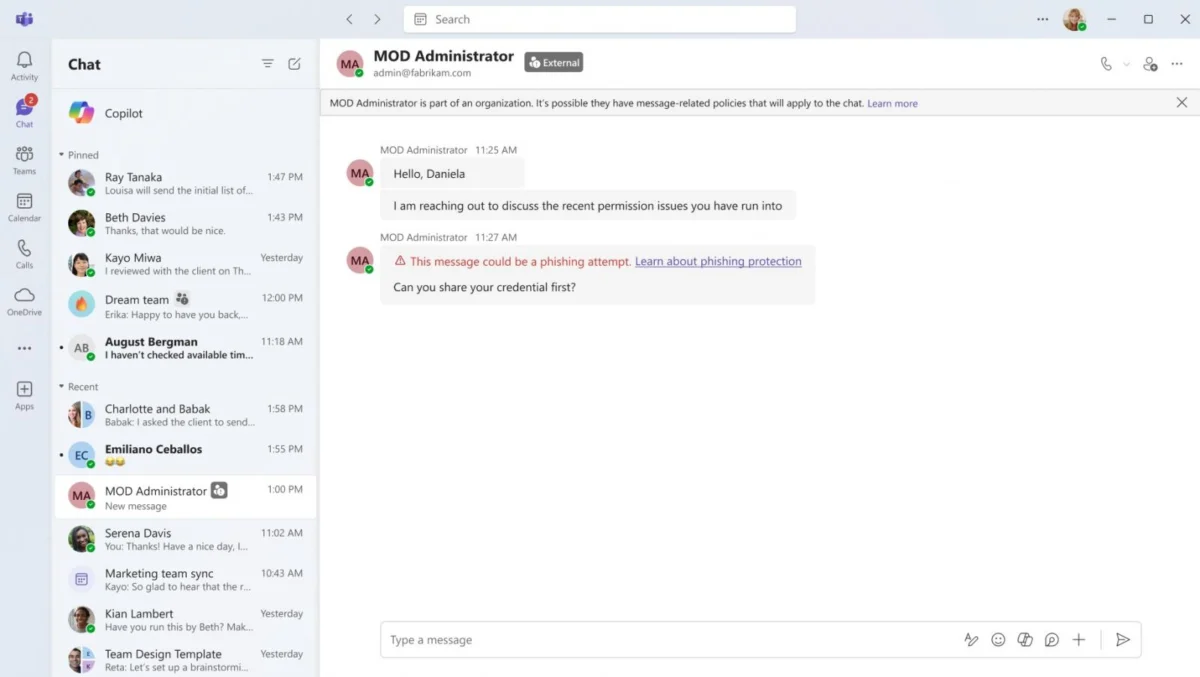
The new AI engine, which will be integrated natively into the Teams backend, scans incoming messages for behavioral markers indicative of phishing or identity theft. Microsoft has emphasized that the tool is specifically tuned to monitor conversations with external or new contacts—individuals outside of a user’s immediate organization who pose the highest risk of impersonation.
The system is designed to operate with a high degree of nuance. Instead of flagging a message simply because it contains a link, the AI will evaluate the linguistic patterns, urgency, and request types commonly associated with credential harvesting. For instance, if an external account posing as an IT administrator requests sensitive information or unauthorized remote access, the system will trigger a security warning, effectively acting as a digital gatekeeper for the user.
Chronology: From Impersonation Tactics to AI Defense
The impetus for this development can be traced back to a series of high-profile security incidents that have targeted Microsoft Teams users. Over the past 24 months, cybersecurity researchers and Microsoft’s own Threat Intelligence team have documented an uptick in "help desk impersonation" attacks.
The Rise of the Help Desk Impersonator
In these scenarios, threat actors create accounts that mimic internal IT support services. By sending messages to employees claiming to be from the company’s technical support department, attackers successfully manipulate staff into granting remote access to their workstations. Once inside, these attackers can deploy ransomware, exfiltrate sensitive data, or establish persistent backdoors into the corporate network.
The Security Roadmap
- Early 2025: Microsoft begins identifying increased frequency in Teams-based social engineering, specifically targeting administrative credentials.
- Mid-2026: Internal testing of the context-aware detection engine commences, focusing on reducing false positives while maintaining high detection rates.
- November 2026: The phased rollout begins. During this period, the system will run in "silent mode" to validate detection quality against real-world traffic.
- December 2026: Expected general availability. By the first half of the month, the system will move from passive validation to active user warnings.
Supporting Data and Technical Implementation
Microsoft has been clear about the technical parameters of this rollout to assuage concerns regarding privacy and performance. The deployment is designed to be seamless for IT departments; it will be enabled automatically across all enterprise tenants, requiring no manual configuration or policy changes.
Privacy and Data Integrity
Perhaps the most significant concern regarding AI-driven surveillance tools is the potential for data misuse. Addressing this, Microsoft has explicitly stated that the messages analyzed by the tool will not be saved for long-term storage, nor will they be used to train future iterations of the company’s Large Language Models (LLMs). This firewall between security analysis and product training is intended to maintain user trust and ensure compliance with strict global data privacy regulations, such as GDPR and CCPA.
The Validation Phase
According to documentation provided in the Microsoft 365 Message Center, the initial deployment will follow a "detection-only" pattern. During the first few weeks, the AI will perform its analysis in the background. This period serves as a vital calibration stage, allowing the algorithm to learn the specific communication norms of different organizations without interrupting workflow. Once the detection engine reaches a predefined confidence threshold, the system will transition to providing visual warnings to users, clearly marking suspicious messages with banners or alerts.
Official Responses and Strategic Vision
Microsoft’s strategic shift reflects a broader industry trend where communication platforms are increasingly being forced to act as security platforms. In a statement regarding the update, Microsoft emphasized that the goal is to provide "frictionless security."
"We are moving toward a model where the platform understands the intent of the user," noted a representative from the Microsoft 365 security team. "By identifying the hallmarks of impersonation in real-time, we provide users with the context they need to make safe decisions, rather than relying on them to be experts in cybersecurity."
The decision to enable the feature by default is a testament to the company’s recognition that IT teams are currently overwhelmed. With the sheer volume of alerts generated by traditional security information and event management (SIEM) systems, manual configuration for every new feature is often a point of failure. By automating this defense, Microsoft is effectively raising the baseline security posture for millions of organizations simultaneously.
Implications for the Enterprise
The introduction of this tool has far-reaching implications for both IT management and the end-user experience.
Reducing the Burden on IT and SecOps
For IT departments, this update is a significant boon. The primary challenge in defending against social engineering is the "human element." Employees are often the weakest link in a company’s security chain. By automating the identification of phishing attempts, Microsoft is effectively reducing the workload on security operations centers (SOCs) that would otherwise spend hours investigating reports of suspicious Teams messages.
The End of the "Wild West" of Collaboration
For years, the collaborative nature of platforms like Teams, Slack, and Zoom has been a double-edged sword. While open communication facilitates productivity, it has also allowed attackers to hide in plain sight. This new feature signifies the end of the "wild west" era of Teams communication. As the AI begins to police the boundaries of external interactions, users will have to become accustomed to a more "guarded" environment where unexpected messages from new contacts are automatically scrutinized.
Future Challenges
Despite the benefits, challenges remain. Sophisticated attackers are likely to evolve their tactics to bypass behavioral analysis. If the AI looks for "urgency" or "IT-related terminology," attackers may shift to more casual, long-form social engineering—the "long con"—where they establish trust over several weeks before launching an attack.
Furthermore, there is the risk of "warning fatigue." If the AI is too aggressive, legitimate business communications from vendors, contractors, or new hires may be flagged, causing unnecessary delays and frustration. The success of this feature will ultimately depend on the accuracy of the detection engine during its validation phase.
Conclusion: A Proactive Defense
The move to integrate AI-powered phishing detection into Microsoft Teams is a necessary evolution in the face of increasingly sophisticated cyber threats. As attackers continue to refine their ability to impersonate trusted internal staff, the defensive side must leverage the same speed and analytical power of artificial intelligence to counter these efforts.
By prioritizing context-aware analysis over simple link-scanning, Microsoft is acknowledging the reality of the modern threat landscape. While no single security measure is a silver bullet, the addition of this tool serves as a vital layer of defense in an increasingly dangerous digital workspace. As the rollout begins this November, organizations would do well to prepare their employees for these changes, ensuring that the transition to a more secure Teams environment is met with awareness rather than confusion.
As we look toward 2027 and beyond, it is clear that the collaboration tools of the future will not just be channels for communication, but active participants in the security of the enterprise. Microsoft’s latest update is a significant step in that direction, setting a new standard for how we trust the messages that arrive in our digital inboxes.