







In the rapidly evolving landscape of Large Language Models (LLMs), the transition from a prototype to a production-grade application is often blocked by a single, critical hurdle: Evaluation. While public benchmarks like MMLU (Massive Multitask Language Understanding) or GSM8K provide a high-level overview of a model’s general intelligence, they are notoriously poor at predicting how a model will perform within the narrow, high-stakes context of a specific enterprise domain.
Whether your LLM is serving as a customer support agent, a legal document analyst, or a code-generation assistant, public metrics won’t tell you if your model adheres to your specific refusal policies or if your RAG (Retrieval-Augmented Generation) pipeline is consistently retrieving relevant context. To bridge this gap, engineers are increasingly turning to custom evaluation harnesses.
This guide provides a comprehensive framework for building a bespoke, modular, and highly extensible evaluation harness using Python. By decoupling your inference, scoring, and logging, you can move away from "vibes-based" development toward a data-driven engineering workflow.
Main Facts: The Anatomy of a Custom Harness
A test harness, in traditional software engineering, is the scaffolding that feeds controlled inputs to a system, captures the resulting outputs, and compares them against a known baseline. When applied to LLMs, this architecture serves as a repeatable pipeline that measures performance, quality, and reliability across a suite of prompts.
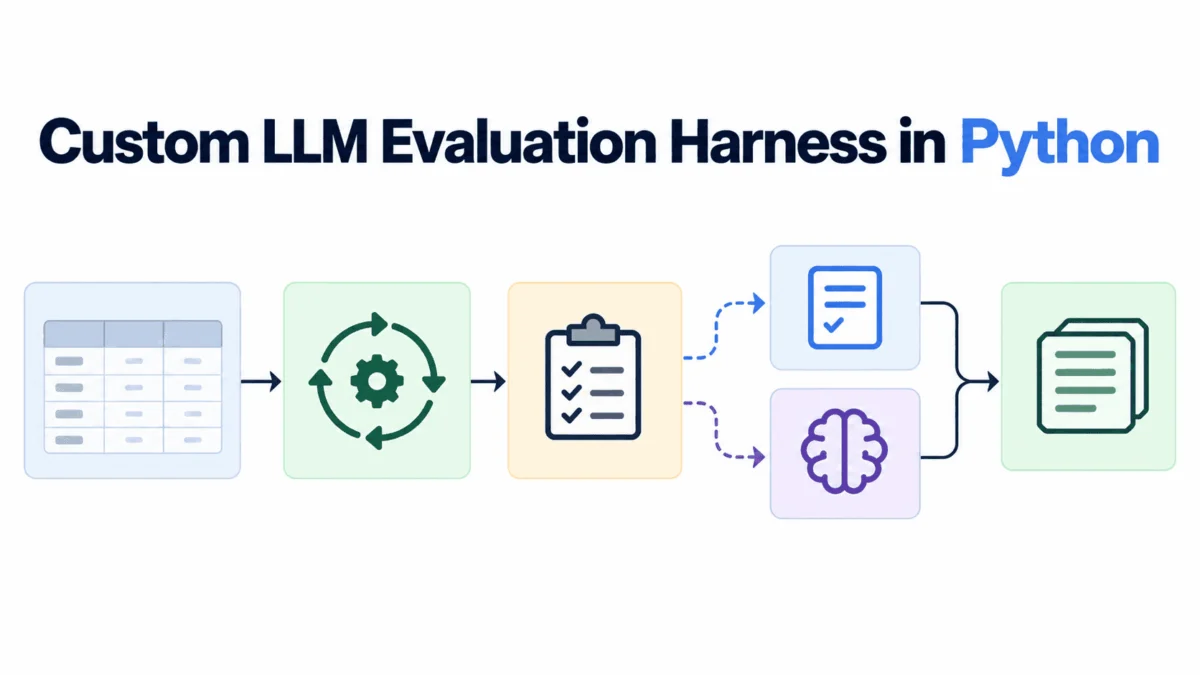
A robust evaluation harness relies on four modular components:
- The Golden Dataset: A curated collection of ground-truth inputs and expected outcomes.
- The Inference Runner: An asynchronous engine that dispatches prompts to various models.
- The Judge Layer: A decision-making mechanism that scores the output as pass/fail or against a rubric.
- The Logger: A persistent storage layer that records raw outputs, metadata, and final scores for longitudinal analysis.
By keeping these components minimal, you avoid the trap of "black-box" frameworks that limit your ability to iterate. Instead, you gain full control over how your models are tested and scored.
Chronology: The Development Workflow
Building your harness requires a systematic approach, ensuring that each layer of the pipeline is built upon the success of the last.
Step 1: The Foundation (Prerequisites)
To begin, you need Python 3.10 or later, which provides native asyncio support—a non-negotiable feature for running concurrent evaluations. For dependencies, we keep the stack light:
- LiteLLM: A unified interface for calling OpenAI, Anthropic, Google, and local models. It allows you to swap backends without refactoring your codebase.
- Pydantic: Used to enforce structured output from your judge, ensuring that scores are always returned in a predictable, typed format.
Step 2: Constructing the Golden Dataset
Your evaluation is only as good as your data. A "Golden Dataset" should contain 20 to 50 representative cases—not synthetic, polished examples, but messy, real-world inputs pulled from user logs or historical failure reports. Each case should include a unique id, the input prompt, and an expected_concept that serves as the ground truth.
Step 3: Implementing the Inference Runner
The runner acts as the bridge between your test cases and the LLM. By utilizing asyncio.gather, you can fire multiple test cases in parallel, drastically reducing the time required for a full regression run. Crucially, the runner should only return raw data, leaving the interpretation of that data to the judge.
Step 4: The Judge Layer
The judge is the "brain" of the operation. You can employ:
- Deterministic Judges: Perfect for regex-based checks or exact string matching (e.g., "Did the model mention our refund policy?").
- LLM-as-a-Judge: Using a stronger model (like GPT-4o) to evaluate the output of a smaller, faster model (like Llama 3 or Haiku) based on semantic criteria.
Supporting Data: Why Decoupling Matters
The architectural decision to separate the inference runner from the judge is the most important design choice in this pipeline.
Consider the "re-scoring" use case. If you have run 500 evaluations against a paid API, you have incurred both latency and cost. By logging the raw_output to a .jsonl file, you can modify your grading rubric or upgrade your judge model to be more nuanced, then re-score the existing raw outputs without ever making another API call to the target model. This allows for rapid iteration on your evaluation methodology without the associated financial overhead.
Efficiency Metrics
| Component | Function | Benefit |
|---|---|---|
| Asyncio | Concurrency | Reduces wait times for large batches. |
| Pydantic | Validation | Prevents runtime errors from malformed JSON. |
| JSONL Logging | Persistence | Crash-safe logging; enables re-scoring later. |
| LiteLLM | Abstraction | Portability across model providers. |
Official Perspectives: The Role of LLM-as-a-Judge
Industry experts increasingly advocate for the "LLM-as-a-Judge" pattern, but with a critical caveat: calibration. Relying on an LLM to judge itself or another model introduces a "subjectivity bias." To mitigate this, developers are advised to:
- Define clear rubrics: Do not ask the judge to "rate the answer." Ask it to "verify if the response contains X, Y, and Z, and return a boolean."
- Use Pydantic for structure: By forcing the model to return a JSON object containing a
passedboolean and areasonstring, you eliminate the ambiguity of natural language grading. - Human-in-the-loop (HITL): Periodically audit the judge’s decisions against human-labeled samples to ensure the judge is not drifting.
Implications: Building for the Future
The move toward custom evaluation harnesses marks a shift in AI engineering from "prompt engineering" to "systems engineering."
Catching Regressions
By integrating this harness into your CI/CD pipeline, you gain the ability to catch "model drift." If an update to your system prompt or a change in the model version results in a lower pass rate on your golden dataset, your build pipeline can automatically block the deployment.
Financial Optimization
Evaluation is often the largest hidden cost in LLM development. By utilizing local, open-source models for the judge layer, companies can perform high-volume testing without the escalating costs of calling frontier models for every single evaluation test.
Scalability
As your application grows, your harness can evolve. You can add latency tracking, cost-per-request monitoring, or more complex scoring metrics (such as faithfulness or answer relevance). The architecture remains the same; only the complexity of the judge increases.
Conclusion
The construction of a custom LLM evaluation harness is not merely a "nice-to-have" utility; it is the fundamental requirement for transitioning an AI project from a laboratory experiment to a robust, enterprise-ready service. By building a modular system—comprised of a golden dataset, an asynchronous runner, a structured judge, and a persistent logger—you secure the ability to iterate safely.
You are no longer guessing whether your model will behave in production; you are verifying it. You are no longer trapped by the limitations of generic benchmarks; you are testing against your specific requirements. As you continue to build, remember that the goal of the harness is not just to provide a "pass/fail" score, but to provide the granular feedback necessary to refine your models, optimize your costs, and ensure that every interaction your system has with a user is as reliable as the software that powers it.
Start small, build your dataset with care, and remember: in the world of generative AI, the most valuable asset you can have is a high-quality, repeatable test harness.