





The landscape of AI development has undergone a seismic shift, characterized by a transition from monolithic, proprietary models to flexible, interoperable architectures. Central to this evolution is the recent rebranding of Meta’s "Llama Stack" into OGX. This is not merely a cosmetic name change; it represents a fundamental pivot toward a model-agnostic, multi-SDK, and production-ready ecosystem for building agentic applications.
For developers navigating the complex waters of agentic API servers, local AI deployment, and OpenAI-compatible infrastructure, OGX offers a unified solution that simplifies the development lifecycle while maintaining high performance. By decoupling the application logic from the underlying model provider, OGX allows developers to move seamlessly from local prototyping to large-scale production.
The Core Facts: Understanding the OGX Evolution
The most important takeaway for any engineer exploring modern AI tooling is that OGX is the direct evolution of Meta’s Llama Stack. The project’s GitHub repository makes this explicit: the transition marks a shift in mission. While the original Llama Stack was intrinsically tied to the Llama ecosystem, OGX has been architected to be "model-agnostic," "multi-SDK," and "production-grade."
This rebranding resolves significant confusion within the developer community. Much of the technical documentation and architectural patterns established under the Llama Stack banner remain fully applicable to OGX. Under the MIT license, OGX has already garnered over 8,400 GitHub stars and 1,400 forks, signaling broad industry adoption and a robust, active community.
What is OGX?
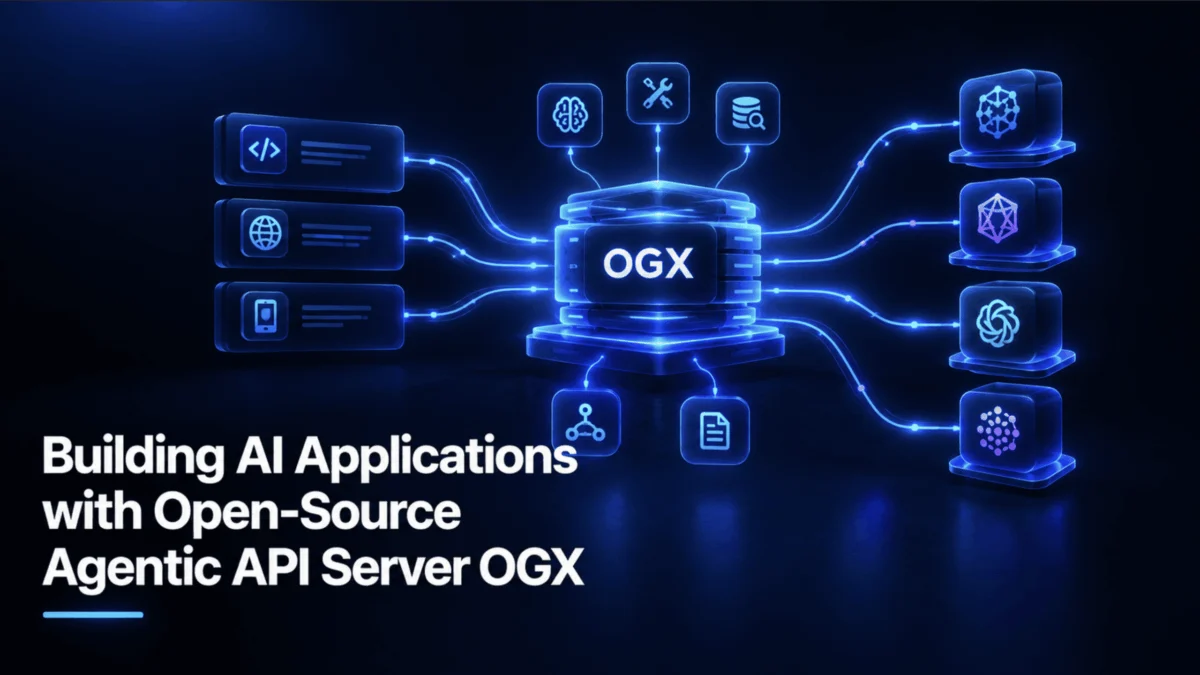
At its core, OGX is an open-source agentic API server. It is designed to act as a drop-in replacement for the OpenAI API. Whether you are running your infrastructure on a personal laptop, a private data center, or a public cloud, OGX provides a consistent interface.
The project’s "secret sauce" is its pluggable provider architecture. Developers can build their application locally using Ollama, scale to production using vLLM, or leverage managed cloud services—all without modifying the application code. By maintaining a stable API surface, OGX ensures that swapping backends is an operational decision rather than a development hurdle.
Chronology: The Journey to a Unified API Standard
The trajectory of OGX follows the industry’s broader movement toward standardizing agentic workflows.
- The Inception of Llama Stack: Initially, Meta introduced the Llama Stack to provide a standard interface for its family of models, acknowledging that developers needed more than just a model—they needed a "stack" that included RAG, tool calling, and memory management.
- The Bottleneck of Vendor Lock-in: As the industry matured, developers found that while the Llama Stack was powerful, it lacked the flexibility to easily integrate with non-Llama models or different inference backends.
- The Pivot to OGX: Recognizing the need for a truly vendor-neutral platform, the project rebranded to OGX. This move signaled a commitment to being an agnostic layer, allowing for the integration of Anthropic, Google GenAI, and open-weights models alongside the Llama series.
- Current Status: Today, OGX functions as a production-grade orchestration layer that handles complex agentic tasks—including multi-step tool calling and server-side RAG—through a singular, unified API surface.
Supporting Data: Why Agnostic Architecture Matters
In the world of software engineering, "write once, run anywhere" is the gold standard. In the context of AI, this is exceptionally difficult because different providers offer different API structures and capabilities.
The Power of Pluggable Providers
OGX abstracts away the complexity of model-specific client libraries. Instead of rewriting your code to switch from openai-python to anthropic-python, you use the OGX server as the intermediary. The server handles the communication with the chosen provider (Ollama, vLLM, or cloud-hosted), allowing the application to remain untouched.
Performance and Reliability
The architectural design of OGX supports:
- Server-side Orchestration: Unlike lightweight wrappers, OGX manages the agentic state on the server, reducing the latency overhead of constant client-server back-and-forth.
- Native MCP Integration: It supports Model Context Protocol (MCP) servers, allowing the AI to interface with real-world databases and tools effortlessly.
- Streamlined RAG: OGX performs chunking, embedding, and indexing on the server side. In a traditional setup, a developer might spend dozens of lines of code managing a vector database; with OGX, this is handled through a few declarative API calls.
Technical Implications: Building "DocBrain"
To illustrate the power of OGX, consider the implementation of a hypothetical application, "DocBrain." This application performs two distinct tasks: intelligent document retrieval (RAG) and active task management.
Prerequisites for Implementation
Building with OGX requires minimal overhead. Using uv (a modern Python package manager) and a local backend like Ollama, a developer can initialize a project in seconds.
uv init docbrain
uv add ogx openai
The Synergy of RAG and Tool Calling
The true strength of OGX is its ability to treat file retrieval and custom function execution as first-class citizens in a single API call. In the DocBrain example, when a user asks for a document summary and a deadline check, the agent does not merely parse text; it invokes a file_search tool to ground the response and a save_action_item tool to write data to a local JSONL file.
By defining the ACTION_ITEM_TOOL_SCHEMA, the developer provides the model with the ability to "act" upon the information it discovers. This transforms the AI from a passive chatbot into an active, autonomous agent capable of bookkeeping and workflow automation.
Official Perspective and Future Outlook
The transition to OGX reflects the broader industry consensus: AI infrastructure must be as modular as the software that consumes it.
Industry experts and maintainers suggest that the future of agentic AI does not lie in specialized, siloed SDKs, but in standardized, interoperable servers. By providing a secure, HTTPS-enabled, and highly extensible server, the OGX project is positioning itself as the middleware layer for the next generation of enterprise AI applications.
Implications for the Developer
For developers, the implication is clear: the barrier to entry for building complex, agentic systems has been significantly lowered. By adopting an OGX-based workflow, companies can:
- Reduce Technical Debt: Eliminate the need to maintain multiple client library implementations.
- Increase Agility: Switch models or infrastructure providers based on cost or performance requirements without a massive refactor.
- Enhance Security: Leverage the server’s built-in security features, such as HTTPS by default, ensuring that local development environments are robust and scalable.
Conclusion: A Platform for Growth
The pivot from Llama Stack to OGX is more than a name change; it is a declaration that the future of AI development is open, interoperable, and agent-centric. Whether you are building a small-scale prototype or a large-scale production system, the ability to maintain a consistent API surface while swapping the "brain" (the model) and the "limbs" (the tools and infrastructure) is invaluable.
As the industry moves away from the "one-model-fits-all" mentality, platforms like OGX will become the backbone of the next generation of AI-native software. It provides the necessary abstraction to keep codebases clean and the necessary power to build agents that don’t just speak, but actually do. For any developer currently researching agentic frameworks, the time to explore OGX is now—it is built not just for the experiments of today, but for the enterprise-grade systems of tomorrow.
About the Author:
Shittu Olumide is a software engineer and technical writer dedicated to demystifying the complexities of modern AI. With a focus on scalable, maintainable architecture, he helps bridge the gap between cutting-edge research and practical, real-world application. Follow his work on LinkedIn or Twitter.