


By [Author/Editorial Team]
Published: October 2026
Main Facts
The landscape of digital media and commercial production has undergone a fundamental structural shift. For years, newcomers to artificial intelligence video generation have fallen into a predictable trap: opening a single generative tool, typing an exhaustive, novel-length prompt, and expecting a polished, theatrical-grade film to emerge from a single generation pass. Industry veterans and early adopters confirm that this approach consistently fails. No single AI model currently dominates every aspect of production—from physics and lighting to character consistency and temporal stability.
Professional AI filmmaking has evolved into a multi-model stack. Much like a traditional film crew relies on specialized professionals for camera operation, lighting, grip work, and sound design, contemporary digital directors leverage distinct AI models for distinct tasks. Treating generative video platforms like a slot machine—generating, hoping for a miracle, and endlessly regenerating clips—results in a rapid depletion of processing credits and viewer patience. Conversely, treating the software suite like a managed production set transforms the workflow into a predictable, highly scalable creative process.
Chronology
The evolution of generative video has accelerated faster than any previous digital content revolution.
- Phase 1: The Novel-Prompt Era (Early Experiments): Creators treated AI video models like text-based chatbots, feeding them massive, descriptive blocks of text and hoping the model would accurately interpret lighting, pacing, and character continuity in one shot.
- Phase 2: The Isolated Tool Era: Platforms introduced higher fidelity, but creators remained siloed within single applications, struggling to maintain visual identity across multiple generated clips.
- Phase 3: The Multi-Model Production Stack (Current State – 2026): The industry has matured into a standardized pipeline. Creators now utilize specialized architectures—such as Google’s Veo and OpenAI’s Sora for advanced physics, lighting, and native lip-sync, alongside models like Kling for stable human articulation—integrated within cohesive multi-model workspaces.
Supporting Data & The 5-Step Production Workflow
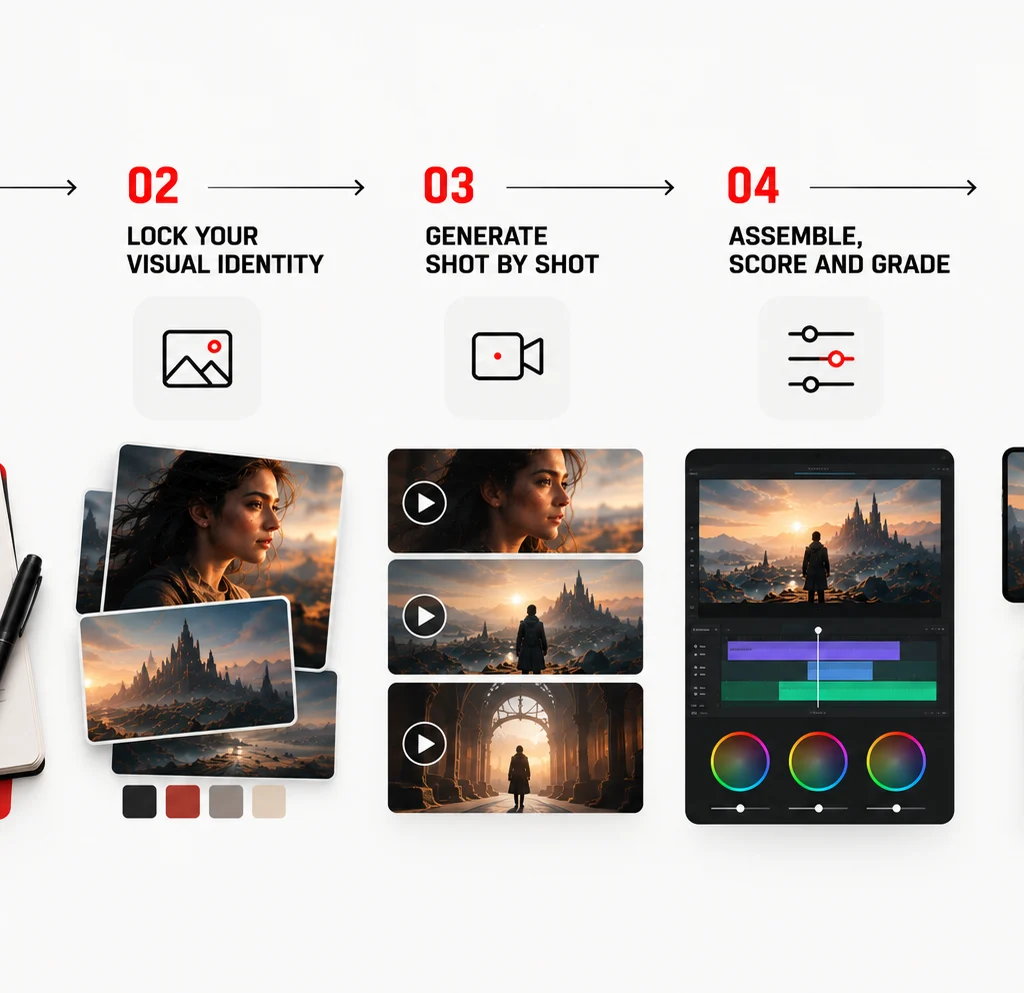
To compress weeks of traditional pre-production, shooting, and post-production into a few focused hours, modern digital creators follow a rigorous five-stage pipeline:
Step 1: Write the Idea Like a One-Page Pitch, Not a Script
Before opening any digital interface, creators draft a concise one-page pitch defining the core character, their primary objective, the obstacles in their path, and a resolution achievable in under five distinct shots. In AI filmmaking, this constraint is vital; every generated frame carries a cost in time and processing credits. A precise pitch dictates exact generation targets and prevents wasted resources.
Step 2: Lock Your Visual Identity Before Touching Video
Skipping this foundational step yields an amateur "AI reel" rather than a unified production. Creators must generate and approve a baseline set of character and environment reference stills before moving to video generation. Feeding these anchors into subsequent prompts ensures continuity.
Step 3: Generate Shot by Shot, Not Film by Film
With visual identity locked, production moves to single-shot video generation. Utilizing image-to-video or character-locking features prevents the compounding variations that ruin multi-shot sequences.
Step 4: Assemble, Score, and Grade
Generated clips represent raw material, not a finished product. Post-production entails editing the sequence, adding sound design, and applying color grading to unify the visual tone.
Step 5: Export for the Platform, Not Just the Film
Different distribution channels demand distinct technical and structural approaches:
| Platform | Recommended Format | Why It Matters |
|---|---|---|
| YouTube | 16:9, full cinematic cut with opening titles | Built for sit-down viewing and SEO-driven discovery. |
| Instagram Reels / YouTube Shorts | 9:16, re-cut to lead with the strongest shot in the first 2 seconds | Algorithms reward an immediate hook, not a slow build. |
| 1:1 or 16:9, captioned, under 90 seconds | Professional audiences frequently watch with sound off by default. | |
| Client Pitch Deck | Full cinematic cut embedded in a slide, plus a behind-the-process slide | Showing the workflow builds trust faster than the film alone. |
Official Responses & Industry Applications
Leading digital agencies and educational institutions have integrated this multi-model workflow into their daily operations, proving its utility across commercial and personal landscapes.
1. Enterprise Brand Campaigns
At digital marketing agencies like echoVME Digital, production teams prototype entire commercial films as AI cinematic shorts before dedicating capital to physical shoots. This allows clients to review and approve emotional directions and visual styles prior to physical resource allocation. In several instances, the polished AI assets have been approved directly as final deliverables for live brand campaigns.
2. Next-Generation Education
Educational frameworks, such as those at Digital Scholar, have embedded AI filmmaking into their core curricula. Educators emphasize that technical mastery of any single tool is secondary to foundational storytelling, pacing, and directorial vision. Because underlying software architectures evolve rapidly, teaching a structured production workflow prepares students for sustained industry relevance.
3. Personal Branding and Thought Leadership
Industry leaders increasingly leverage cinematic teasers for keynotes and major announcements. These short-form assets require a fraction of the time needed for traditional video shoots and consistently outperform standard talking-head videos in watch-time metrics and social shares.
Implications
The rise of accessible, high-fidelity generative video carries profound implications for the creative economy, technical limitations, and legal frameworks surrounding digital media.
Overcoming Technical Hurdles
While modern models handle native dialogue, synchronized lip-syncing, and complex physics far better than their predecessors, temporal continuity across long sequences remains a hurdle. Creators mitigate this by focusing on tight, highly directed narrative shorts rather than attempting feature-length continuities in single passes. Furthermore, character drift—where subjects alter appearance between cuts—is resolved strictly through reference-image locking rather than reliance on text prompts alone.
Legal and Commercial Compliance
As brands adopt AI-generated video for advertising, legal vetting is essential. Industry standards dictate verifying commercial usage rights on underlying platforms, avoiding unauthorized likenesses of real individuals, and complying with local disclosure mandates regarding AI-generated media.
The Ultimate Skill: Directing Over Prompting
The technical gap between generative models continues to narrow, but the chasm between random clip generation and intentional cinematic storytelling is widening. Industry experts stress that the definitive skill of 2026 is direction. By studying established cinematography, framing, and narrative structure, creators can harness generative video not as a novelty, but as a legitimate cinematic medium.
For aspiring creators, the barrier to entry has never been lower, but the requirement for intentional storytelling has never been higher. The future belongs not to those with the largest production budgets, but to those who master the art of the multi-model production stack.