







EXECUTIVE SUMMARY: In the rapidly evolving landscape of enterprise artificial intelligence, the differentiator is no longer what an LLM can do in a single, isolated query, but how it integrates into sustained, repeatable business workflows. Revenue operations, marketing teams, and sales leaders are moving past experimental, ad-hoc prompting and adopting "Claude skills"—standardized, reusable instruction sets engineered to automate recurring execution. When paired with native CRM connectors, such as the newly popularized integration between Anthropic’s Claude and HubSpot, these dynamic capabilities allow revenue teams to radically shrink administrative overhead while preserving strict human oversight over strategic validation, customer communications, and commercial terms.
The Strategic Shift: Moving Beyond the Single Prompt
For the past several years, the baseline enterprise interaction with generative AI has relied on the single-shot prompt: a user crafts an ad-hoc set of instructions, pastes raw data, evaluates the output, and discards the prompt. While effective for one-off tasks, this methodology scales poorly across high-volume departments. Marketing and sales teams routinely grapple with recurring operational duties—campaign briefings, post-call analysis, target account research, editorial outlining, commercial proposal drafting, and performance reporting.
Rebuilding bespoke prompts for these repetitive processes introduces human error, brand drift, and unnecessary friction. Claude skills solve this structural inefficiency by packaging established instructions, designated inputs, reference frameworks, and expected outputs into persistent, modular components.
Unlike a fragile prompt, a Claude skill establishes a defined operational contract. It acts as an execution blueprint, dictating how Claude should process designated inputs, handle missing data points, reference authorized source materials, and format the final deliverables. By standardizing these processes, organizations ensure that every campaign brief, sales recap, or persona analysis adheres strictly to company parameters—without requiring team members to reinvent the wheel with every execution cycle.
Anatomy of a Claude Skill: Architecture and Operational Mechanics
To understand why skills represent a qualitative leap in AI productivity, one must examine their core architecture. A robust Claude skill is far more than a block of text; it is a multi-layered asset designed to guide an AI agent through complex, multi-step business logic.

+-------------------------------------------------------------------+
|                        CLAUDE SKILL ARCHITECTURE                  |
+-------------------------------------------------------------------+
|  [Core Instructions]                                              |
|   ├── Defined Task Objectives & Step-by-Step Logic                |
|   ├── Data Validation Constraints & Gap-Flagging Rules            |
|   └── Behavioral & Tone Guidelines                                |
+-------------------------------------------------------------------+
|  [Supporting Resources]                                           |
|   ├── Templates & Structural Outlines                             |
|   ├── Reference Documents & Approved Brand Assets                 |
|   └── Optional Scripts & Asset Pipelines                          |
+-------------------------------------------------------------------+
|  [Dynamic Inputs & CRM Context]                                   |
|   ├── User-Supplied Transcripts, Notes, & Metrics                 |
|   └── Permission-Aware CRM Data (e.g., HubSpot Connector)         |
+-------------------------------------------------------------------+
Core Components of an Enterprise Skill
- Defined Task Objectives: A clear declaration of what the skill is engineered to achieve, ensuring the model remains anchored to a singular business outcome.
- Step-by-Step Execution Logic: Sequential workflows that guide Claude from initial data intake through processing, synthesis, and final drafting.
- Template and Formatting Requirements: Rigid structural frameworks that dictate how the output must be organized (e.g., mandatory sections for a campaign brief or strict categorization for a sales discovery call).
- Validation and Gap-Flagging Rules: Explicit instructions detailing how Claude must handle missing information, unsupported claims, or ambiguous data points. Instead of hallucinating details to fill voids, a well-built skill forces the model to label missing inputs as unknowns for human resolution.
- Supporting Reference Materials: Embedded style guides, product facts, regulatory disclaimers, or historical templates that provide necessary operational context.
Furthermore, these structures accommodate advanced developer workflows. Through specialized implementations like Claude Code skills, technical teams can package identical instruction sets for recurring engineering tasks—such as automated code reviews that enforce uniform styling and security standards across disparate repositories.
High-Impact Claude Skills for Modern Marketing Teams
Marketing organizations operate at the intersection of creative execution and data-driven strategy. Deploying Claude skills across this department allows teams to automate the heavy lifting of campaign development and content scaling while keeping human strategists firmly in the driver’s seat.
1. The Campaign Brief and Calendar Builder
Demand generation and content marketing teams frequently waste hundreds of cumulative hours formatting campaign parameters across disparate spreadsheets and documents. A Campaign Brief and Calendar Builder skill ingests fragmented inputs—core business objectives, target audience demographics, value propositions, approved marketing channels, flight dates, and messaging frameworks—and synthesizes them into an exhaustive operational blueprint.
Beyond drafting, this skill acts as an automated quality control checkpoint. If a marketer submits a brief with an undefined audience or an ambiguous timeline, the skill flags these discrepancies before downstream content creation begins. Once the plan is finalized, integrated platforms like HubSpot Marketing Hub can be leveraged to execute and monitor the resulting campaigns, utilizing native connectors to pull real-time page performance metrics and draft promotional materials seamlessly.
2. Persona and ICP Research Assistant
Product marketers and growth strategists often struggle to synthesize qualitative interview transcripts, customer surveys, and market research into coherent Ideal Customer Profile (ICP) documentation. A Persona Research skill analyzes approved source materials to extract observable pain points, buying triggers, operational objections, and explicit decision criteria.

Critically, the instructions enforce strict evidentiary boundaries. The skill is programmed to anchor every major conclusion directly to the supplied text, distinguishing robust, recurring behavioral patterns from isolated anecdotes. If the data fails to support a demographic or firmographic assumption, the skill isolates the gap in an "Unknowns" section, preventing marketing teams from building campaigns on top of fabricated AI inferences.
3. Editorial Outlining and Content Production
Scaling content production without sacrificing brand voice is a perennial challenge for enterprise media teams. A Blog and Social Post Outliner transforms raw keywords, executive briefs, or foundational research into detailed, structurally optimized content architectures. By embedding deep brand voice training data—including specific terminology matrices, stylistic dos and don’ts, and formatting preferences—content teams can ensure that every outline generated by Claude mirrors the organization’s unique editorial posture.
High-Impact Claude Skills for Revenue and Sales Operations
For sales leaders, account executives, and business development representatives (BDRs), administrative latency directly impacts win rates. Claude skills designed for sales workflows focus on accelerating post-call velocity, refining discovery insights, and generating commercial collateral with unprecedented precision.
1. Sales Call Recap and Follow-Up Planner
Following a complex enterprise discovery session, sales representatives must quickly distribute meeting notes, update pipeline stages, and draft customized follow-up communications. A Sales Call Recap and Follow-Up Planner skill ingests raw call transcripts, notes, and CRM deal history to generate an organized engagement summary.
The skill is architecturally designed to draw a hard line between confirmed customer statements and suggested sales next steps. By compartmentalizing verified prospect utterances from AI-generated recommendations, the skill allows reps to instantly evaluate the accuracy of the output and ensure that follow-up materials accurately reflect the nuances of the account relationship.

2. Proposal and One-Pager Draft Helper
Translating discovery notes and technical requirements into polished commercial proposals is historically time-consuming. A Proposal Draft Helper ingests discovery documentation, product specifications, and enterprise pricing guidelines, mapping them directly onto approved company templates. While human oversight remains mandatory for pricing tables, contractual commitments, and legal indemnifications, this skill eliminates the blank-page syndrome, providing sales teams with an immediate, structurally sound first draft.
3. Reporting and Performance Narrative Assistant
Revenue Operations (RevOps) teams spend countless hours translating raw CRM exports and analytics dashboards into executive-ready performance summaries. A Reporting and Performance Narrative Assistant ingests approved metrics, historical benchmarks, and reporting periods to surface notable variance, operational anomalies, and strategic questions requiring leadership intervention. By separating observable quantitative changes (e.g., a measured drop in mid-funnel conversion rates) from speculative root-cause analysis, the skill provides a pristine foundation for executive decision-making.
Chronology of Integration: Bridging the CRM Chasm
The true enterprise value of advanced language models is unlocked only when they possess contextual awareness of a company’s customer data. Historically, this required cumbersome, insecure copy-pasting of sensitive CRM records into external chat interfaces. The introduction of permission-aware CRM connectors has fundamentally altered this timeline.
- Phase 1: Isolated Prompting (Pre-2024): Organizations relied on manual data extraction. Sales reps and marketers manually exported CRM records, sanitized personal data, and pasted text into isolated chat windows to generate ad-hoc summaries.
- Phase 2: API-Driven Point Solutions (2024–2025): Early middleware solutions enabled basic data synchronization between generative AI models and sales databases, though these integrations often lacked granular permission mapping and required complex custom engineering.
- Phase 3: Native Connector Ecosystems (Current Era): Platforms like HubSpot introduced native, no-code connectors for Claude. These architectures allow Claude to query authorized CRM records directly within the interface, strictly governed by existing user permissions, eliminating manual data handling while maintaining uncompromising security compliance.
Technical Integration: How the HubSpot Connector for Claude Operates
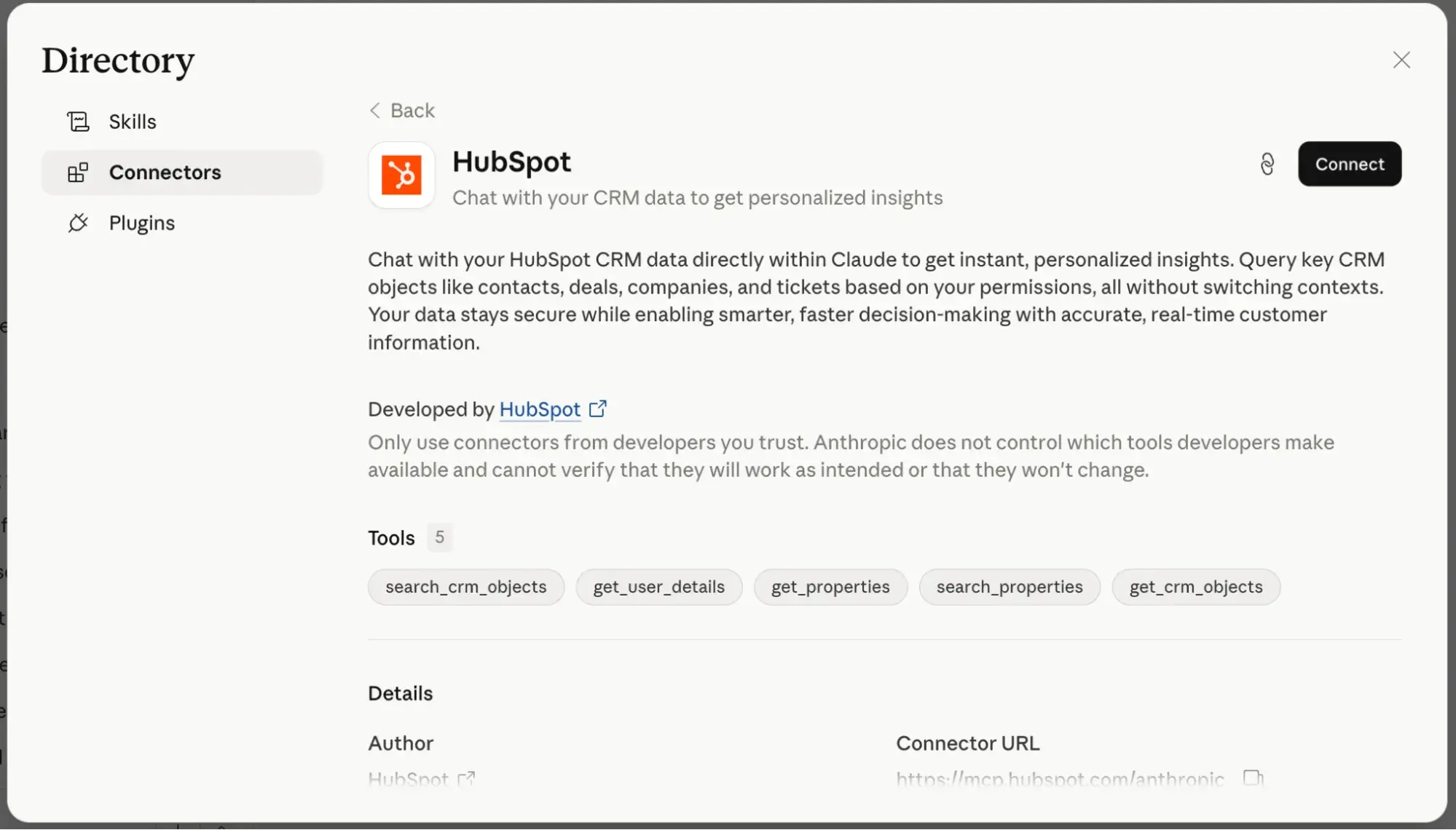
The integration between HubSpot and Claude bridges the gap between unstructured generative capabilities and structured CRM data. Operating through Claude’s native connector directory, the integration requires zero custom coding, enabling administrators to authorize access in minutes.
+-------------------------------------------------------------------+
|               HUBSPOT-CLAUDE CONNECTOR WORKFLOW                   |
+-------------------------------------------------------------------+
|  1. USER INITIATION                                               |
|     User issues a request within Claude's web or desktop interface|
+-------------------------------------------------------------------+
                              │
                              ▼
+-------------------------------------------------------------------+
|  2. PERMISSION-AWARE QUERYING                                     |
|     Claude queries authorized HubSpot records (Contacts, Deals)   |
|     governed strictly by the user's native CRM permissions        |
+-------------------------------------------------------------------+
+-------------------------------------------------------------------+
|  3. CONTEXTUAL SYNTHESIS                                          |
|     Claude merges CRM data with designated skills/instructions    |
+-------------------------------------------------------------------+
                              │
                              ▼
+-------------------------------------------------------------------+
|  4. ACTION & RECORD UPDATES                                       |
|     Users review outputs; approved updates sync back to HubSpot   |
+-------------------------------------------------------------------+
Crucially, the underlying CRM records remain securely stored within HubSpot. Claude accesses this data strictly on an as-needed basis, bounded by the specific authorization limits of the connected user profile. Mobile interfaces are currently excluded from this connector architecture, restricting native CRM data access to secure web and desktop environments.

Supported CRM Operations
Through permission-aware integration, revenue teams can execute several advanced workflows directly inside Claude:
- Pipeline and Deal Analysis: Reviewing active deal stages, historical engagement notes, and stalling pipeline bottlenecks to recommend next-best actions.
- Account Research Preparation: Pulling historical touchpoints, support tickets, and contact records prior to a major client check-in.
- Automated Record Updating: Instructing Claude to update supported CRM fields (such as meeting notes, task completions, and custom property updates) while strictly prohibiting destructive actions like record deletions.
Official Industry Perspectives and Implications
As enterprises rush to operationalize AI skills, industry leaders emphasize that productivity gains must not outpace governance.
"The democratization of AI via reusable skills represents a fundamental shift in how revenue teams operate," notes a leading enterprise AI strategist. "However, organizations must recognize that automation is not an exemption from accountability. The goal of a Claude skill is to accelerate operational velocity, not to outsource strategic judgment. Human validation remains the ultimate arbiter of business truth."
Key Implications for Enterprise Leadership
- Redefinition of Administrative Roles: As AI skills absorb recurring reporting, transcribing, and drafting duties, marketing and sales professionals are freed to focus on high-touch relationship management, strategic alignment, and creative problem-solving.
- Governance and Data Minimization: Security architectures must prioritize data minimization. Skills should only ingest the precise field sets necessary to complete a defined task, mitigating compliance risks and reducing noise within the model’s working memory.
- Institutionalizing Brand Governance: By embedding granular brand voice guides, compliance disclaimers, and mandatory review checkpoints directly into skill architectures, organizations can enforce uniform quality control across distributed remote teams.
Best Practices for Enterprise Deployment
To maximize the efficacy of Claude skills while safeguarding brand equity and operational integrity, revenue leaders should adhere to a rigorous implementation framework:
- Descriptive Naming Conventions: Adopt a standardized naming formula (e.g.,
[Task] + [Output], such as "Campaign Brief Builder") to ensure intuitive navigation as enterprise skill libraries expand. - Systematic Version Control: Treat skills as living codebases. Maintain version histories to track how iterative instruction updates impact output quality, especially when underlying product messaging or metric definitions change.
- Calibrated Human Oversight: Scale human review intensity to match the potential consequences of an error. While a blog post outline requires minimal oversight, commercial proposals involving pricing structures, legal terms, or contractual commitments demand rigorous, multi-layered scrutiny.
- Progressive Rollout Strategy: Begin deployment with low-risk, high-frequency tasks—such as sales call recaps and editorial outlining—before advancing into complex, cross-functional strategic workflows.
Conclusion
The evolution of generative AI in marketing and sales has reached an inflection point. By moving beyond isolated prompts and embracing standardized Claude skills integrated directly with enterprise CRM platforms like HubSpot, revenue teams can bridge the gap between creative ideation and rigorous operational execution. When deployed with disciplined version control, strict data minimization, and unwavering human oversight, these intelligent workflows transform administrative friction into a sustainable competitive advantage.