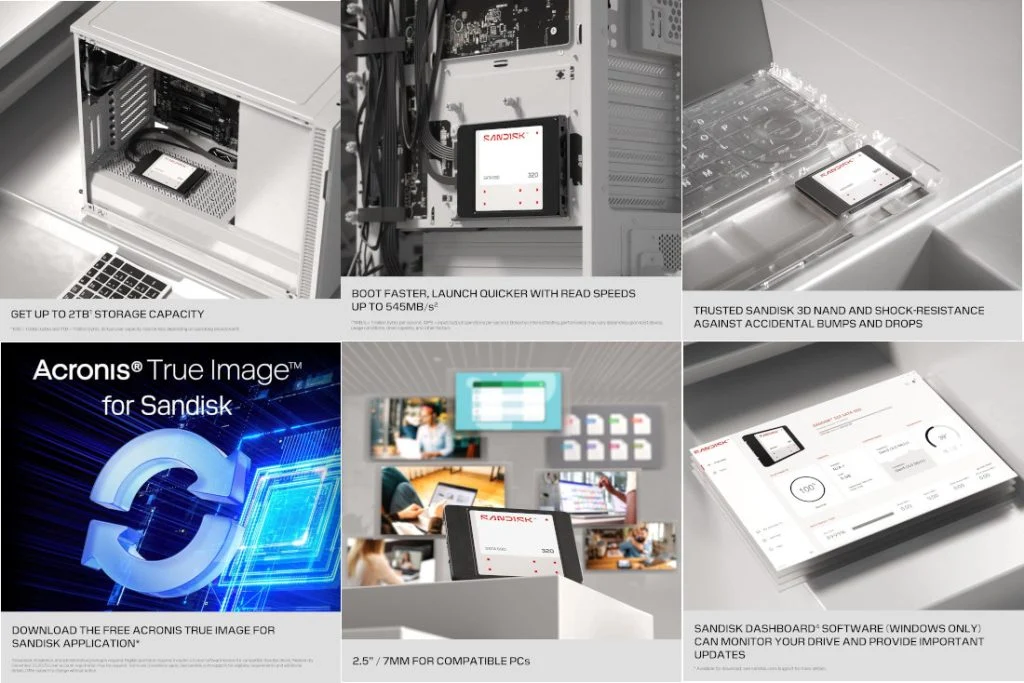
In an era where the tech industry is aggressively pushing toward NVMe and PCIe 5.0 architectures, a significant segment of the global computing infrastructure remains tethered to the reliable, albeit older, SATA III interface. Recognizing the need for cost-effective, high-reliability storage solutions for these legacy systems, SanDisk has officially expanded its storage portfolio with the introduction of the SanDisk 520 SATA SSD and the SanDisk 320 SATA SSD.
These new 2.5-inch drives serve as a strategic bridge for professionals and home users alike, offering a pathway to modernize aging hardware without the necessity of a complete motherboard or platform overhaul. By injecting new life into legacy machines, SanDisk is addressing a vital market gap where longevity and budget-conscious upgrades take precedence over bleeding-edge throughput.
Main Facts: The New Standard for SATA Upgrades
The announcement marks a commitment from SanDisk to support the vast ecosystem of computers that still rely on the 2.5-inch SATA form factor. Both the 520 and 320 models are engineered to maximize the theoretical throughput of the SATA III bus, providing a near-instantaneous performance boost for systems currently suffering from the bottlenecks of traditional mechanical hard disk drives (HDDs).
The SanDisk 520: The Professional Workhorse
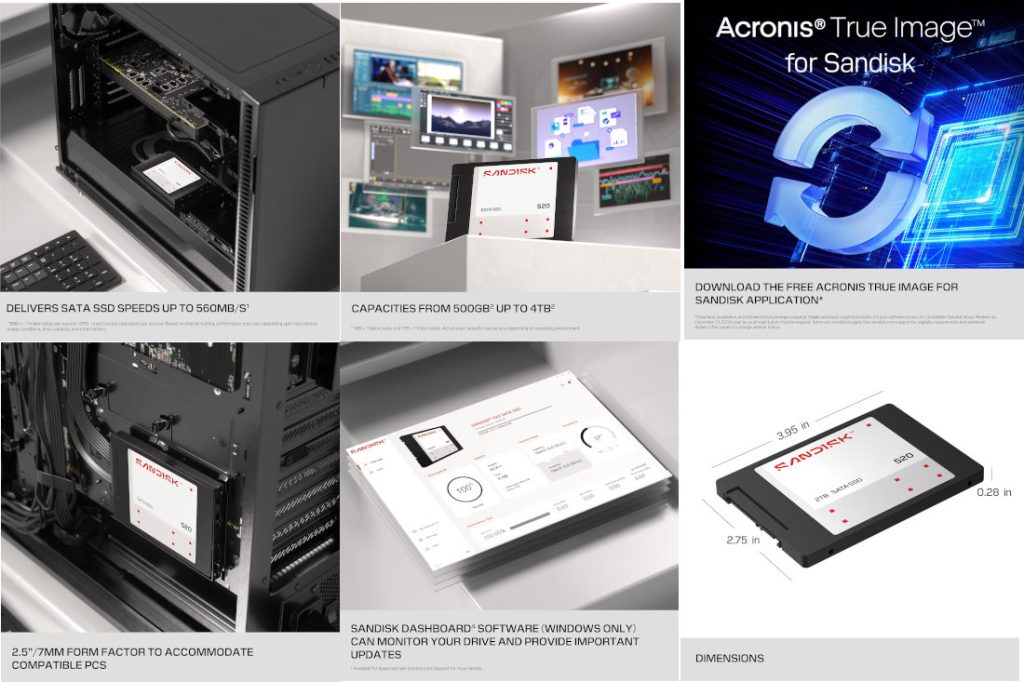
The SanDisk 520 SATA SSD is the premium offering in this duo, tailored specifically for IT professionals, video editors, and creative prosumers. With capacities reaching up to 4TB, it provides ample space for high-resolution project files, raw footage, and extensive data libraries. It is built to withstand the rigors of sustained workloads, featuring an impressive endurance rating of up to 1,000 TBW (Terabytes Written) and a Mean Time To Failure (MTTF) of 2.25 million hours.
The SanDisk 320: The Mainstream Solution
In contrast, the SanDisk 320 SATA SSD is designed for the everyday user. Whether it is reviving an old home office laptop or creating a secondary storage pool for casual multimedia, the 320 series focuses on responsiveness and shock resistance. By eliminating the moving parts found in mechanical HDDs, this drive offers a significant upgrade in durability, protecting data from the physical shocks that often plague portable or desktop systems.
A Chronological Perspective: The Evolution of SATA Storage
The history of the SATA interface is one of the most stable chapters in computing. Introduced in the early 2000s, Serial ATA (SATA) replaced the bulky Parallel ATA (PATA) cables, paving the way for more efficient airflow and faster data transfer.
- Early 2000s: The inception of SATA I, bringing 1.5 Gb/s speeds.
- 2004-2008: The transition to SATA II (3 Gb/s), which became the industry standard for the better part of a decade.
- 2009-Present: The maturation of SATA III (6 Gb/s), which remains the ceiling for the form factor.
For many years, the limitation of the SATA interface was the mechanical drive itself—the physical spinning platters could not saturate the 6 Gb/s bus. The introduction of SSDs changed this, but as NVMe took over the high-end market, SATA SSDs were often sidelined. SanDisk’s new 2026 release cycle proves that SATA is not "dead"; rather, it has settled into a crucial role as the gold standard for reliable, high-capacity, and affordable storage for millions of existing devices.
Supporting Data: Comparative Performance Metrics
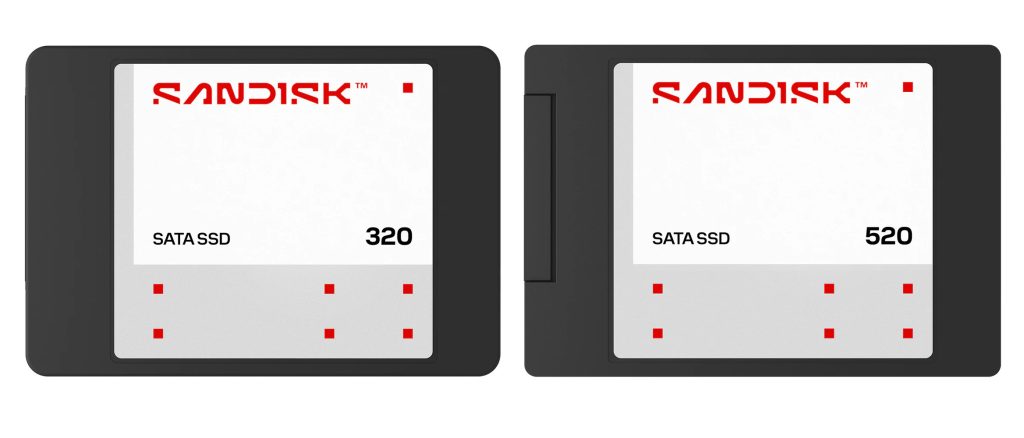
To understand the value proposition of these new drives, one must look at the technical specifications side-by-side. The following table highlights the operational differences between the professional-grade 520 series and the value-oriented 320 series.
| Feature | SanDisk 520 SATA SSD | SanDisk 320 SATA SSD |
|---|---|---|
| Primary Audience | Creative/Pro/IT | General Consumer/Office |
| Max Read Speed | Up to 560 MB/s | Up to 545 MB/s |
| Max Write Speed | Up to 525 MB/s (4TB) | Standard SATA Optimized |
| Capacity | Up to 4TB | 250GB to 2TB |
| Endurance (MTTF) | 2.25M Hours | High Reliability |
| Warranty | 5-Year Limited | 3-Year Limited |
The 520 series clearly leverages superior controller technology to maintain high write speeds even as the drive fills up, a critical factor for video editors who frequently move large files. The 320 series, conversely, optimizes for cost-per-gigabyte, making it the ideal choice for those looking to swap out a failing 1TB HDD for a faster, quieter, and more resilient SSD.
Official Perspectives and Market Implications
SanDisk’s decision to release these drives at this specific juncture suggests a market analysis indicating that the "legacy" segment is far larger than many tech analysts initially estimated.
Why SATA Still Matters
Industry experts note that while high-end gaming rigs and workstations have moved to M.2 NVMe slots, the corporate environment moves much slower. Thousands of office machines, point-of-sale systems, and industrial controllers are still equipped with 2.5-inch drive bays. For these businesses, replacing a motherboard to accommodate a new interface is not just a cost issue—it is a compatibility and downtime nightmare.
"The SanDisk 520 and 320 provide a plug-and-play solution that respects the existing infrastructure," says an industry analyst. "By providing a high-quality, branded solution, SanDisk is allowing IT departments to extend the useful life of their fleet by another three to five years without incurring the hidden costs of system-wide upgrades."
Economic Accessibility
In the Indian market, the pricing strategy reflects a desire to penetrate both the retail and enterprise sectors. With the 520 starting at INR 8,600 and the 320 at INR 5,700, SanDisk has positioned these products as affordable upgrades. The immediate availability across e-commerce platforms and retail outlets signals a robust supply chain ready to meet the demand for "storage-first" upgrades.
The Broader Implications for Computing
The launch of the SanDisk 520 and 320 SATA SSDs carries several broader implications for the tech industry:
1. The Sustainability Angle
One of the most overlooked aspects of the modern tech cycle is the "e-waste" problem. By enabling users to swap out slow, aging HDDs for high-performance SSDs, SanDisk is actively participating in the circular economy. Keeping an existing computer in service for three extra years is an environmentally superior choice compared to discarding the machine in favor of a new one.
2. Performance Parity
For the average user—someone browsing the web, editing office documents, or streaming media—the difference between an NVMe drive and a high-quality SATA SSD like the SanDisk 520 is often negligible in day-to-day operations. Both provide the "instant-on" feel that characterizes modern computing. By bringing high-end reliability to the SATA format, SanDisk is democratizing the high-performance computing experience.
3. Reliability Over Raw Speed
The inclusion of a 5-year warranty on the 520 series and a 3-year warranty on the 320 series indicates that SanDisk is confident in the flash memory longevity. In a world where data loss is a major concern, the shift from mechanical parts to solid-state storage provides a level of peace of mind that cannot be measured in MB/s alone.
Conclusion: A Strategic Choice for the Future
SanDisk’s latest offerings are a testament to the idea that innovation is not always about increasing speed; sometimes, it is about increasing accessibility and reliability. The 520 and 320 SATA SSDs are not trying to compete with the lightning-fast Gen5 NVMe drives of the world. Instead, they are carving out a vital space in the market by serving the millions of users who need their machines to be fast, reliable, and functional today.
Whether you are a creative professional pushing the boundaries of your workstation with the 520, or a home user looking to silence the clicking noise of an old hard drive with the 320, SanDisk has provided a clear path forward. As these drives hit the shelves in India and beyond, they stand as a reminder that with the right component, yesterday’s hardware can still perform like a machine of tomorrow.