










For as long as online retail has existed, product returns have been treated as an unavoidable cost of doing business. Often referred to by logistics experts as the "silent killer" of retail margins, product returns drain billions of dollars annually, straining reverse-logistics supply chains, increasing warehouse processing overhead, and leaving merchants with unsellable or heavily discounted open-box inventory.
However, a transformative shift is quietly underway. According to early data and consumer insights highlighted in Adobe’s August 2026 AI Traffic Trends Report, artificial intelligence is emerging as a powerful antidote to high return rates. By fundamentally altering how consumers research, evaluate, and purchase products online, AI-aided shopping is bridging the gap between customer expectations and product reality—ultimately promising a future where online shoppers buy less of what they don’t want and more of what they will actually keep.
Main Facts: Unlocking the Potential of AI-Aided Shopping
The intersection of artificial intelligence and ecommerce return rates is one of the most compelling narratives in modern retail technology. While many industry analysts initially focused on AI’s ability to generate text, personalize homepages, or power customer service chatbots, its role as a pre-purchase research engine is yielding the most profound financial implications.
The core findings of Adobe’s comprehensive report—which draws on Adobe Analytics data tracking over 1 trillion visits to U.S. retail sites, 100 million SKUs, and a July 2026 survey of 5,000 U.S. consumers—reveal a striking shift in consumer psychology:
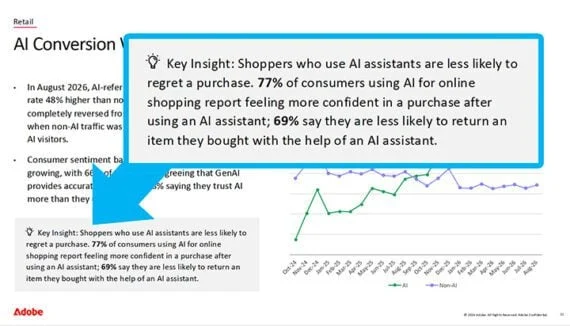
- Boosted Purchase Confidence: Approximately 77% of consumers surveyed who used AI for online shopping reported that the technology made them significantly more confident about their purchase decisions.
- Lowered Return Intent: Roughly 69% of those same AI-assisted shoppers stated they were noticeably less likely to return an item purchased with the help of artificial intelligence.
- Extraordinary Conversion Rates: In July 2026, retail visitors referred by AI platforms converted at a rate 60% higher than traditional, non-AI-referred site traffic.
- Higher Revenue Per Visit: AI-referred consumers generated an impressive 53% more revenue per visit compared to standard web traffic, proving that these shoppers are not just browsing—they are buying with intent and higher basket values.
These metrics suggest that AI is not merely acting as a novel traffic driver; it is actively filtering, educating, and qualifying buyers long before they ever land on a merchant’s product detail page.
Chronology: The Evolution of Online Discovery and the Rise of AI Agents
To understand how we arrived at this pivotal moment in retail history, it is essential to trace the evolution of the online shopping journey over the past three decades.
Era 1: The Keyword Search and Directory Model (Late 1990s – 2010s)
In the early days of ecommerce, discovery was largely transactional and primitive. Shoppers relied on search engines like Google or internal site search bars, typing in basic keywords. The onus was entirely on the consumer to sift through pages of results, open multiple browser tabs, cross-reference user reviews, and decipher technical specification sheets. This friction-heavy process frequently led to impulse buys or misinformed purchases—the primary drivers of high return rates.
Era 2: Algorithmic Recommendations and Social Commerce (2010s – Mid-2020s)
As machine learning advanced, platforms introduced personalized recommendations based on browsing history, past purchases, and demographic data. While effective at driving discovery ("If you liked this, you might like that"), these algorithms were designed to encourage more buying rather than smarter buying. Retargeting ads and endless scrolls often exacerbated impulse purchasing, doing little to curb the systemic issue of product returns.
Era 3: The Conversational and Agentic AI Era (2025 – Present)
By 2026, shopping behavior shifted decisively toward conversational agents and autonomous AI assistants. Rather than forcing users to browse dozens of discrete retail sites, tools like Meta’s Muse and advanced retail-integrated large language models (LLMs) began deploying virtual web browsers. These systems can autonomously visit multiple ecommerce storefronts, analyze dimensions, compare compatibility across variants, synthesize real consumer reviews, and weigh pricing differentials.
When an AI assistant finally refers a consumer to a specific merchant, the shopper has already navigated a rigorous pre-qualification funnel. The referral arrives not at the beginning of the buyer’s journey, but near the finish line—after uncertainty has been systematically eliminated.
Supporting Data: Dissecting the Adobe 2026 Traffic Trends Report
While Adobe’s 59-page AI Traffic Trends Report covers a vast array of digital marketing metrics, the section addressing returns and consumer confidence offers a crucial glimpse into the future of retail economics.
The Research Phase Shift
Historically, pre-purchase research was a fragmented, multi-step chore. A consumer looking for a specialized piece of smart-home hardware, for instance, might spend hours visiting manufacturer websites, reading Reddit threads, watching YouTube review videos, and checking compatibility charts.

In the current landscape, an AI assistant can ingest all of that disparate data in seconds. When the assistant presents a curated recommendation, it is backed by a synthesized understanding of the user’s specific constraints—whether that means physical dimensions, technical specifications, or functional requirements.
Quantifying the Financial Impact
The financial ramifications of this shift are highlighted by the stark performance differences between AI-referred traffic and traditional traffic:
| Traffic Metric | Traditional Web Traffic | AI-Referred Traffic | Performance Gap |
|---|---|---|---|
| Conversion Rate | Baseline | Elevated | +60% higher |
| Revenue Per Visit | Baseline | Elevated | +53% higher |
| Purchase Confidence | Moderate | High | 77% report high confidence |
| Return Intent | Standard industry average | Lowered | 69% less likely to return |
These statistics underscore a fundamental truth: informed shoppers are profitable shoppers. By shifting the burden of research from the human brain to processing algorithms, ecommerce ecosystems are witnessing a dramatic reduction in buyer’s remorse.
Official Responses and Industry Perspectives
As retailers and technology developers digest the implications of the 2026 data, industry leaders are weighing in on how merchant strategies must adapt to the rise of AI-driven commerce.
Retail technologists emphasize that merchants can no longer view product pages simply as static marketing brochures meant to entice human eyes. Instead, product data must be optimized for machine consumption.
"AI assistants can reduce purchase uncertainty only when they have accurate, extensive information—specifications, dimensions, compatibility details, variants, delivery estimates, reviews, FAQs, and comparisons," industry analysts note. If better product information helps an assistant recommend the right product to the right shopper, merchants could gain both a sale and fewer returns."
Furthermore, software providers are racing to build infrastructure that accommodates AI agents. Platforms that previously sought to lock users into walled gardens are increasingly opening their APIs to external AI tools (such as Shopify integrating with advanced shopping agents), recognizing that frictionless, AI-guided discovery ultimately benefits gross merchandise value (GMV) and protects margins from the staggering costs of reverse logistics.
Implications: What This Means for Merchants, Consumers, and the Future of Retail
The emergence of AI-aided shopping as a moderating force on return rates carries profound implications for every stakeholder in the retail ecosystem.
1. The Death of Superficial Product Data
For online merchants, mediocrity in product catalog management is no longer viable. If a retailer’s product page lacks granular details—such as exact weight, precise dimensions, material composition, or compatibility limitations—AI assistants will simply bypass that product in favor of a competitor with better-structured data. Merchants must invest heavily in rich, structured product information management (PIM) systems to ensure their inventory is accurately understood and recommended by third-party AI agents.
2. A Paradigm Shift in Reverse Logistics
For years, high return rates have forced companies like Amazon, Target, and thousands of direct-to-consumer (DTC) brands to implement restocking fees, shorten return windows, or even tell customers to keep unwanted items because processing the return costs more than the item is worth. If the trend identified in Adobe’s report scales across the broader retail economy, businesses could see a structural compression in return rates. This would free up capital previously lost to shipping, restocking, labor, and inventory depreciation.
3. Redefining Customer Loyalty
As AI assistants take on a larger role in daily decision-making, brand loyalty may evolve. Consumers may develop deeper trust in the AI platforms or agents that consistently steer them toward satisfactory purchases. Consequently, merchants will need to build strong relationships not only with end consumers but also with the digital platforms and protocols that power AI discovery.
4. The Path Forward
While experts caution that it remains early days and longitudinal studies spanning multiple holiday seasons will be necessary to fully quantify the long-term impact on return rates, the directional signal is clear. AI-aided shopping is transforming ecommerce from a game of high-volume guesswork into a precision-guided marketplace. By aligning customer intent with accurate data, artificial intelligence is solving one of retail’s oldest and most expensive problems—creating a win-win scenario for merchants and shoppers alike.



