











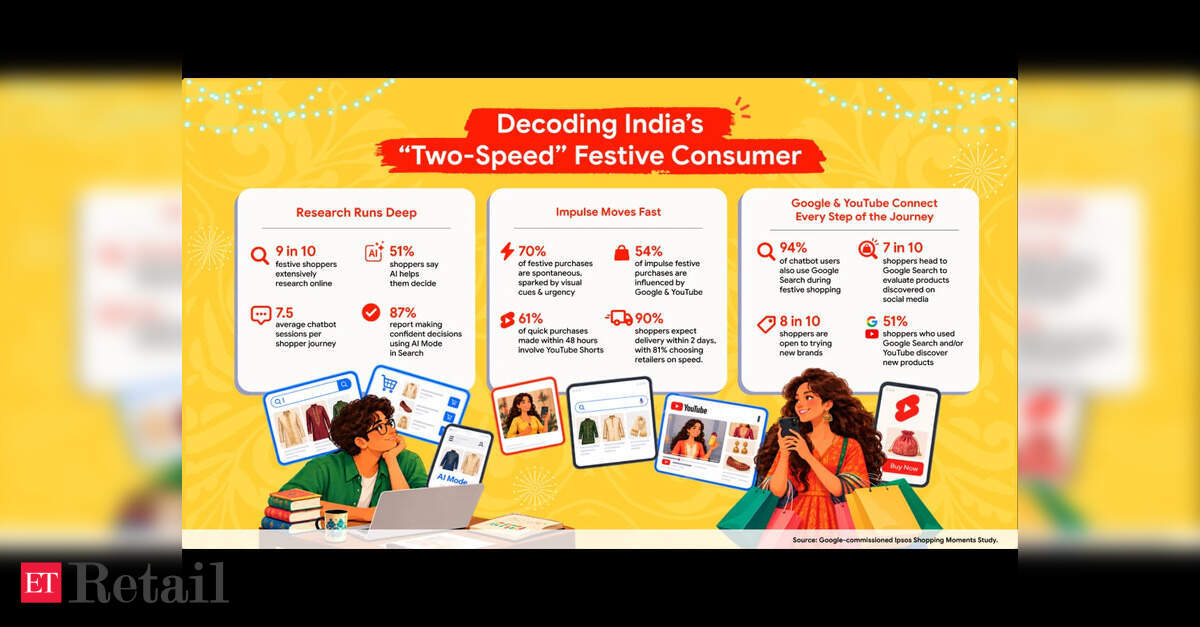
The Indian festive season, a period synonymous with massive economic activity and cultural fervor, is undergoing a profound transformation. As consumers prepare for the peak of the Navratri and Diwali shopping windows, the lines between deliberate, long-term research and spontaneous, impulse-driven acquisition have blurred. According to a landmark study commissioned by Google and conducted by research firm Ipsos, the modern Indian consumer has evolved into a "hybrid shopper"—a sophisticated individual who balances high-tech research with rapid-fire decision-making.
This shifting behavior presents both an immense opportunity and a complex challenge for retailers. With 90% of shoppers engaging in extensive online research before clicking "buy," yet 70% of purchases being decided on the spur of the moment, the traditional linear sales funnel is effectively obsolete.
The Anatomy of a Festive Purchase: Main Facts
The Google-Ipsos study provides a granular view of the contemporary shopping journey. It reveals that the decision-making process is no longer a solitary event but a multi-touchpoint marathon. On average, Indian festive shoppers perform over eight online searches and consume nearly eight videos as they navigate their way toward a purchase.
Perhaps the most disruptive finding is the integration of Generative AI and chatbots into the retail experience. More than half of all festive shoppers now leverage AI tools to inform their buying decisions. These users interact with chatbots an average of 7.5 times per purchase, particularly when navigating high-involvement categories such as consumer electronics, home appliances, interior decor, and personal care.
The "impulse" factor remains a dominant force. Driven by festive urgency, aggressive promotional pricing, and the visual allure of digital discovery, 54% of all unplanned purchases are now directly influenced by Google Search and YouTube.
A Chronological Evolution: From Traditional Retail to Digital Immersion
To understand current trends, one must look at the evolution of the Indian consumer over the last decade.
- Pre-2015: Shopping was primarily an offline, experience-based activity. Discovery happened through physical storefronts and word-of-mouth.
- 2016–2020: The "Digital First" transition. With the advent of affordable data, consumers began using the internet for price comparison and basic research, though checkout was still largely offline or rudimentary online.
- 2021–2023: The "Hyper-Convenience" era. The pandemic accelerated the adoption of quick-commerce and delivery-speed expectations. Retailers began investing heavily in supply chain logistics to meet the 48-hour delivery benchmark.
- 2024 and Beyond: The "AI-Driven Discovery" phase. We have entered a period where technology doesn’t just host the store; it acts as a personal shopping assistant. Visual search, influencer-led inspiration, and AI-driven recommendations now dictate the flow of the festive market.
Supporting Data: The Metrics of Modern Consumption
The data underscores a fundamental shift in how trust and interest are generated in the digital age:
- The Research-Purchase Loop: 70% of consumers who discover a product on social media immediately transition to Google Search to validate the brand.
- The AI Multiplier Effect: Among those who use chatbots, 94% also utilize Google Search. Notably, these chatbot users perform 1.3 times more searches than their non-chatbot counterparts, suggesting that AI acts as a catalyst for deeper product investigation rather than a shortcut that bypasses research.
- Visual Discovery: 53% of shoppers are now utilizing visual tools like Google Lens to compare features or identify products seen in real-life settings.
- Influencer Impact: 73% of shoppers turn to content creators and influencers for inspiration, confirming that the "creator economy" has become a primary pillar of festive marketing.
- Logistics as a Differentiator: The demand for speed is absolute. 90% of shoppers categorize sub-two-day delivery as a "non-negotiable" service standard, and 81% of consumers base their final retailer choice on the promised delivery window.
Industry Implications: How Retailers Are Responding
The implications for businesses are stark. Retailers can no longer afford to operate in silos. The study highlights that eight out of ten shoppers are actively seeking to try new retailers, provided those retailers can offer a seamless discovery-to-delivery experience.
The Death of the Linear Funnel
Marketing professionals are being forced to pivot from "customer acquisition" to "customer engagement." Since 51% of shoppers discover new products while actively searching for something else, visibility at the "discovery" stage is now as important as pricing. Retailers are now investing in "always-on" search strategies that ensure they appear at every touchpoint, from the initial video watch to the final chatbot query.
The Rise of the "Visual Storefront"
With more than half of consumers using visual search tools, the aesthetic quality of product imagery has become a competitive advantage. Brands that fail to optimize their product catalogs for visual recognition (i.e., making products easy to find via Google Lens) are effectively invisible to a large segment of the younger, mobile-first demographic.
The Logistics Imperative
The study’s findings on delivery speed serve as a wake-up call for legacy retailers. In the current market, logistics is no longer a back-end operation; it is a front-end marketing message. Retailers who cannot promise or guarantee sub-two-day delivery are losing market share to agile competitors, regardless of product quality or price competitiveness.
Expert Perspectives: Balancing AI and Human Touch
While the report does not quote specific executives, the consensus among industry analysts is clear: the integration of AI is not meant to replace the human element of shopping but to remove the "friction of choice."

"Retailers are moving toward an era of hyper-personalization," notes an industry consultant familiar with the study’s findings. "When a shopper uses a chatbot 7.5 times, they aren’t just looking for a price; they are looking for validation. They are asking: ‘Is this the right fit for my home? Is this the right specification for my needs?’ The brands that provide the best answers via AI, while maintaining a human-centric support system, are the ones winning this festive season."
Furthermore, the openness of consumers to switch retailers—a massive 80%—indicates that loyalty is currently "up for grabs." This creates a high-stakes environment where every touchpoint must be optimized to ensure that the "impulse" purchase lands on the right platform.
Conclusion: Preparing for the Future of Retail
The Google-Ipsos study paints a picture of a dynamic, impatient, and highly informed Indian consumer. For businesses, the message is unequivocal:
- Be Everywhere: Maintain a strong presence on Search, YouTube, and social media, as these are the gateways to the consumer journey.
- Embrace AI: Integrate chatbots and AI-driven recommendation engines to assist consumers in their evaluation phase.
- Optimize Visuals: Ensure your product data is optimized for visual discovery tools like Google Lens.
- Prioritize Speed: Logistics is now a key pillar of your brand promise; invest in distribution networks that prioritize speed.
As India approaches the peak of its festive calendar, the retailers that thrive will be those that recognize the dual nature of the modern shopper—the one who researches like a scientist but buys like an enthusiast. The fusion of digital intelligence and emotional urgency has redefined the marketplace, and for those ready to adapt, the rewards of the festive season are greater than ever before.



