










For over forty years, the digital experience has been defined by a singular, rigid contract: the Graphical User Interface (GUI). From the pioneering Xerox Star to the original Apple Macintosh, we have been conditioned to view software as a labyrinth. To achieve a goal—be it booking a flight, researching a medical symptom, or purchasing apparel—users have been forced to navigate endless menus, fill out multi-step forms, grapple with range sliders, and manage dozens of browser tabs. We have become "software managers," spending more time operating the tool than achieving the outcome.
However, a radical shift is currently underway. Driven by the explosive maturity of Large Language Models (LLMs) and autonomous agent frameworks, the web is pivoting toward a philosophy of Intent-Driven Design. The new objective is no longer to build "prettier" buttons or more fluid animations; it is to eliminate the interface entirely.
The Evolution of Interaction: From Clicks to Intent
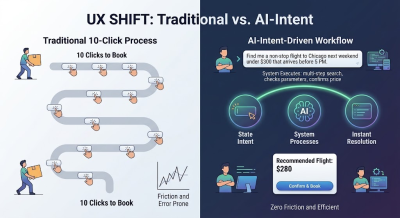
To understand the current transformation, we must recognize the friction we have accepted as "normal." The traditional web workflow is a "point-and-click" paradigm. In this model, the computer is a passive container of data, and the human is the manual orchestrator. We provide the labor; the machine provides the database.

Intent-driven design flips this dynamic on its head. Instead of asking the user to navigate the mechanical steps of how to find a result, these systems ask, "What are you trying to accomplish?" When a user inputs a high-level goal—such as, "Find me a non-stop flight to Chicago next weekend under $300 arriving before 5 PM"—the software consumes the intent, executes the multi-step query, synthesizes the results, and presents a single, actionable resolution. The ten-click process dissolves into one intelligent interaction.
A Chronology of the Interface
- The Pre-GUI Era (1970s): Command-line interfaces required deep technical knowledge. Interaction was direct but inaccessible to the general public.
- The GUI Explosion (1980s–1990s): The Xerox Star and Macintosh introduced the metaphor of the "desktop." Menus, icons, and windows democratized computing but introduced the "point-and-click" tax.
- The Mobile & Social Web (2000s–2010s): The paradigm shifted to touchscreens and infinite scrolls. Engagement metrics—time-on-page and click-through rates—became the primary KPIs for success.
- The Era of Intent (2024–Present): AI-native platforms move beyond fixed layouts. The interface is now generative, ephemeral, and outcome-oriented.
Real-World Pioneers of the Invisible Web
This transition is not a distant vision; it is happening within the browser today. Three platforms currently lead the charge in demonstrating that the best interface is, indeed, no interface.
1. Perplexity AI: The End of Tab Fatigue
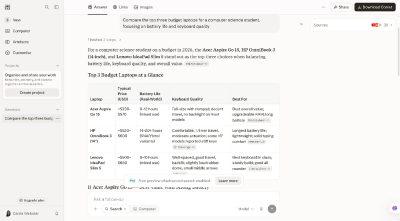
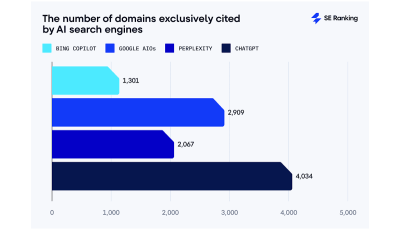
Traditional search engines were built as directories. You typed a keyword, and the interface rewarded you with ten blue links. The cognitive load of opening multiple tabs, skimming articles, and manually synthesizing an answer was the user’s burden. Perplexity AI has effectively bypassed this stage. By synthesizing information in real-time and citing sources within a single conversational response, it eliminates the need for manual cross-referencing.
2. Vercel v0: The Death of Manual Building
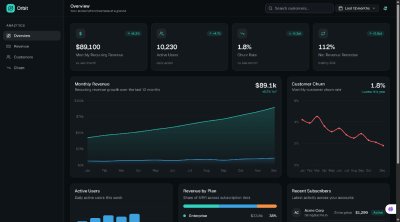
For decades, web design required hours of manual labor: drawing rectangles in Figma, defining hex codes, and adjusting CSS padding. Vercel v0 allows users to generate fully functional UI components through natural language prompts. The "drag-and-drop" era is being superseded by the "describe-and-generate" era, where layouts are rendered on the fly based on the specific requirements of the project.
3. Goblin.tools: Cognitive Offloading
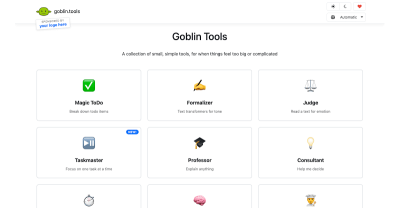
Many productivity suites are bloated, requiring users to manually construct Kanban boards and manage micro-deadlines. Goblin.tools offers a minimalist, single-page suite of AI tools that decompose complex tasks into manageable checklists. By focusing on the "what" rather than the "how," the platform removes the executive function tax often associated with complex project management software.
The Pillars of Intent-Driven UX
When designers strip away traditional sidebars, menus, and navigation headers, how do they maintain usability? The industry is coalescing around three foundational pillars identified by leading UX researchers:
Pillar I: High-Level Goal Orientation
Interfaces must shift from being command-based to being goal-based. By leveraging environmental metadata—such as device state, location, and past interaction history—systems can anticipate needs. As per Apple’s Human Interface Guidelines on Contextual & Ambient Design, the goal is to provide proactive assistance before the user explicitly clicks a button.
Pillar II: Generative UI
In the traditional paradigm, every user sees the same page. In an intent-driven paradigm, the interface is rendered dynamically. If a user expresses a need for financial data, the system generates a dynamic calculator widget. Once the task is complete, the widget recedes. This minimizes "visual clutter" and ensures that the user is only presented with tools relevant to their current, immediate objective.
Pillar III: Autonomous Execution
Traditional software is obsessed with "error prevention," leading to a deluge of confirmation modals ("Are you sure you want to delete this?"). Intent-driven design shifts the paradigm to "easy reversibility." Because AI agents are executing tasks, the focus shifts to robust, transparent "Undo" mechanisms and clear audit logs, allowing the user to remain in control while offloading the manual grunt work.
The Implications for UX Professionals
For the modern UX designer, this represents an existential pivot. The role is moving from "Screen Architect" to "Intent Strategist."
As we move toward a screenless, agent-driven world, designers must grapple with two critical risks:
- The Illusion of Control: When software makes decisions, it can feel invasive. Designers must maintain strict boundaries, particularly with high-stakes actions like financial transactions or privacy settings. The "human in the loop" remains a necessity.
- The Black Box Problem: In a traditional UI, a user can diagnose why a search failed by checking their filters. In an intent-based system, transparency is paramount. According to the Google PAIR (People + AI Research) Guidebook, systems must explicitly state their interpretation of the user’s intent before executing it, ensuring the user can calibrate trust and correct the machine’s assumptions.
Ethical Frameworks and the Future of Engagement
The digital industry has long measured success through "engagement metrics"—time spent in-app, session duration, and click-through rates. These metrics encouraged designers to create "sticky" interfaces that kept users trapped in loops of interaction.
The philosophy of the "No Interface" movement, championed by figures like Golden Krishna and the Center for Humane Technology, turns these metrics on their head. We are entering an era where the most successful application is the one that solves the user’s problem and then disappears.
Supporting Data: Shifting KPIs
| Metric | Traditional UX Focus | Intent-Driven UX Focus |
|---|---|---|
| Primary KPI | Time spent in app | Time saved for the user |
| Success State | High click-through rate | Successful task completion |
| Navigation | Deep, multi-level menus | Natural language/Direct intent |
| System State | Static / Permanent | Ephemeral / Generative |
Conclusion: The Ultimate Goal
The future of the web is not more interaction; it is seamless, invisible completion. As AI continues to bridge the gap between human thought and digital execution, the "button"—that humble icon that has defined the digital experience for half a century—will become a relic of a more laborious age.
For UX designers, the path forward is clear. We must stop designing static pages and start designing dynamic, generative, and transparent systems. We must move away from the obsession with "capturing attention" and toward the higher goal of "providing utility."
Ultimately, the best design is no design. By mastering these new patterns of ambient feedback, inline prompts, and autonomous agent coordination, we can ensure that the next generation of web experiences is not only more efficient but deeply, fundamentally human-centered. The digital frontier is no longer a place to navigate; it is a place to get things done.