







For decades, the lifecycle of a website has followed a predictable, tragic trajectory. The project begins with a high-stakes launch: months of strategy, design iterations, and development culminate in a "go-live" day that feels like a culmination of perfection. For a fleeting moment, the site is exactly as intended—a digital mirror of the brand’s current vision.
Then, the decay begins.
It is not a sudden collapse. The code remains functional, the servers stay online, and the design remains technically sound. But the world outside the screen continues to shift. Competitors release new features, messaging strategies pivot, accessibility standards evolve, and the business itself grows. Slowly, the website transforms from a modern asset into a "period piece"—a stagnant document of who the company used to be. Pierre Burgy, co-founder of the autonomous web platform Fimo, argues that this decay is not a law of nature, but a failure of process. The solution? Autonomous, self-optimizing websites.
The Core Problem: The Silent Decay of Digital Assets
In the current development paradigm, maintaining a website is a manual, labor-intensive chore. Teams are often trapped in a cycle where they build, launch, and then immediately move on to the next project, leaving the previous site to wither in the background.
"Every website is at its best the day it ships," says Burgy. This observation highlights a critical disconnect between the pace of modern business and the static nature of web infrastructure. When an organization’s market positioning shifts, but its website—the primary touchpoint for customers—remains static, the brand suffers from "digital drift."
The cost of this drift is rarely measured in dollars until it is too late. It manifests in subtle ways: a broken link from a legacy blog post, an image that fails to render on newer devices, or a failure to meet updated WCAG accessibility guidelines. These small, ignored technical debts accumulate until the site no longer represents the company it serves.
Chronology: From Static Pages to Agentic Autonomy
The evolution of the web has been marked by a series of shifts toward efficiency. The era of hand-coded HTML gave way to Content Management Systems (CMS), which promised to democratize content updates. However, even with a CMS, the burden of maintenance remained firmly on the human team.
The Rise of Autonomous Agents
In the last two years, the integration of Large Language Models (LLMs) and autonomous agents has shifted the conversation from "content management" to "agentic maintenance." Unlike traditional automation, which follows rigid "if-this-then-that" scripts, autonomous agents utilize reasoning to solve problems as they arise.
- Phase 1: Manual Maintenance. The era of the "webmaster," where every pixel and link required human intervention.
- Phase 2: The CMS Revolution. Platforms like WordPress and Webflow allowed non-technical staff to update content, though architectural updates remained manual.
- Phase 3: The Autonomous Horizon. The current shift, where software agents monitor a site in real-time, identifying regressions, optimizing performance, and ensuring design-system integrity without human oversight.
The promise of this third phase is a "self-healing" web: an agent detects that a design-system update didn’t propagate to the pricing page and fixes it; another compresses images that were uploaded in a rush; a third monitors accessibility and flags regressions.
Supporting Data: Why "Full Autonomy" Often Fails
While the technical capability for full website autonomy exists today, the adoption curve has been hampered by a psychological barrier. Through the development of Fimo, Burgy and his team discovered an uncomfortable truth: almost nobody wants a website that changes entirely on its own.
When developers and designers were offered a system that could "fully manage" their site, they recoiled. The resistance wasn’t rooted in technical skepticism—they believed the agents worked—but in the loss of agency. A website is not a monolith; it is a collaborative entity. Different departments—Marketing, Design, Engineering, and Sales—all claim ownership over different sections.
The Three-Tier Classification of Web Tasks
To reconcile the desire for automation with the need for control, Burgy suggests a taxonomy of web tasks:
- The "No-Brainer" Chores (80%): These are rule-bound, repetitive tasks. Updating meta tags, compressing images, fixing broken links, and ensuring accessibility compliance. These tasks are devoid of creative "taste" and represent the primary source of technical debt.
- The "Untouchable" Judgments (5%): These are the high-level creative decisions. What should the brand voice sound like? Does this layout evoke the right emotional response? No AI can replace the human eye in these matters, and attempting to automate them is where most autonomy projects fail.
- The "Contextual" Gray Area (15%): This is the most complex category, where the decision to automate depends entirely on the stakeholder. A developer might view a CSS default change as a routine task, while a designer might view that same change as a violation of brand identity.
Official Perspectives and Industry Implications
The implications for the industry are profound. If we accept that 80% of web maintenance is pure, soul-crushing drudgery, then the industry has been wasting a massive amount of high-value human talent on low-value tasks.
"The point of autonomy was never to remove you from your website," Burgy notes. "It was to remove the decay."
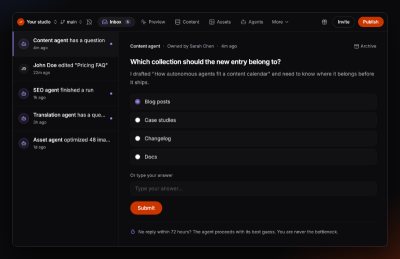
By delegating the 80% to agents, companies can theoretically reclaim thousands of hours of developer time. However, this requires a fundamental shift in how we build and manage software. It moves the job description of a web developer from "builder of static pages" to "architect of autonomous agents."
Implications for the Workforce:
- Trust-based Delegation: Instead of a binary "on/off" switch for autonomy, teams must treat agents as junior employees. You start by assigning them low-risk, rule-based tasks and, as they demonstrate reliability, grant them more autonomy.
- Auditability as a Requirement: The primary feature of any successful autonomous web platform is not the "fix," but the "log." Users need to see exactly what an agent changed, why it changed, and have the ability to revert it.
- The End of the "Set and Forget" Mentality: Organizations must stop viewing a website launch as a project with a fixed end date and start viewing it as a living product that requires continuous stewardship.
The Path Forward: Designing for Collaborative Autonomy
The future of the web lies in a "human-in-the-loop" model. In this framework, the agent acts as a force multiplier. It does the heavy lifting—cleaning up the code, verifying standards, and maintaining performance—while the human creative leads set the guardrails.
This approach solves the "frozen site" risk. In a world of autonomous agents, a website does not fall behind because the team is too busy; it stays current by default. The agent is always on, always watching, and always refining.
Moving Beyond the Toggle
The realization that the "line" between automation and human control is personal means that software must move away from universal settings. Future platforms will likely allow users to "compose" their agents. One team might have an aggressive SEO agent that updates keywords daily, while keeping their content agent on a strictly "read-only" basis.
The goal is to move the human intervention point further up the value chain. By eliminating the manual labor of web maintenance, teams can refocus on the only thing that truly matters: the user experience and the brand narrative.
Conclusion: The Choice Between Decay and Evolution
The fear that an agent will "change something it shouldn’t" is valid, but it ignores the greater danger: a site that remains stagnant while the world accelerates. A frozen website is, in effect, a shrinking asset.
As we move deeper into this new era, the most successful organizations will be those that embrace the nuance of autonomy. They will learn to distinguish between the chores that hold them back and the creative decisions that define their brand. By building systems that allow for this collaborative, tiered approach to autonomy, we can finally break the cycle of the launch-day peak and the long, slow drift into obsolescence. The website of the future will not be "built"; it will be grown.