










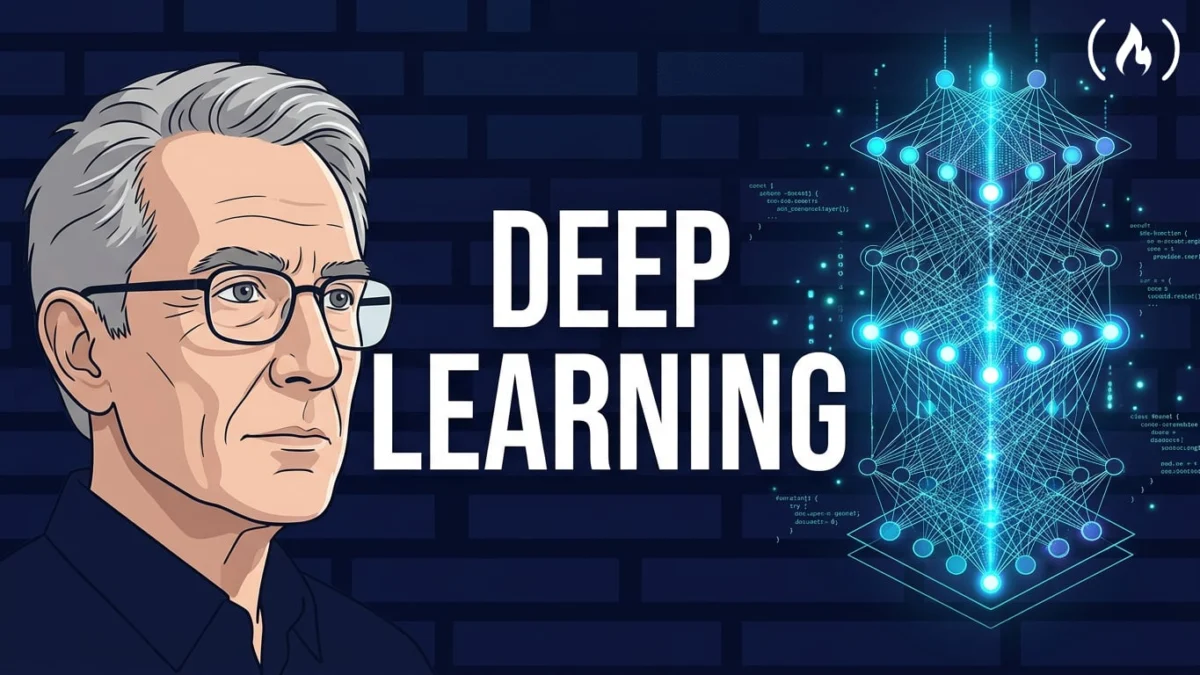
In the fast-paced world of artificial intelligence, where breakthrough models are announced seemingly by the week, it is easy to forget that today’s generative giants—from large language models to complex computer vision systems—are built upon decades of foundational research. Much of this theoretical bedrock can be traced back to one man: Geoffrey Hinton, widely celebrated as the "Godfather of AI."
To bridge the gap between historical theory and modern implementation, freeCodeCamp has released an exhaustive, 27-hour masterclass on its YouTube channel. Taught by instructor Mohammed Abrah, the course invites developers, researchers, and AI enthusiasts to journey through the decades by recreating the most groundbreaking discoveries in neural network history. Rather than merely consuming high-level summaries, students dive deep into Hinton’s seminal research papers, understanding the original motivations, untangling the mathematical theories, and translating those concepts into functional PyTorch code.
This article explores the landscape of this monumental course, detailing the chronological evolution of deep learning, examining the core pillars of Hinton’s contributions, and analyzing the profound implications this hands-on educational approach holds for the future of AI development.
Main Facts: Deconstructing the 27-Hour Masterclass
The newly launched curriculum represents one of the most ambitious open-access educational resources dedicated to neural network architecture. Spanning a massive 27 hours of instruction, the course is structured to provide both historical context and practical, code-level execution.
At its core, the masterclass focuses on the papers and architectural milestones that transformed artificial intelligence from a stagnant academic theory into a dominant technological force. Instructor Mohammed Abrah breaks down each major milestone using a rigorous, multi-step pedagogical framework:
- The Historical Motivation: Understanding the specific bottlenecks or theoretical limitations of the era that prompted the research.
- The Core Problem: Defining the exact computational or mathematical hurdle researchers faced.
- The Breakthrough Idea: Analyzing the novel hypothesis or architecture introduced in Hinton’s landmark papers.
- Hands-On Implementation: Bridging the abstract theory to reality by writing clean, educational PyTorch code from scratch.
By pairing historical study with hands-on coding, the course ensures that learners do not just understand what a neural network does, but why it is designed that way, and how decades-long incremental improvements compounded to create the AI revolution we witness today.
Chronology of a Revolution: From Boltzmann Machines to the Forward-Forward Algorithm
To truly appreciate modern AI, one must understand the tortuous path neural networks took to gain prominence. The freeCodeCamp course maps this journey chronologically, capturing the setbacks, winter periods, and triumphant breakthroughs that defined Hinton’s career.
1. The Early Foundations: Boltzmann Machines and Backpropagation
In the early days of connectionism, training multi-layer networks efficiently was an elusive goal. The introduction of Boltzmann Machines—stochastic recurrent neural networks composed of symmetrically connected neurons—offered a way to solve difficult combinatorial problems through energy-based modeling.
Simultaneously, while backpropagation (the foundational algorithm for training neural networks by calculating gradients of the loss function) was not invented single-handedly by Hinton, his co-authorship of the landmark 1986 paper ("Learning representations by back-propagating errors") proved instrumental in popularizing it. The masterclass revisits these foundational mechanics, demonstrating how errors are propagated backward through layers to adjust weights.
2. Overcoming the Winter: Deep Belief Networks and Unsupervised Pre-training
By the late 1990s and early 2000s, support vector machines (SVMs) and kernel methods largely overshadowed neural networks because deep networks were notoriously difficult to train—suffering from vanishing and exploding gradients.
The tide turned in 2006 when Hinton, along with his colleagues, introduced Deep Belief Networks (DBNs). By utilizing unsupervised greedy layer-wise pre-training (often leveraging Restricted Boltzmann Machines), they successfully initialized weights in a meaningful region of the parameter space before fine-tuning them with backpropagation. This breakthrough effectively launched the "Deep Learning Era," proving that deep architectures could indeed be trained effectively.
3. The Computer Vision Boom: AlexNet and the ImageNet Triumph
The watershed moment for deep learning in industry arrived in 2012 with AlexNet. Designed by Alex Krizhevsky, Ilya Sutskever, and Geoffrey Hinton, this deep convolutional neural network pulverized the competition in the ImageNet Large Scale Visual Recognition Challenge.
The course dedicates significant time to analyzing the architecture of AlexNet, highlighting the use of GPUs for parallel training, Rectified Linear Units (ReLU) to accelerate convergence, and Dropout regularization to prevent overfitting. Recreating AlexNet in PyTorch gives students a firsthand look at the engineering decisions that made modern computer vision possible.
4. Refining the Craft: Regularization, Normalization, and Compression
As networks grew deeper and wider, new challenges emerged, primarily overfitting and computational inefficiency. The masterclass covers crucial stabilization and optimization techniques developed or championed during this era:
- Dropout: A regularization technique where randomly selected neurons are ignored during training, forcing the network to learn robust, redundant features.
- Layer Normalization: A method to normalize the inputs across the features for each training point, stabilizing the training of recurrent and deep neural networks.
- Knowledge Distillation: A model compression technique where a smaller "student" network is trained to reproduce the behavior of a larger, cumbersome "teacher" ensemble, democratizing deployment on edge devices.
- Capsule Networks: Hinton’s ambitious attempt to overcome the limitations of traditional CNNs regarding spatial hierarchies and viewpoint invariance by introducing "capsules" of neurons.
5. The Horizon: The Forward-Forward Algorithm
In recent years, Hinton has questioned whether standard backpropagation is biologically plausible. Brains, after all, do not maintain a global backward pass of exact error gradients.
The masterclass culminates in an exploration of the Forward-Forward Algorithm, Hinton’s proposed alternative to backpropagation. Instead of alternating between a forward pass and a backward pass, the algorithm replaces them with two forward passes: one with positive (real) data and one with negative (generated or corrupted) data. This cutting-edge topic challenges students to think beyond standard paradigms and glimpse the potential future of neural network training.
Supporting Data: The Anatomy of the 27-Hour Curriculum
Designing an educational resource of this magnitude requires a careful balance of breadth and depth. To understand the scale of what Mohammed Abrah and freeCodeCamp have assembled, consider the structural breakdown of the course:
- Total Duration: 27 hours of comprehensive video instruction.
- Framework Used: PyTorch, the premier open-source machine learning library favored by both academic researchers and industrial giants.
- Core Papers Covered: Over a dozen defining research papers spanning four decades of AI research.
- Target Audience: Intermediate to advanced developers, machine learning engineers, and computer science students looking to elevate their theoretical foundation and practical coding prowess.
The Pedagogical Value of Reimplementation
Many developers learn deep learning by importing high-level libraries like torch.nn or using pre-built APIs, treating neural networks as black boxes. By contrast, this course demands that students build foundational architectures from the ground up.
By writing the math out in PyTorch tensors, learners encounter the same numerical instabilities, dimension-matching errors, and optimization hurdles that historical researchers faced. This granular approach bridges the gap between reading a PDF of a 1980s research paper and deploying a production-ready model today.
Official Perspectives and Industry Implications
The release of this masterclass arrives at a fascinating inflection point in technology. Geoffrey Hinton recently made global headlines when he stepped down from his role at Google to speak more freely about the existential risks of artificial intelligence—a move that culminated in his sharing of the 2024 Nobel Prize in Physics for foundational discoveries and inventions that enable machine learning with artificial neural networks.
Despite his warnings regarding the societal impacts of advanced generative models, Hinton remains deeply passionate about the underlying science of learning systems. Educational initiatives like the freeCodeCamp masterclass align with the broader scientific ethos of open-source knowledge sharing.
Why This Matters for Modern Developers
In an industry fixated on prompt engineering and fine-tuning off-the-shelf Large Language Models (LLMs), a dangerous skills gap has emerged. Many practitioners understand how to call an API or load a Hugging Face model, but few understand the underlying mechanics of gradient descent, weight initialization, regularization, or alternative training paradigms.
This masterclass serves as an antidote to superficial technical knowledge. By tracing the historical progression of neural networks, developers gain:
- First-Principles Thinking: The ability to diagnose model failure not by trial and error, but by understanding the mathematical and structural constraints of the architecture.
- Innovation Capability: Familiarity with alternative approaches (like the Forward-Forward Algorithm or Capsule Networks) that may spark the next wave of AI architectures outside the transformer monopoly.
- Debugging Mastery: A deep, intuitive sense of how tensor operations behave across layers, making the tuning of complex modern models significantly more intuitive.
Conclusion: Bridging Past Innovation to Future Frontiers
Artificial intelligence is advancing at a breathtaking pace, yet it rests entirely upon the shoulders of foundational giants like Geoffrey Hinton. The freeCodeCamp 27-hour deep learning masterclass is much more than a coding tutorial; it is a historical archive brought to life through code.
By challenging learners to recreate Boltzmann Machines, master backpropagation, implement AlexNet, and explore the Forward-Forward Algorithm in PyTorch, instructor Mohammed Abrah has created an invaluable bridge between yesterday’s theoretical breakthroughs and tomorrow’s engineering challenges.
For anyone serious about mastering artificial intelligence—not just as a user of tools, but as an architect of the technology—this 27-hour journey offers a masterclass in first-principles thinking. The complete course is available now on the official freeCodeCamp.org YouTube channel, ready to transform how a new generation of developers understands the mind of machines.



