










By Anand Kalyanaraman
Edited by Amulya Hiremath
Introduction: A Tale of Two Banking Giants
For years, the narrative governing India’s financial sector felt like an immutable law of nature: HDFC Bank was the undisputed darling of the stock market, an elite private-sector compounder delivering steady, predictable growth that left public-sector lenders in the dust. Meanwhile, the State Bank of India (SBI)—the behemoth of public-sector banking—was frequently dismissed as a lumbering giant, weighed down by legacy operational structures, bureaucratic inertia, and cyclical asset quality headaches.
Today, that narrative has been turned completely on its head.
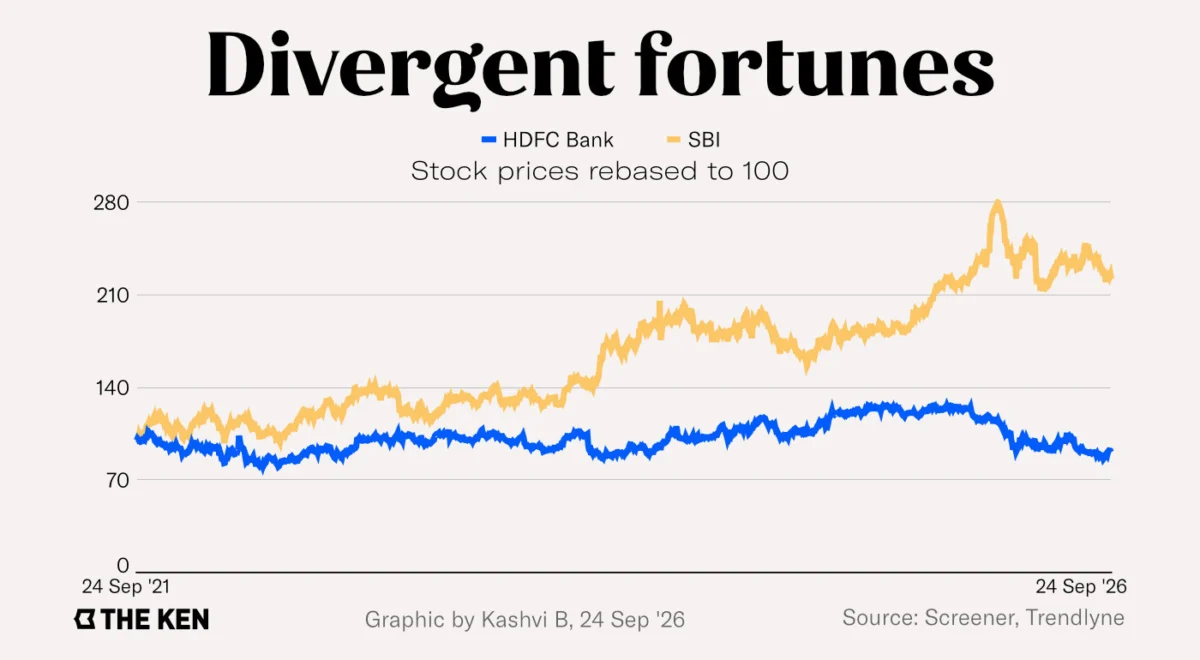
In a dramatic reversal that has caught institutional investors and retail wealth managers alike by surprise, HDFC Bank’s once-unassailable market dominance has faced a grueling reality check. Hit by a massive correction following its mega-merger and grappling with multi-year negative returns, India’s largest private lender has seen its towering valuation advantage evaporate. On the other side of the ledger, SBI has mounted a dream rally, defying historic market prejudices to close the valuation gap at a breath-taking pace.
As HDFC Bank prepares to crown a new chief executive to succeed Sashidhar Jagdishan, the market has offered a tentative sigh of relief. But beneath the temporary euphoria of a modest stock bounce lies a deeper, more profound structural evolution in India’s banking hierarchy.

Main Facts: The Numbers Behind the Divergence
The shifting fortunes of India’s two premier lending institutions are starkly visible when examining market performance across multiple time horizons:
- The Immediate Pop: Over a fortnight leading up to the narrowing down of candidates to succeed Sashidhar Jagdishan, HDFC Bank shares ticked up by roughly 6%. Investors interpreted the impending leadership transition as a potential catalyst to steady a drifting ship.
- The Near-Term Correction: Zoom out slightly, however, and that 6% gain looks microscopic. Since January, HDFC Bank’s stock has suffered a harrowing correction, hammered down by nearly 30% as the bank struggled with post-merger deposit mobilisation, compressed net interest margins (NIMs), and tightening liquidity conditions.
- The Long-Term Drag: Looking across a three-to-five-year lens reveals an even more sobering truth for long-term investors. HDFC Bank, once billed as an eternal market favourite that could do no wrong, has actually delivered negative returns: down 5% over three years and down 9% over five years.
- SBI’s Relentless Ascent: Conversely, SBI has been on an extraordinary multi-year tear. Despite giving up roughly a fifth of its peak gains since February, the public-sector titan has more than doubled in value over a five-year period, surged over 60% across three years, and maintained positive returns across almost every intermediate timeframe.
This stark divergence in path and price action has radically reconfigured the valuation landscape. In 2021, the market capitalisation gap between HDFC Bank and SBI stood at a formidable chasm of more than Rs 4 lakh crore. Even when the massive lending entity HDFC Ltd. officially merged into HDFC Bank in 2023—propelling the combined bank’s valuation to new heights—that gap briefly ballooned to nearly Rs 6 lakh crore.
Today? That differential has sharply shrunk to just Rs 2.2 lakh crore, bringing the country’s largest private and public sector banks closer in market value than they have been in decades.
Chronology of Events: From Merger Mania to Market Reality
To understand how India’s banking heavyweight stumbled while its public-sector counterpart surged, one must trace the timeline of key strategic pivots and economic headwinds over the past half-decade.
1. The Pre-2021 Golden Era
HDFC Bank enjoyed an uninterrupted run as the gold standard of Indian banking. Powered by rigorous credit underwriting, a low-cost retail deposit franchise (Current Account Savings Account, or CASA), and aggressive geographic expansion, the stock compounded wealth reliably, earning a premium valuation (often trading at over 3 to 4 times price-to-book) that few peers could dream of matching.

2. The Mega-Merger (2022–2023)
The strategic decision to merge the parent mortgage giant Housing Development Finance Corporation (HDFC Ltd.) with HDFC Bank was billed as a masterstroke designed to create a domestic financial superpower capable of funding massive infrastructure and corporate credit demands. However, the sheer scale of the integration introduced massive structural complexities.
Absorbing a balance sheet laden with long-term, lower-yielding wholesale mortgages without an immediate, matching low-cost retail liability base strained HDFC Bank’s financial metrics. The bank suddenly found itself burdened with an inflated asset base, a temporarily diluted capital adequacy ratio, and an arduous transition period to meet stringent reserve requirements (CRR and SLR) without destabilising its core lending margins.
3. The Deposit Squeeze (2023–2024)
As system-wide credit growth outpaced deposit generation across the Indian banking sector, HDFC Bank—like its peers—faced intense competition for retail savings. However, due to its massive post-merger size, the pressure to maintain and grow its deposit base forced the bank to offer higher interest rates on term deposits. This aggressive pursuit of liabilities squeezed its Net Interest Margins (NIMs), frustrating investors accustomed to industry-leading profitability metrics.
4. SBI’s Quiet Turnaround (2021–2025)
While HDFC Bank wrestled with integration pangs, SBI was quietly cleaning up its balance sheet. Having successfully navigated the legacy cycle of corporate Non-Performing Assets (NPAs) and aggressive provisioning, SBI emerged with a remarkably clean book. Backed by an unmatched sovereign-backed trust and a sprawling rural and semi-urban branch network, SBI capitalised on the broader corporate credit revival in India. Its lower relative valuation provided a comfortable margin of safety for institutional buyers, fueling a sustained, multi-year re-rating.
5. The Leadership Transition (Late 2025–Present)
With current CEO Sashidhar Jagdishan nearing the end of his tenure, the race to find a successor has become a critical focal point for market sentiment. The recent 6% bump in HDFC Bank’s stock reflects the Street’s hunger for strategic clarity, operational reinvigoration, and a renewed roadmap to revive growth.

Supporting Data and Financial Metrics
A comparative look at the financial mechanics underpinning HDFC Bank and SBI highlights the fundamental shifts driving their market valuations:
- Valuation Multiples: HDFC Bank has historically traded at a rich valuation premium due to its superior return on assets (RoA) and return on equity (RoE). However, as post-merger earnings growth plateaued and margins compressed, this valuation premium began to contract. SBI, trading at much more modest price-to-book multiples during its turnaround phase, offered significantly higher headroom for capital appreciation.
- Asset Quality and Credit Costs: SBI’s Gross NPA ratios, which historically plagued public sector banks, dropped to multi-year lows, approaching parity with some private sector peers. Meanwhile, HDFC Bank’s credit-deposit (CD) ratio crept upward post-merger, highlighting the challenge of deploying capital efficiently without compromising underwriting standards.
- Market Capitalisation Convergence: The narrowing of the valuation gap to Rs 2.2 lakh crore underscores a broader democratisation of market confidence. Investors are no longer willing to blindly penalise public-sector banks simply on account of their ownership structure, nor are they willing to grant private-sector entities an infinite grace period when growth metrics stutter.
Official Responses and Market Reactions
Market analysts, institutional investors, and banking sector observers have weighed heavily on the shifting dynamics between the two banking behemoths.
- On the Leadership Transition: Financial analysts note that while a new CEO brings psychological comfort to equity holders, the challenges facing HDFC Bank are structural rather than purely executive. "A leadership change sets the tone, but the fundamental mechanics of deposit mobilisation, asset-liability management, and margin defence will dictate the stock’s medium-term trajectory," notes a senior institutional equities researcher.
- On SBI’s Resurgence: Public sector banking proponents argue that SBI’s performance is a testament to structural reforms enacted over the past decade. By fortifying balance sheets and leveraging technology to improve operational efficiency, SBI has effectively shaken off the "PSU discount" that historically dragged down its equity valuation.
- On the End of Extreme Polarization: Market commentators suggest that the convergence of valuations indicates a maturing Indian stock market. Investors are increasingly evaluating banks on current execution, capital efficiency, and sustainable deposit franchises rather than relying solely on historical brand reputation or sector tags (private vs. public).
Implications: What This Means for the Future of Indian Banking
The convergence of HDFC Bank and SBI’s market capitalisations—and the stark divergence in their recent stock trajectories—carries profound implications for the broader Indian financial ecosystem:
- The Death of the "Private Bank Premium" Blindspot: For years, institutional portfolios operated on the heuristic that any private bank was inherently superior to any public sector bank. The struggles of HDFC Bank post-merger and the stellar outperformance of SBI prove that execution, balance sheet hygiene, and macro-economic positioning matter far more than corporate lineage.
- Deposit Franchise as the Ultimate Moat: Both banks serve as a microcosm of the broader liquidity crunch facing Indian lenders. In an era where credit demand outstrips household financial savings growth, institutions with sticky, granular, low-cost deposit bases will dictate market leadership. The bank that successfully solves the deposit-cost equation under its new leadership will command the next structural bull run.
- Re-evaluating Systemic Risk and Scale: Mega-mergers are notoriously difficult to digest. HDFC Bank’s experience serves as a cautionary tale for financial conglomerates pursuing growth purely through inorganic consolidation. Scale brings systemic importance, but it also introduces operational friction that can paralyze agile decision-making.
- Outlook for Investors: As HDFC Bank prepares to turn the page with a fresh chief executive and SBI consolidates its hard-won market gains, the era of easy, predictable compounding has given way to a more nuanced, highly competitive banking battleground. Investors can no longer rely on set-and-forget strategies; instead, they must closely monitor margin pressures, credit-deposit ratios, and retail liability mobilisation across both institutions.
Conclusion
HDFC Bank’s losing streak and SBI’s dream rally may have temporarily converged to narrow the valuation gap to Rs 2.2 lakh crore, but the race for banking supremacy in India is far from over. As the dust settles on one of the most tumultuous chapters in Indian banking history, the upcoming leadership transition at HDFC Bank will test whether the private sector pioneer can reclaim its crown, or if SBI’s public-sector renaissance has permanently rewritten the rules of the game.



