










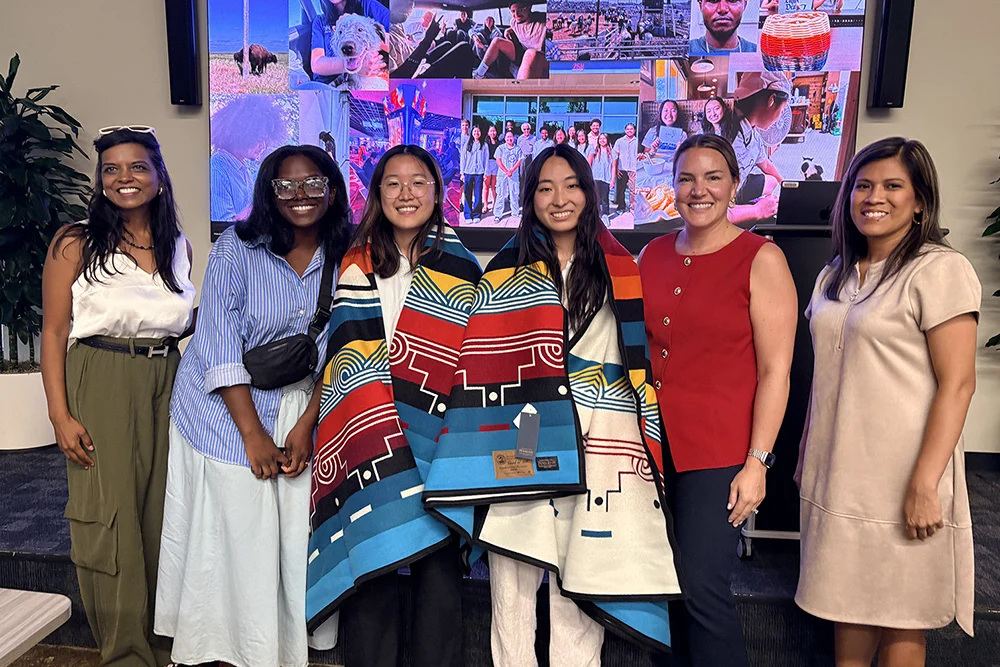
When Daphne Wang, a mechanical engineering student at the Massachusetts Institute of Technology (MIT), arrived in Tulsa, Oklahoma, last summer for an internship with the Muscogee (Creek) Nation Department of Health, she arrived with a specific expectation: she would be writing code. She anticipated long hours in front of a terminal, debugging software, and optimizing algorithms.
Instead, she found herself in a deep-dive exploration of tribal history, maternal health data governance, and the profound ethical implications of technical innovation within sovereign nations. "I learned so much that I think should be required curriculum for every single person in this country," Wang reflects. "I think ‘tech for good’ is genuinely getting out into communities and learning about people who aren’t you, creating worldly perspectives that you ultimately can take into everything else that you do."
Wang’s experience is not an anomaly; it is the heartbeat of Code.Tulsa, an immersive summer program facilitated by MIT’s PKG Center for Social Impact. By placing elite engineering students in the heart of Native American communities, the program is attempting to solve a fundamental problem in modern education: the detachment of technical skill from human empathy.
The Confluence of Code and Culture: Main Facts
Code.Tulsa is a collaborative initiative currently in its second year. Funded by the Patrick J. McGovern Foundation and the George Kaiser Family Foundation, the program brings ten MIT undergraduates to Tulsa for an intensive summer experience. The students live at the University of Tulsa and embed themselves within the Muscogee and Cherokee Nations, as well as local grassroots organizations like Black Tech Street and the Urban Coders Guild.
The projects are as diverse as the students themselves, ranging from artificial intelligence implementation and data science to community-focused infrastructure projects. However, the technical output is only half the story. The program mandates that students engage with the cultural, historical, and governance contexts of the communities they serve. As Alison Badgett, Director of the PKG Center, puts it: "Our aim is to help students integrate an engineer’s approach to problem-solving with a humanist lens on the nature of social challenges, and by extension, interventions."
A Chronology of Impact: From Concept to Classroom
The genesis of Code.Tulsa is a testament to the power of student-led advocacy. The program was the brainchild of Jack Carson, an electrical engineering and computer science (EECS) student at MIT. As a member of the Cherokee Nation and a native of Tulsa, Carson recognized a persistent disparity: rural Native students, who possess immense potential and a strong desire to uplift their communities, often lack the infrastructure and access required to pursue advanced STEM education.
2023–2024: Building the Infrastructure
- Conceptualization: Carson approached the PKG Center during his first year, proposing a bridge between MIT’s technical resources and the needs of his home community.
- Curriculum Development: Recognizing that technical skills require pedagogical support, Carson partnered with Harvard student Allie Zong to create the Tulsa Advanced Sciences Camp (TASC).
- The Inaugural Camp: The team designed a rigorous weeklong camp for high schoolers from federally recognized tribes, covering AI, DNA technology, physics, chemistry, and energy.
- Scaling and Refining: By the second year, the program solidified its internship pipeline, with interns serving as both technical contributors and camp instructors, creating a cycle of mentorship.
Supporting Data: The Case for Maternal Health
One of the most significant projects facilitated by Code.Tulsa involved Daphne Wang and her colleague, Lucy Sun, an AI and decision-making major. The two were tasked with supporting the Muscogee Nation’s first Pregnancy Risk Assessment Monitoring System (PRAMS) survey.
The project required a sophisticated balance of skills. It was not merely a data collection task; it involved:
- Literature Review: Synthesizing existing health data specific to Muscogee women.
- Governance Mapping: Navigating the complexities of data sovereignty, ensuring that the Muscogee Nation maintained control over its sensitive medical information.
- Survey Design: Drafting questions that were culturally resonant and statistically meaningful.
The impact of this work was immediate. Breanna McNaughton-Long, an epidemiologist with the Muscogee Nation and supervisor to the interns, noted that the speed and quality of the students’ contributions were "instrumental." She added, "They brought this sense that we were doing something that mattered. They did work that we wouldn’t have been able to do as quickly on our own."
Official Responses and Philosophical Shifts
The integration of humanities into STEM education has sparked a profound change in the students themselves. Chenise Harper, an electrical engineering major who interned with the Urban Coders Guild, candidly admits her previous distaste for history.
"I hated history," Harper says. "But I learned a lot about why it is useful for making social change and how to go about researching it. I now feel a lot more confident that I can make an impact."
This sentiment is echoed by the leadership of the Cherokee Nation. Principal Chief Chuck Hoskin Jr. emphasized the weight of this responsibility during his address to TASC campers: "Technology can be used for good, or it can be used for harm. Your generation has the opportunity to bend that arc toward something good."
Chief Hoskin praised the partnership as a "special relationship," highlighting how the reciprocal exchange—where MIT reaches out a hand of technology and the Cherokee Nation reaches back with guidance and culture—is the blueprint for future tribal-academic cooperation.
Implications: A New Model for STEM Education
The implications of Code.Tulsa extend far beyond the summer months. For the high school campers, the experience is transformative. Alyssa Theofanidis, a Cherokee Nation citizen and former camper-turned-teaching assistant, noted that the camp was the catalyst for her self-studying calculus. Others reported that the presence of diverse, brilliant mentors from MIT made them view their own potential through a wider lens.
The "Humanist Lens" as a Technical Skill
The most profound takeaway from the program is the shifting definition of what it means to be an "engineer." As Elvis Chipiro, a computer science and engineering junior, observed: "Social impact is not separate from mainstream technology; rather, it is embedded in the choices engineers make every day."
This philosophy challenges the traditional "siloed" approach to engineering education, where social context is treated as an afterthought. Instead, Code.Tulsa posits that:
- Responsibility is local: Technology should not be designed in a vacuum; it must be designed with the specific, lived experience of the end-user in mind.
- Mentorship is cyclical: By having MIT interns teach TASC campers, the program creates a sustainable pipeline of knowledge that empowers Native youth to lead their own technical future.
- Purpose fuels performance: When students connect their high-level technical work to the tangible well-being of a community, their academic stress is replaced by a sense of mission.
Conclusion: Designing for Inclusion
As Code.Tulsa continues to grow, it serves as a powerful model for how elite academic institutions can move beyond the "ivory tower." By facilitating a two-way street of learning—where MIT students gain cultural competency and tribal nations gain high-level technical support—the program is successfully rewriting the narrative of what STEM can achieve.
As Harper poignantly noted, many students arrive at institutions like MIT with a desire to help others, only to lose that focus under the weight of academic pressure. Code.Tulsa provides the vital reminder that technical prowess is most potent when it is paired with empathy, responsibility, and an unwavering commitment to the community. In the end, the success of these students will not be measured by the code they write, but by the systems they design with the people they serve at the very center.



