










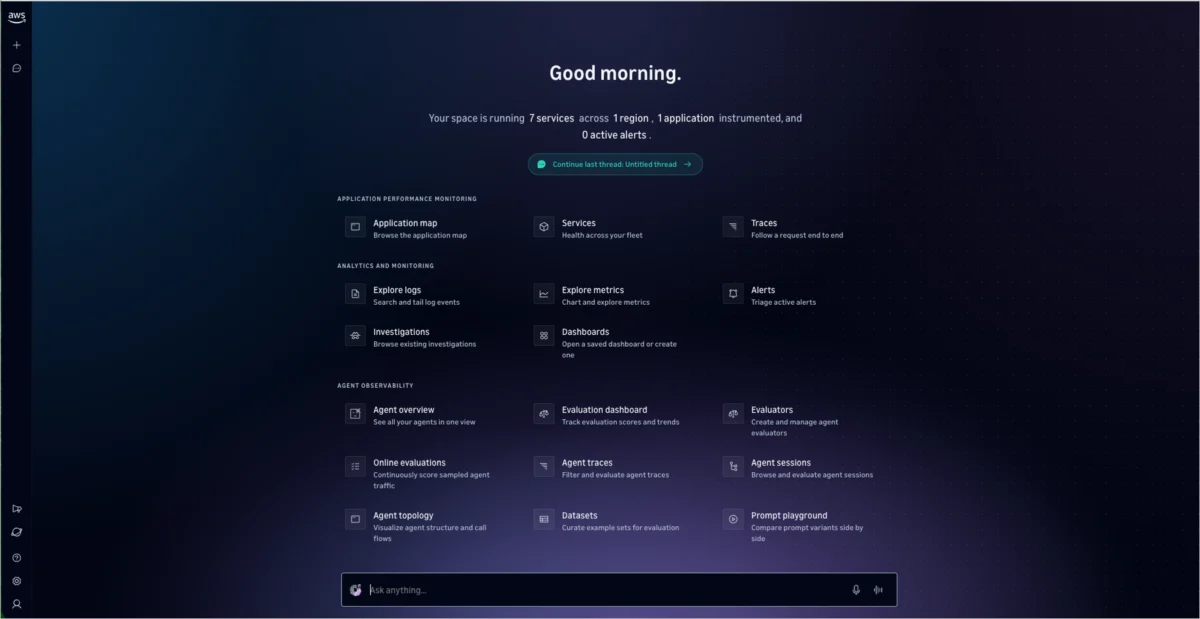
SEATTLE — In a major expansion of its cloud management and developer tooling portfolio, Amazon Web Services (AWS) has officially announced the general availability of Amazon CloudWatch Omni. Positioned as a unified, app-centric, and AI-powered observability solution, CloudWatch Omni is specifically engineered to address the complex monitoring, evaluation, and experimentation demands of modern cloud applications and autonomous AI agent workloads.
By bridging the traditional gap between development environments and production operations, CloudWatch Omni introduces a dual-surface architecture. It delivers a native developer experience directly inside integrated development environments (IDEs) like VS Code and Kiro, paired with a standalone, browser-based operational interface accessible via Single Sign-On (SSO) without requiring an AWS Management Console session.
The platform launches at a critical juncture for enterprise software development. As organizations increasingly deploy agentic AI systems—applications where Large Language Models (LLMs) make autonomous decisions, invoke external tools, and chain complex multi-step reasoning processes—traditional observability tools have proven fundamentally inadequate. CloudWatch Omni aims to solve these non-deterministic failure modes through open standards, built-in evaluators, and a comprehensive suite of developer-first features.
Main Facts: What Is Amazon CloudWatch Omni?
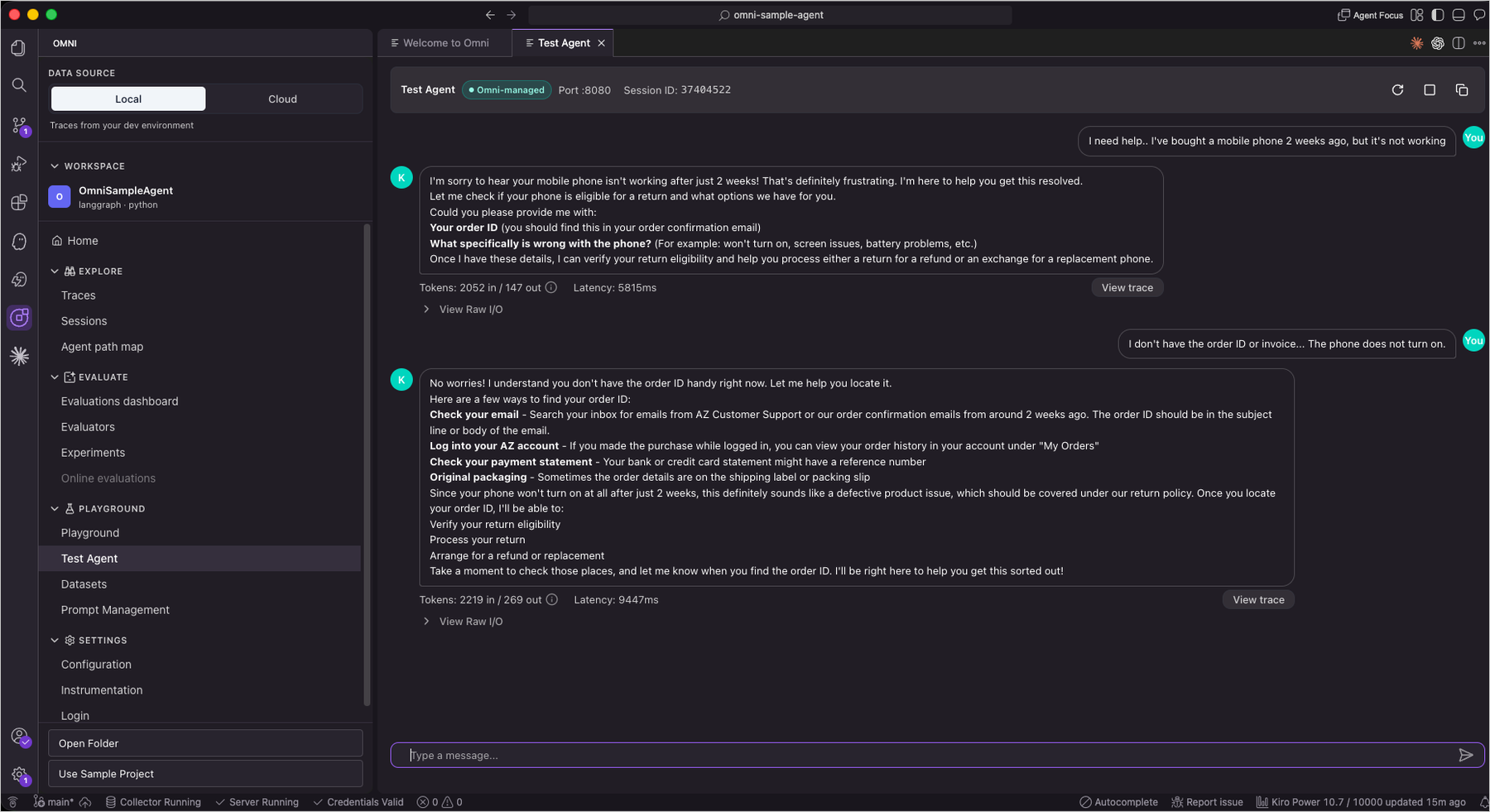
At its core, CloudWatch Omni is designed to provide end-to-end visibility, rigorous evaluation capabilities, and structured experimentation for AI agents and cloud applications. Unlike conventional Application Performance Monitoring (APM) tools that track basic metrics like CPU utilization, memory thresholds, and HTTP error rates, Omni looks deep inside the cognitive architecture of AI systems.
Key Pillars of CloudWatch Omni:
- App-Centric and AI-Powered: Designed from the ground up to monitor both traditional application code and complex, non-deterministic AI agent behaviors.
- Open Standards Foundation: Built natively on OpenInference and AWS Distro for OpenTelemetry (ADOT), ensuring compatibility across multiple model providers, frameworks, and runtimes without vendor lock-in or forced re-platforming.
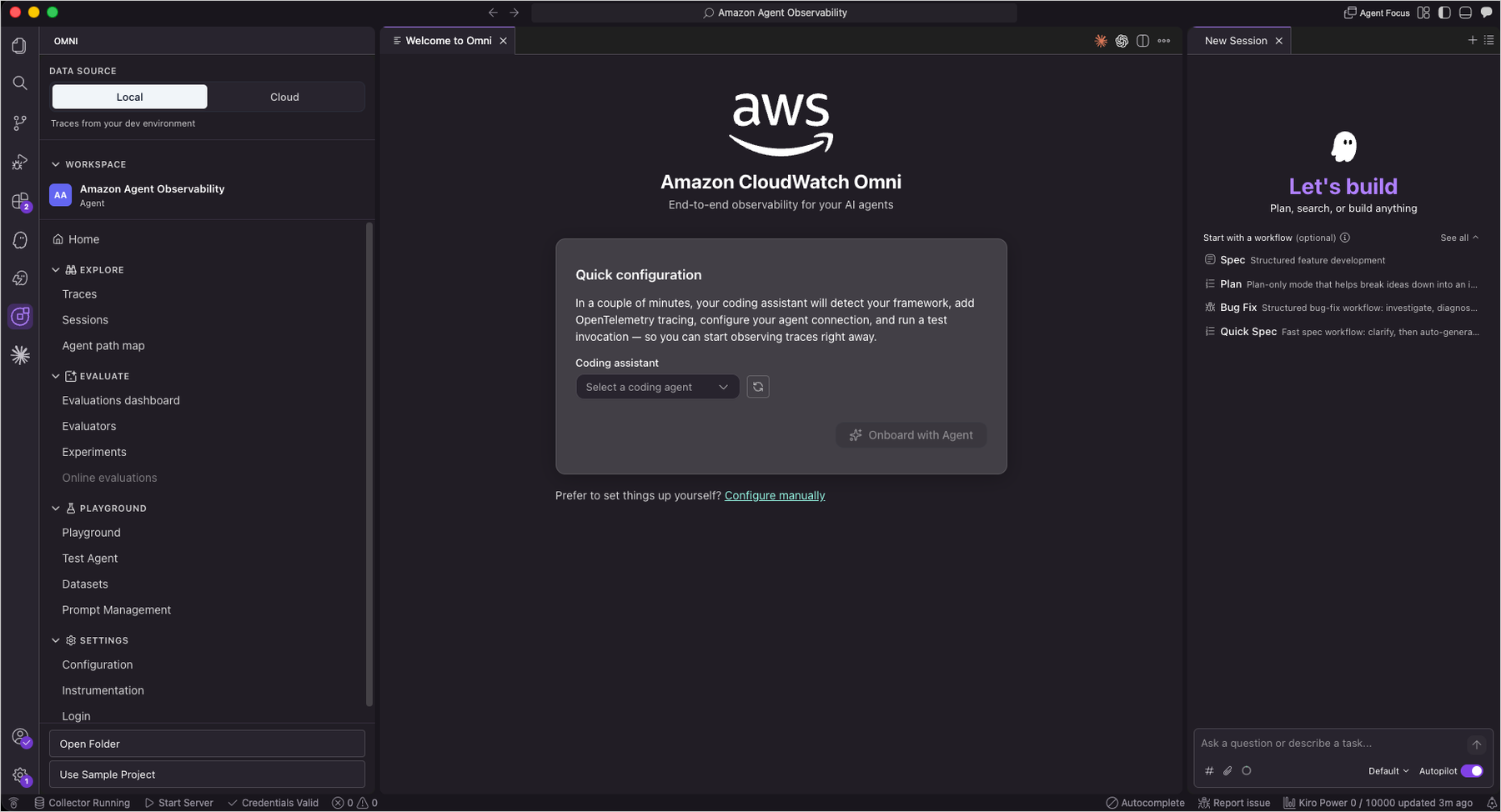
- Dual-Surface Delivery: Features a dedicated VS Code/Kiro IDE extension for developers to test and trace locally, alongside a collaborative web application for operations, fleet monitoring, and AI-driven investigations.
- Comprehensive Evaluation Suite: Includes 17 built-in evaluators measuring correctness, coherence, helpfulness, faithfulness, and routing accuracy, supplemented by support for third-party tools like AutoEval and DeepEval.
- Flexible Cloud Connectivity: Developers can utilize the platform entirely offline or locally during initial development, leveraging the "Cloud Login" feature to securely push telemetry data to Amazon CloudWatch for persistent storage, team sharing, and production monitoring when ready.
Chronology: The Evolution Toward Agentic Observability
The release of CloudWatch Omni reflects the rapid evolution of generative AI from static, single-prompt chat interfaces to highly dynamic, multi-agent systems capable of executing complex workflows.
The Rise of Non-Deterministic Challenges
Over the past two years, enterprise adoption of generative AI shifted dramatically. Organizations moved past basic Retrieval-Augmented Generation (RAG) models toward autonomous agents capable of selecting tools, writing code, and querying databases independently. However, developers quickly encountered severe operational bottlenecks.

Because agent behavior is non-deterministic, a minor tweak to a system prompt could severely degrade response quality even while standard software metrics showed zero errors. Engineers found themselves spending countless hours manually reviewing fragmented logs across disparate systems, trying to diagnose why an agent chose a specific tool path or hallucinated an incorrect response.
The Development of Omni
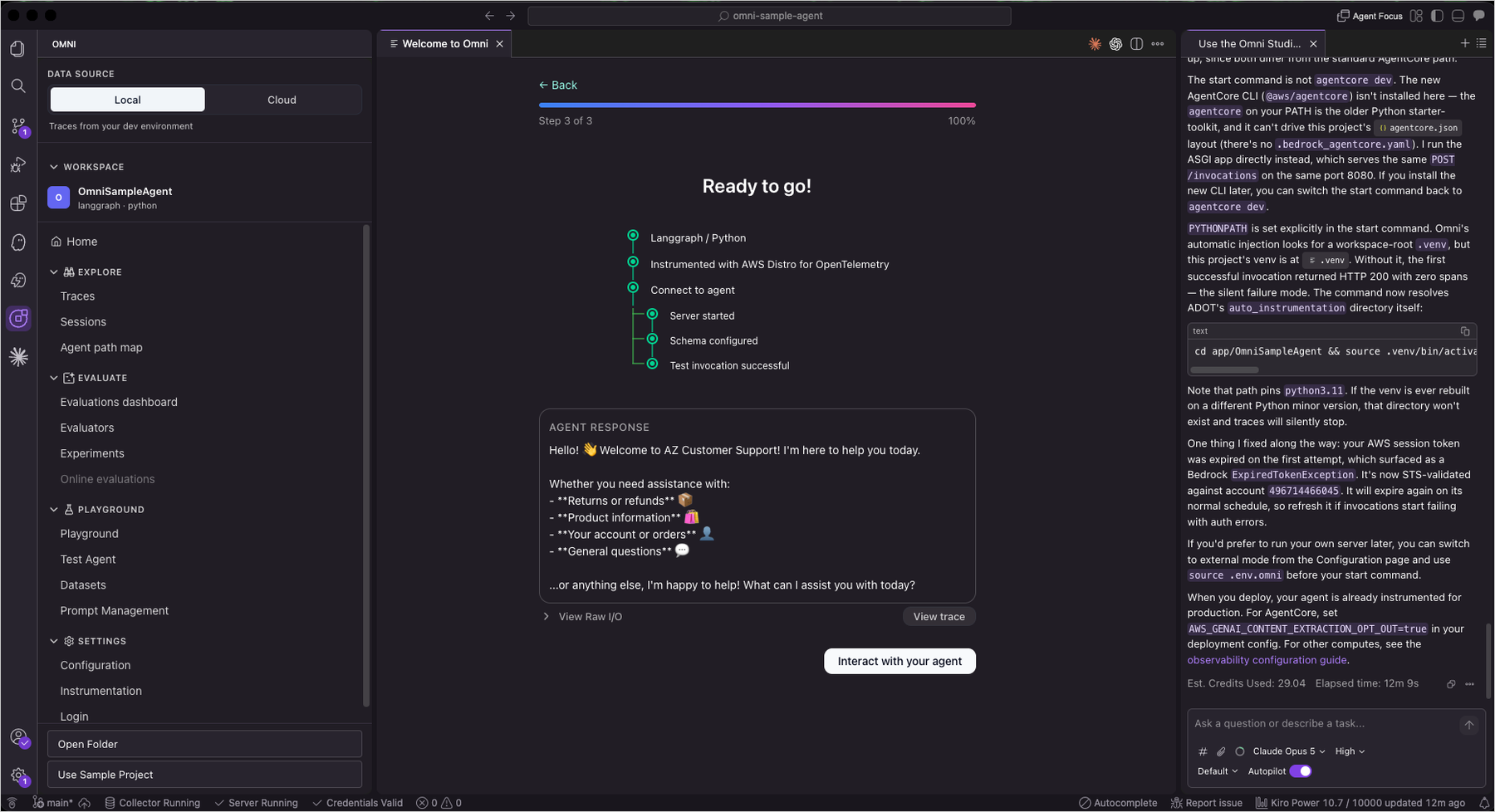
Recognizing that existing monitoring stacks forced developers into tedious context-switching between code editors and web dashboards, AWS engineers built CloudWatch Omni to integrate telemetry directly into the development workflow. By partnering with AI code assistants such as Kiro, Claude Code, and Codex, AWS streamlined the instrumentation process. Developers could now set up local development servers, inject OpenTelemetry traces, and launch interactive agent testing sessions in a matter of minutes.
General Availability
Today, CloudWatch Omni is globally available as a fully supported AWS service. The IDE extension is completely free to download from the Visual Studios Code Marketplace, requiring no initial AWS account creation or complex credential setups for local experimentation. Developers only need API keys or AWS Bedrock credentials when querying external LLM providers.
Supporting Data & Technical Architecture
CloudWatch Omni’s technical depth is highlighted by its robust instrumentation, visualization tools, and structured experimentation pipelines.
Deep Trace Visibility and Topology Mapping
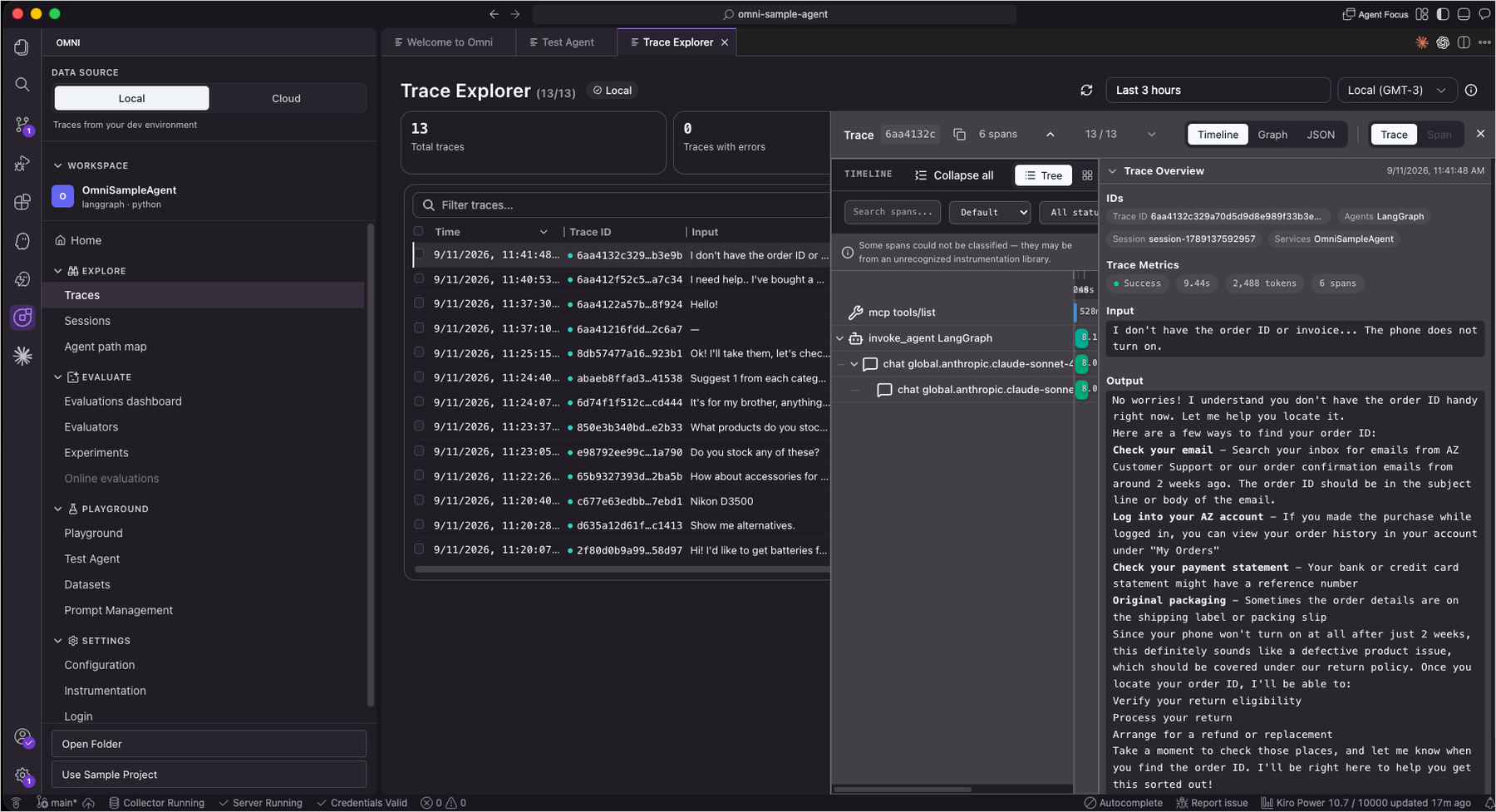
Traditional monitoring tracks a request from point A to point B. Agentic workflows, conversely, resemble dynamic decision trees. CloudWatch Omni captures every individual trace, logging LLM calls, prompt compositions, sub-agent handoffs, and tool invocations into a hierarchical timeline via the Trace Explorer.
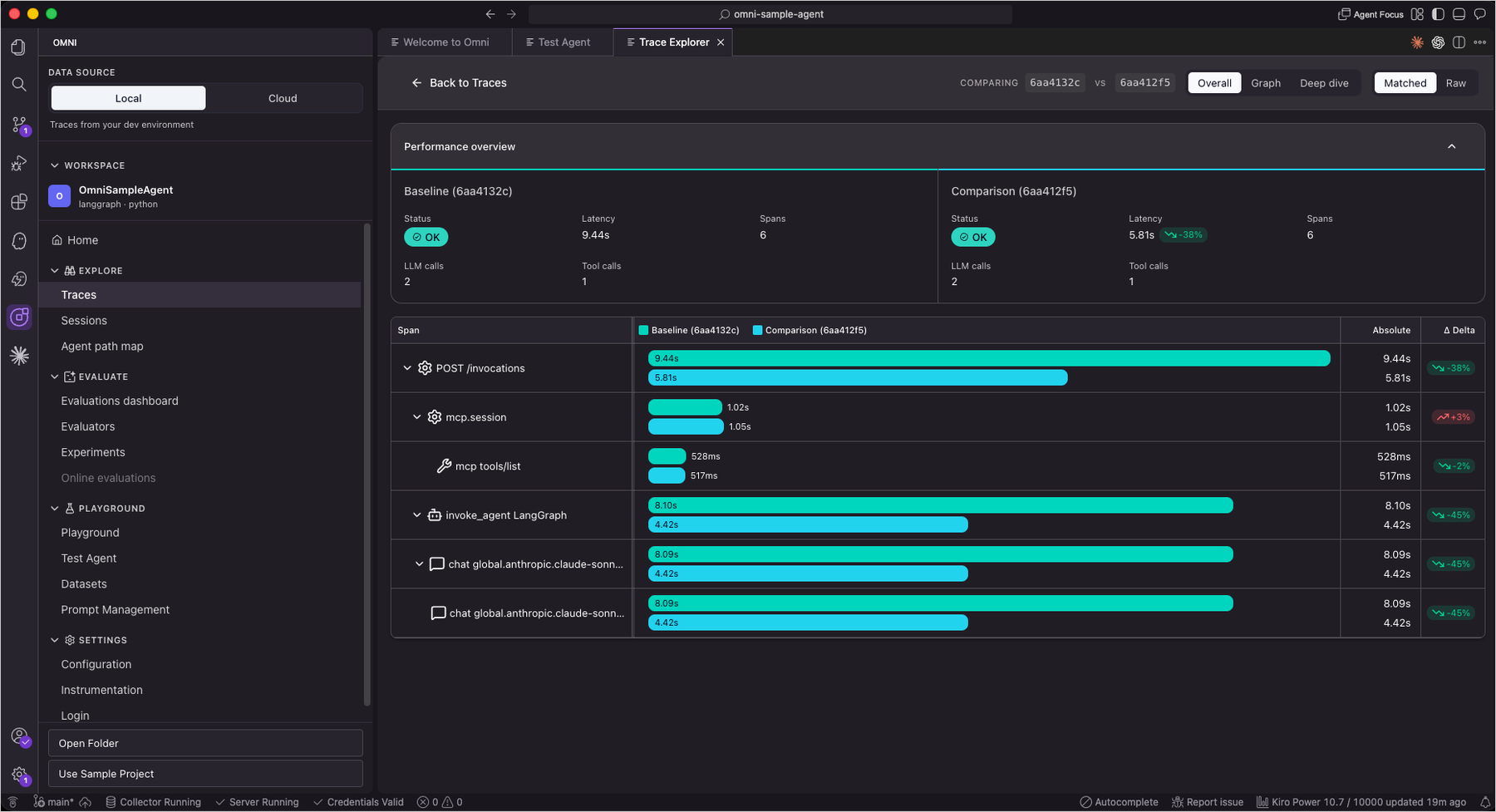
- Compare Mode: Allows engineers to place two distinct execution traces side by side to analyze how prompt variations or configuration changes alter agent behavior, proving invaluable during regression testing.
- Ask Assistant: An integrated AI analysis tool that parses complex traces to automatically answer diagnostic questions, such as "Why did the agent invoke this specific tool twice?"
- Agent Topology View: Visualizes the architectural layout of an agentic system, displaying sub-agents, interconnected tools, and dependencies, enabling teams to instantly isolate bottlenecks.
Evaluation and Golden Datasets
To bridge the gap between telemetry and actual user experience, Omni embeds 17 specialized evaluators. Developers can curate high-performing production interactions into golden datasets. Using the Experiments function, engineering teams can run these datasets against multiple agent variants simultaneously—evaluating scores, token consumption, and latency side-by-side to determine the optimal configuration before deploying to production.
Framework Compatibility
CloudWatch Omni avoids proprietary silos by natively integrating with the most popular agentic frameworks in both Python and TypeScript, including:
- LangChain and LangGraph
- CrewAI
- OpenAI SDK
- Strands
- Vercel AI SDK
- Amazon Bedrock AgentCore
Furthermore, because the platform relies on OpenInference and ADOT standards, telemetry data flows seamlessly regardless of whether agents run on AWS Lambda, Amazon ECS, Amazon EKS, or alternative cloud computing environments.
Official Responses and Industry Context
In introducing the platform, AWS product leadership emphasized the collaborative nature of modern software engineering and the unique hurdles posed by generative AI workloads.
"Organizations deploying agentic AI systems face observability challenges that traditional monitoring simply cannot address," noted Daniel Abib in the official AWS launch announcement. "Agent behavior is non-deterministic: a prompt change can degrade response quality even when standard metrics show no errors. With CloudWatch Omni, we are bringing the debugging experience directly to where developers write code, while giving operators a unified web dashboard to manage fleets securely and collaboratively."
Industry analysts have noted that as businesses transition from experimental AI proofs-of-concept to mission-critical production deployments, governance and reliability will become paramount. Solutions like CloudWatch Omni directly address enterprise demands for transparency, prompt version control, and auditable AI behavior—key requirements for industries operating under strict regulatory compliance frameworks.
Implications for Developers, Operators, and Enterprises
The launch of Amazon CloudWatch Omni carries profound implications for the software engineering landscape, fundamentally changing how teams build, test, and maintain AI-infused applications.
1. Elimination of Context Switching
By embedding the observability layer directly inside VS Code and Kiro, developers no longer need to jump between their IDE and browser-based monitoring dashboards to verify if a code change worked. Traces appear organically as the agent executes locally, radically accelerating the iteration loop.
2. Unified Collaboration Across Silos
Historically, developers and operations teams relied on entirely different toolsets and data sources. CloudWatch Omni bridges this divide: the exact trace a developer debugs locally in their IDE is the exact trace an operator investigates in the cloud-connected web console. This shared single source of truth minimizes miscommunication during incident response and debugging sessions.
3. Democratized Quality Assurance
By packaging sophisticated evaluation metrics (such as faithfulness, coherence, and routing correctness) into accessible out-of-the-box modules, Omni lowers the barrier to entry for rigorous AI testing. Teams no longer need to spend weeks engineering custom evaluation frameworks to understand the quality of their LLM outputs.
4. Enterprise-Grade Governance and Rollbacks
With features like Prompt Management, organizations maintain a clear historical ledger of prompt versions and model configurations. If a newly deployed prompt induces unexpected regressions or hallucinations in production, teams can execute rapid rollbacks backed by comprehensive session histories and automated regression test suites.
Getting Started
Developers eager to explore Amazon CloudWatch Omni can immediately install the free extension from the Visual Studio Code Marketplace. For teams ready to engage with cloud-native capabilities, the platform is fully documented on the AWS Builder Center and the official Amazon CloudWatch Technical Documentation pages. Additionally, developers can leverage the AWS MCP Server and associated plugins to interact with APIs, search technical documentation, and troubleshoot deployments using their preferred AI development assistants.



