










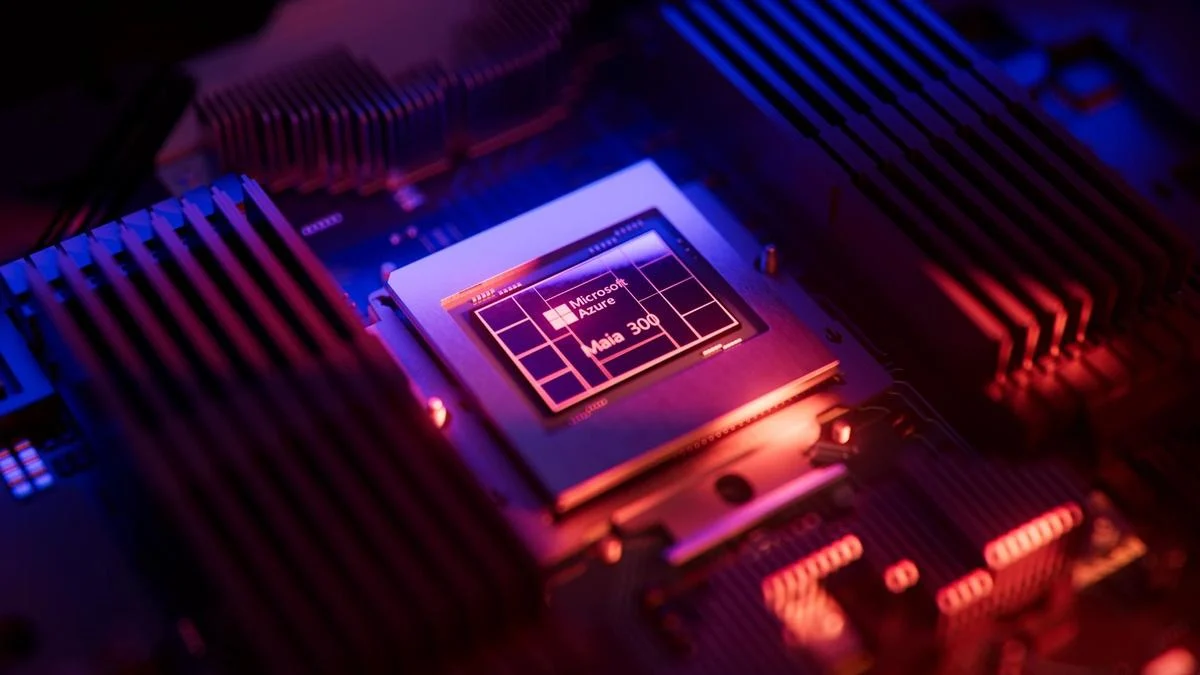
SAN FRANCISCO — In a landmark move poised to reshape the architecture of global cloud computing, Microsoft has officially unveiled the Maia 300, its third-generation custom artificial intelligence chip. Signaling a definitive shift toward hardware independence, the Redmond-based tech giant announced ambitious plans to deploy potentially more than one million units of the new silicon next year.
The rollout is designed to power Microsoft’s rapidly expanding suite of internal AI services, support its massive Azure cloud infrastructure, and handle the intensive computations required for advanced generative AI models. As Big Tech races to secure supply chains and optimize efficiency in the face of skyrocketing AI workloads, the Maia 300 stands as Microsoft’s most aggressive bid yet to loosen Nvidia’s historic stranglehold on the AI accelerator market.
1. Main Facts: Engineering the Maia 300
The Maia 300 is not merely an incremental upgrade over its predecessor; it represents a fundamental rethinking of how AI silicon is architected, manufactured, and deployed at scale. Designed specifically to handle heavy data-crunching tasks—such as automated coding, real-time reasoning, and executing complex, autonomous business workflows on a user’s behalf—the chip arrives as enterprises worldwide demand faster, more cost-effective AI inference and training.
Unlike traditional graphics processing units (GPUs) favored by market leaders like Nvidia—which typically rely on one massive, monolithic computing die surrounded by high-bandwidth memory (HBM)—Microsoft took a radically different technical path with the Maia 300.
At the heart of the Maia 300 silicon is a "chiplet" architecture. Instead of a single giant processor, the central computing engine is composed of multiple specialized smaller chips, or chiplets, bonded tightly together. For its core computing functions, Microsoft leveraged cutting-edge 2-nanometer (nm) technology from the Taiwan Semiconductor Manufacturing Company (TSMC). Meanwhile, other functional chiplets within the design utilize cost-effective 3-nanometer technology to manage peripheral tasks, such as high-speed data movement off the processor and routing information across the broader server system.
When packaged into server infrastructure, the scale of the deployment becomes clear. The Maia 300 processors are organized into dense server racks containing 96 chips, drawing approximately 167 kilowatts of power. For comparison, Nvidia’s recent GB300 AI server racks house 72 of its flagship GPUs and consume roughly 142 kilowatts.
Despite the higher raw power consumption per rack, Microsoft claims extraordinary efficiency gains. According to company metrics, the Maia 300 delivers approximately 40% more useful computing output per megawatt than unnamed "leading GPU-based systems," positioning efficiency, rather than raw brute-force power, as the chip’s primary competitive advantage.
2. Chronology: The Road to Custom Silicon
Microsoft’s journey from a software and cloud titan dependent on merchant silicon to a vertically integrated hardware designer has been methodical and swift.
- Early Reliance (Pre-2023): For years, Microsoft relied almost exclusively on commercial off-the-shelf GPUs—predominantly from Nvidia—to power its Azure cloud and its burgeoning partnership with OpenAI. However, supply chain bottlenecks, soaring procurement costs, and supply shortages during the generative AI boom catalyzed a strategic shift.
- The Genesis (Late 2023): Microsoft formally announced its silicon ambitions by introducing its first-generation AI accelerators, laying the groundwork for customized infrastructure tailored specifically to large language model (LLM) workloads.
- The Second Generation (2024–2025): The predecessor to the Maia 300 quietly entered production and deployment, successfully running Microsoft’s proprietary in-house AI models as well as pioneering OpenAI models delivered seamlessly through the Azure cloud platform.
- The Current Breakthrough (October 2026): Microsoft lifts the veil on the Maia 300. The company outlines a aggressive deployment timeline, targeting the integration of over a million units by next year as part of its multi-gigawatt data center expansion strategy.
3. Supporting Data: Financial Commitment and Power Metrics
The financial and operational scale of Microsoft’s hardware pivot is staggering. To support its next-generation AI infrastructure, Microsoft has projected capital expenditures exceeding $175 billion for the current calendar year, a significant portion of which is channeled directly into data center expansion, power procurement, and silicon engineering.
To understand the engineering trade-offs of the Maia 300, industry analysts have closely examined its power-to-performance ratio:
- Rack Configuration: 96 Maia 300 chips per rack.
- Power Draw: 167 kilowatts per rack (compared to 142 kW for Nvidia GB300 racks with 72 GPUs).
- Efficiency Metric: ~40% higher useful computing output per megawatt relative to standard market benchmarks.
- Deployment Scale: Potential deployment exceeding one million units next year, characterized by "multi-gigawatt deployments."
This focus on watts, dollars, and memory bytes is not accidental. As data center operators face severe constraints on electrical grid capacity globally, chips that deliver higher computational intelligence per watt are becoming the holy grail of modern cloud architecture.

4. Official Responses and Industry Perspectives
Leadership at Microsoft has emphasized that the Maia 300 is the physical embodiment of a whole-system optimization philosophy.
"It’s basically delivering more intelligence for every watt, every dollar, and every byte of memory by optimizing across the entire system," said Rani Borkar, President of Azure Hardware Systems and Infrastructure at Microsoft, in an exclusive interview with Reuters.
Borkar highlighted that by controlling both the software stack and the underlying silicon architecture, Microsoft can eliminate inefficiencies that plague general-purpose hardware.
The launch of the Maia 300 also arrives amid a broader industry landgrab. Across the tech sector, cloud computing giants (such as Amazon with its Trainium and Inferentia chips, and Google with its Tensor Processing Units) alongside AI pioneers like OpenAI are racing to design custom silicon. The shared objective is clear: break the pricing power and market dominance of Nvidia, which has commanded the vast majority of AI chip sales during the generative AI era.
While Nvidia continues to innovate at a rapid pace with architectures like the Blackwell and GB series, the entry of custom ASICs (Application-Specific Integrated Circuits) like the Maia 300 introduces formidable competition tailored specifically to hyperscale workloads.
5. Strategic Implications: What the Maia 300 Means for the Future of AI
The debut of the Maia 300 carries profound implications for the technology landscape, touching everything from supply chain economics to the future cost of artificial intelligence.
A. Decreased Reliance on Merchant Silicon
For years, Nvidia’s CUDA software ecosystem and high-performance GPUs gave it near-monopoly pricing power over the AI sector. By fielding its own silicon capable of running both internal models and OpenAI workloads, Microsoft reduces its vulnerability to external supply shocks, geopolitical friction in semiconductor manufacturing hubs, and aggressive hardware pricing.
B. Redefining Data Center Economics
Power availability has become the primary bottleneck for the expansion of artificial intelligence. By squeezing 40% more efficiency out of its megawatt consumption compared to traditional systems, Microsoft can scale its computing capacity further without placing an unbearable burden on local electrical grids. This efficiency advantage could translate directly into lower operational costs for Azure customers running heavy AI workloads.
C. The Rise of Co-Design
The Maia 300 underscores a definitive trend in modern computing: the era of general-purpose hardware handling specialized AI tasks is waning. By co-designing software models, cloud architecture, and custom silicon (utilizing advanced 2nm and 3nm TSMC nodes), tech giants are proving that bespoke hardware yields superior performance-per-dollar ratios at scale.
D. Economic Ripple Effects
With capital expenditures topping $175 billion this year and a planned deployment of over one million Maia 300 chips next year, Microsoft is locking in multi-billion-dollar commitments with fabrication partners like TSMC and advanced packaging suppliers. This massive injection of capital will likely accelerate the maturation of advanced packaging, chiplet integration, and extreme ultraviolet (EUV) lithography supply chains.
Conclusion
Microsoft’s unveiling of the Maia 300 marks a critical inflection point in the artificial intelligence revolution. As the industry transitions from the initial gold rush of raw experimentation to a mature phase focused on operational efficiency, cost management, and infrastructure scaling, custom silicon has evolved from a luxury into an absolute necessity. With millions of Maia chips slated to illuminate Azure data centers next year, Microsoft is laying the physical foundation for the next decade of ambient, intelligent computing—while signaling to the semiconductor world that the rules of the AI hardware game are being rewritten.



