BARCELONA — Managing a modern municipality has always been a complex exercise in resource allocation, balancing immediate citizen needs against long-term sustainability goals. From scheduling routine asphalt repairs to optimizing municipal energy grids, city administrators constantly make decisions that directly impact the daily lives of residents.
Today, that operational calculus is undergoing a fundamental transformation. Across Europe, the Middle East, and Africa (EMEA), local governments and their technology partners are turning to NVIDIA accelerated computing to build physical AI agents and high-fidelity digital twins. These sophisticated technological deployments are no longer confined to science fiction or isolated academic labs; they are actively anticipating infrastructure maintenance needs, guiding forward-looking urban planning, and dramatically increasing the responsiveness of vital public services.
Driven by an expansive ecosystem of software developers, system builders, and global integrators—showcased prominently at the Smart City Expo World Congress in Barcelona—municipalities from the United Kingdom to the United Arab Emirates are proving that sovereign, localized artificial intelligence can redefine urban governance.
Main Facts: The Tech Stack Powering Tomorrow’s Cities
At the heart of this regional urban transformation is a robust suite of advanced NVIDIA technologies designed to bridge the gap between digital data and the physical world.
The initiative relies heavily on NVIDIA Cosmos open models and the NVIDIA Metropolis Blueprint for video search and summarization (VSS). Together, these tools empower AI agents to interpret complex video feeds, enabling real-time detection of traffic congestion, degradation of physical infrastructure, underused public spaces, and unforeseen safety hazards that demand immediate municipal attention.
Complementing the vision capabilities are NVIDIA Nemotron open models, which allow developers to construct AI agents capable of advanced reasoning. These agents can converse naturally with human operators and deploy hyper-realistic digital twins using NVIDIA Omniverse libraries.
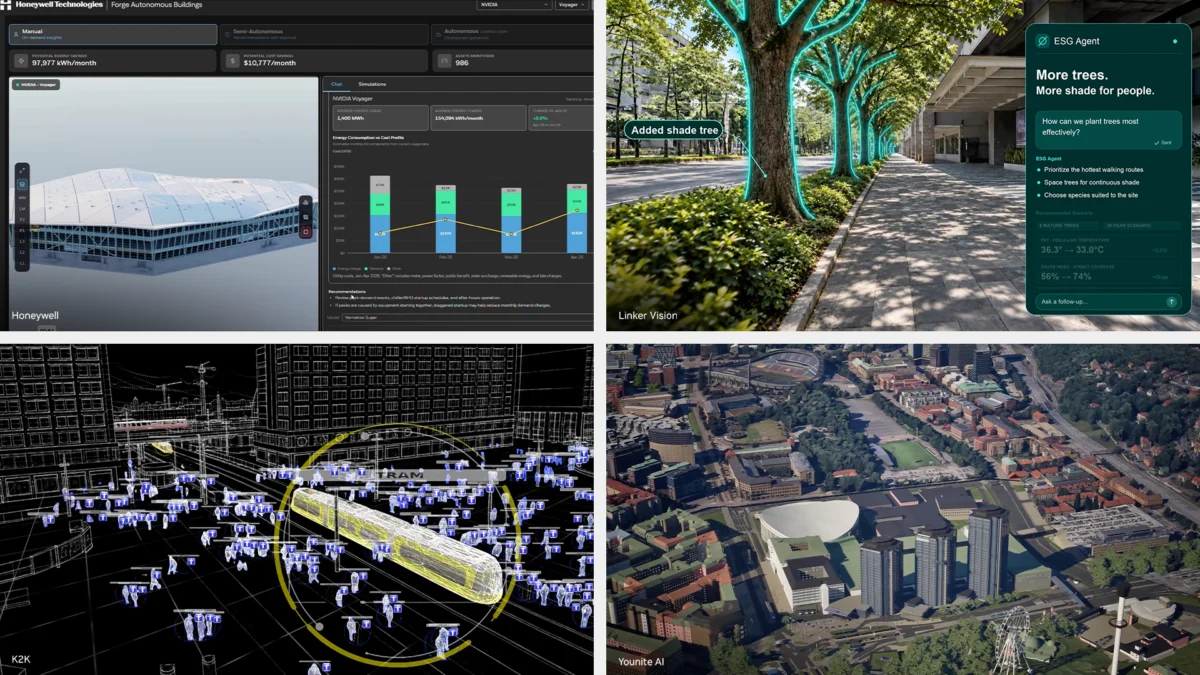
To turn these capabilities into reality, a vast network of software partners—including ABA Technology, Akila, Galene AI, Honeywell Technologies, K2K, Linker Vision, Milestone, Onetera, ThinkDeep, and Younite AI—is actively engineering customized applications tailored to the unique operational challenges of modern cities.
Crucially, these deployments are supported by heavy-hitting hardware and infrastructure builders like Cisco, Dell Technologies, HPE, Lenovo, and Supermicro. By packaging NVIDIA accelerated computing, specialized networking, and high-performance storage into localized "AI factories," these systems ensure that cities retain complete operational control, sovereignty, and security over their local data and AI models.
Chronology: From Isolated Proof-of-Concepts to Regional Scale
The rapid deployment of physical AI across EMEA did not happen overnight; it is the culmination of strategic investments, regional pilot projects, and expanding software ecosystems coming to maturity.
Early Foundations and Regional Pilots (Late 2024–2025)
Initial deployments focused on isolated municipal challenges. Early adopters began testing the waters with localized digital twins, primarily looking at energy consumption in public buildings and basic traffic flow analytics. During this phase, software partners like Akila and ThinkDeep began laying the groundwork for sovereign operational agents, integrating disparate municipal databases into unified visualization platforms.
The Rise of Agentic AI and Sovereign Infrastructure (2026)
By 2026, the technological paradigm shifted from passive data collection to active agentic AI—systems capable of autonomous reasoning and cross-departmental execution.
- In the U.K., the Liverpool City Region, alongside K2K, began exploring AI factories to support smart mobility and public safety. Simultaneously, the Island of Jersey and Innovation City Belfast initiated projects targeting clean energy, citizen safety, and event management.
- In France, the Department of Côte-d’Or rolled out comprehensive operations agents across more than 500 public buildings, slashing document search times and immediate operating costs.
- In Italy, the Milan region—starting with Cinisello Balsamo—commenced work on a localized AI factory with Galene.AI, Dell Technologies, and TD Synnex, targeting instant administrative data access for citizens.
- In Belgium, the Port of Antwerp-Bruges partnered with Milestone and Dell Technologies to pilot agentic vision AI using synthetic data training to prepare for rare industrial emergencies like oil spills.
Current Expansion and Cross-Border Collaboration (Late 2026 and Beyond)
Today, these disparate pilots are scaling into interconnected regional networks. Cities are moving beyond single-department solutions to deploy city-wide digital twins, such as Gothenburg’s implementation of NVIDIA Omniverse libraries under the European Union’s Citiverse initiative. Furthermore, major enterprise players like Honeywell Technologies are bringing Forge Cognition—powered by NVIDIA technology—into commercial real estate and hospitality, exemplified by deployments at the Dubai Fairmont Hotel.
Supporting Data: Measurable Impact on Municipal Operations
The financial and operational metrics emerging from these early deployments validate the heavy investments made by local governments and infrastructure partners.
- Operational Cost Reductions: In France, the Department of Côte-d’Or’s implementation of Akila and ThinkDeep’s operational agents has already yielded a 10% reduction in total operating costs across more than 500 public buildings, with municipal planners targeting a 30% reduction as the system scales to full capacity.
- Administrative Efficiency: Document search and retrieval—historically a notorious bottleneck in bureaucratic municipal workflows—has been dramatically accelerated. In regions utilizing the new AI frameworks, document search times have plummeted from weeks to mere minutes. Similarly, Italian citizens in participating municipalities of the Milan region can now access complex municipal data in seconds rather than hours.
- Synthetic Data Readiness: At the Port of Antwerp-Bruges, the integration of NVIDIA Cosmos allows engineers to train vision AI models using synthetic data. This is particularly vital for safety protocols regarding high-risk events like oil spills, where real-world training data is intentionally scarce.
- Geographic Spread: Current projects and pilot expansions actively span Belgium, Finland, France, Italy, the Netherlands, Poland, Sweden, the United Arab Emirates, the United Kingdom, and island territories like Jersey, proving the inherent adaptability of the technology across varied legal, linguistic, and structural frameworks.
Official Responses and Industry Perspectives
The rapid adoption of physical AI has drawn commentary from municipal leaders, technology architects, and integration experts alike, all emphasizing the balance between technological innovation and democratic governance.
Technological leaders point out that the primary hurdle for municipal AI has never been a lack of data, but rather the inability of legacy systems to process, reason over, and act upon that data in real time. By utilizing open models like Nemotron and Cosmos, developers can build transparent, auditable systems that municipal workers actually understand and trust.
System integrators—including global professional services giants like EY and Accenture—play a critical role in this ecosystem. By providing the operational expertise needed to bridge cutting-edge artificial intelligence with legacy municipal IT systems, these firms help cities construct repeatable deployment blueprints. These blueprints allow local governments to seamlessly adapt applications across different departments—such as moving from transport management to waste reduction—and expand them as regional needs grow.
Furthermore, infrastructure providers emphasize the absolute necessity of data sovereignty. Through locally operated AI factories built by firms like Cisco, Dell, HPE, Lenovo, and Supermicro, European and international cities retain absolute autonomy over their digital infrastructure, shielding sensitive citizen data from external vulnerabilities while maintaining high-performance computing capabilities.
Implications: What This Means for the Future of Urban Life
The widespread deployment of physical AI agents and digital twins across EMEA carries profound implications for the future of urban centers, municipal labor forces, and citizen engagement.
1. From Reactive Maintenance to Proactive Governance
Historically, city management has been inherently reactive—fixing potholes after complaints are filed, or dispatching emergency services after an incident occurs. Physical AI transforms municipal operations into a proactive science. By continuously ingesting sensor data, video feeds, and historical infrastructure records, AI agents can predict equipment failures, optimize traffic flows before gridlock occurs, and allocate maintenance crews with surgical precision.
2. The Rise of the "Sovereign AI Factory"
As geopolitical and data-privacy concerns mount globally, the model of routing all municipal data through centralized, foreign cloud providers is losing favor. The regional approach championed across Europe—where cities build localized AI factories using hardware from trusted vendors and open-weight models like NVIDIA Cosmos and Nemotron—establishes a new blueprint for digital sovereignty. Cities retain control of their operations while still benefiting from cutting-edge global AI research.
3. Transforming the Role of the Municipal Worker
Far from replacing human administrators, physical AI agents are acting as sophisticated digital assistants. By reducing document search times from weeks to minutes and automating complex procurement, compliance, and zoning queries, these tools free civil servants to focus on high-level strategic planning, community engagement, and complex decision-making.
4. Seamless Citizen Services
For the average resident, the most noticeable impact will be the friction-free interaction with local government. Whether through instant multilingual chatbots handling administrative requests, real-time public transit optimization, or advanced event-access simulations like Gothenburg’s "Citiverse" project, cities are becoming more accessible, transparent, and responsive to human needs.
As municipal leaders gather at events like the Smart City Expo World Congress in Barcelona, the message is clear: the urban intelligence revolution is no longer a distant vision of the future. It is being built today, brick by digital brick, across the cities of Europe and beyond.