






Introduction: The Data Bottleneck
In the modern digital landscape, the sheer volume of unstructured text—ranging from corporate emails and news articles to social media feeds and technical reports—presents a significant challenge for data scientists. While this information is rich with insight, it remains largely inaccessible for traditional machine learning models, which demand tidy, structured rows and columns.
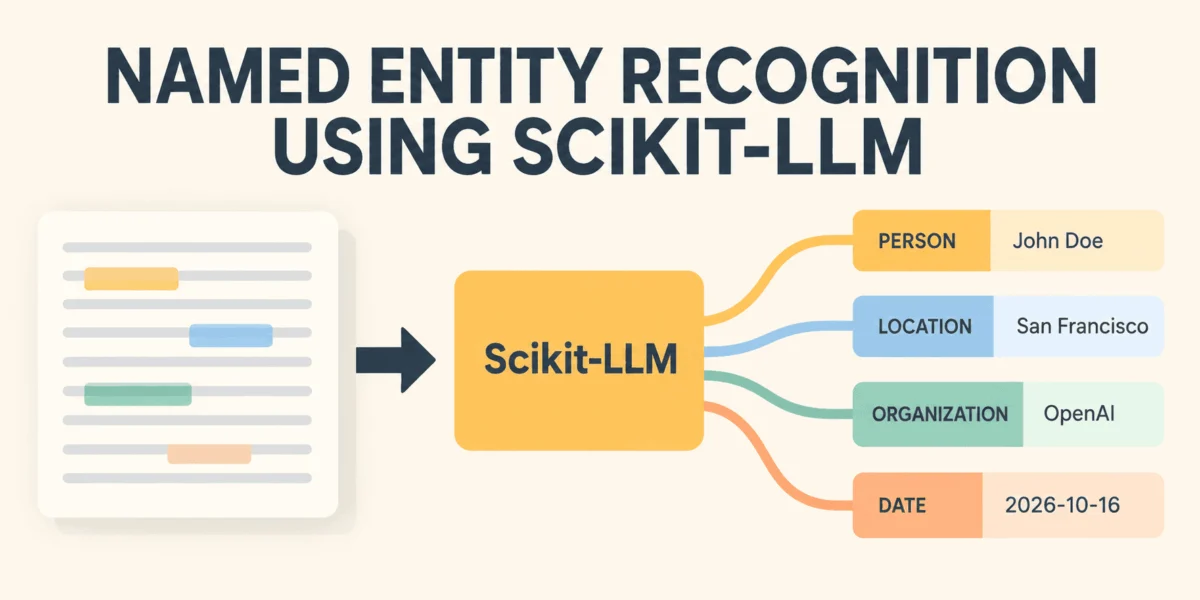
Named Entity Recognition (NER) has long been the primary bridge between these two worlds. By identifying and categorizing key information—such as company names, executive leaders, or specific product lines—within raw text, organizations can unlock predictive insights. Historically, however, NER required complex, bespoke NLP architectures, vast labeled datasets, and months of fine-tuning. Today, a new wave of tooling, led by the open-source library Scikit-LLM, is fundamentally shifting that paradigm, allowing developers to harness the reasoning capabilities of Large Language Models (LLMs) with minimal friction.
Main Facts: The Scikit-LLM Revolution
The core innovation behind Scikit-LLM is its ability to integrate the sophisticated reasoning of LLMs directly into the familiar Scikit-Learn workflow. By wrapping powerful LLMs in the standard fit_transform interface, developers no longer need to build custom APIs or manage complex tokenization pipelines to achieve high-accuracy entity extraction.
Key Capabilities
- Zero-Shot Extraction: Unlike traditional models, Scikit-LLM allows users to define entities via natural language descriptions, meaning the model "understands" what it is looking for based on context rather than pattern matching.
- Infrastructure Flexibility: While designed with OpenAI standards in mind, the library is agnostic. It supports various providers, including high-speed inference engines like Groq, which allow for low-latency, cost-effective extraction.
- Explainable Outputs: As demonstrated by the
GPTExplainableNERmodule, the library does not just provide a tag; it can provide the underlying reasoning for why a specific token was classified as a particular entity, adding a layer of transparency to the extraction process.
Chronology: Implementing the Pipeline
To understand the practical application of this technology, we must look at the step-by-step evolution of an NER project, moving from initial configuration to refined output.
Phase 1: Environment and Configuration
The process begins in a controlled environment, such as a Google Colab notebook. The initial setup requires the installation of the scikit-llm library and the secure management of API credentials. Because Scikit-LLM utilizes an OpenAI-compatible architecture, developers can redirect the base URL to specialized providers like Groq. This is a critical step for teams looking to leverage high-speed open-source models (such as gpt-oss-20b) without the overhead of enterprise-level costs.
Phase 2: Defining the Domain Logic
Unlike traditional supervised learning where one must curate thousands of labeled examples, Scikit-LLM uses an "entity dictionary." In this phase, the user defines the categories they wish to extract—for example, EXECUTIVE, CORPORATION, PRODUCT, and CITY—alongside plain-English descriptions. These descriptions act as the "instruction set" that steers the model’s reasoning during the inference phase.
Phase 3: Model Execution and Transformation
With the environment configured and the dictionary defined, the GPTExplainableNER estimator takes the unstructured data and maps it against the definitions. The fit_transform method triggers the LLM’s reasoning engine, which traverses the text and segments it into structured blocks.
Phase 4: Post-Processing and Structuring
Raw output from an LLM is rarely perfectly formatted for a database. The final chronological step involves a post-processing layer—typically using regular expressions—to strip away the "reasoning" metadata and return a clean, key-value dictionary that can be seamlessly imported into a pandas DataFrame or a SQL database.
Supporting Data: Why This Approach Matters
Traditional NER methods rely on Conditional Random Fields (CRFs) or older BERT-based models that are inherently "brittle." If a company changes its product naming convention, a traditional model often requires a complete retraining cycle.
In contrast, the Scikit-LLM approach provides:
- Adaptability: Adding a new entity type simply requires updating the dictionary. No retraining is necessary.
- Accuracy in Context: In the examples provided, the model correctly distinguishes between "Microsoft" as a corporation and "Copilot" as a product, even when the sentence structures vary significantly.
- Efficiency: Using optimized hardware, as provided by the Groq API, reduces the latency of extraction to a fraction of the time required by standard cloud-based LLM calls.
Official Perspectives: The Role of AI Engineering
Industry experts, such as AI advisor and writer Iván Palomares Carrascosa, highlight that the democratization of these tools is the next frontier for corporate data maturity. The philosophy behind projects like Scikit-LLM is to shift the burden from model training to prompt engineering and domain definition. By allowing domain experts—not just ML engineers—to define the entities they need, the feedback loop between data generation and data consumption is drastically shortened.
Implications: The Future of Data Analysis
The adoption of LLM-driven NER has profound implications for several industries:
1. Financial Services
Banks can use these pipelines to automatically extract key financial metrics and executive comments from thousands of quarterly earnings reports, enabling real-time sentiment analysis and risk assessment that was previously impossible.
2. Legal Tech
Law firms are already testing similar frameworks to extract clause types, jurisdictions, and party names from vast repositories of legacy contracts, turning static documents into actionable intelligence.
3. Supply Chain Management
Logistics companies can parse unstructured emails and manifests to identify supplier names, delivery locations, and product identifiers, effectively creating a "digital twin" of their supply chain in real-time.
Challenges and Considerations
While the results are impressive, developers must remain vigilant regarding "hallucinations." As noted in the implementation steps, the model may occasionally generate formatting variations or misinterpret context. Therefore, robust validation layers (such as the regex parser used in the example) are essential for production-grade deployments. Furthermore, privacy remains a paramount concern; when using third-party APIs, sensitive data must be handled according to strict compliance standards (e.g., GDPR or HIPAA).
Conclusion: A Paradigm Shift in Processing
The evolution of Named Entity Recognition from a deep-learning research problem to a high-level API call represents a massive shift in how we handle information. Libraries like Scikit-LLM serve as the "connective tissue" that allows developers to leverage the immense power of foundation models within standard, repeatable data pipelines.
By reducing the barriers to entry—removing the need for massive labeled datasets and complex model training—the tech community is moving toward a future where structured intelligence can be derived from any source of text in minutes, rather than weeks. As these tools continue to mature, the divide between "unstructured noise" and "structured insight" will continue to vanish, providing organizations with a sharper, clearer view of the data that defines their success.
For those looking to get started, the integration of Scikit-LLM with accessible platforms like Groq offers a perfect sandbox. The ability to iterate quickly, define custom domains, and achieve near-immediate results is not just a convenience—it is a competitive advantage in an era where data is the most valuable commodity on the market.