








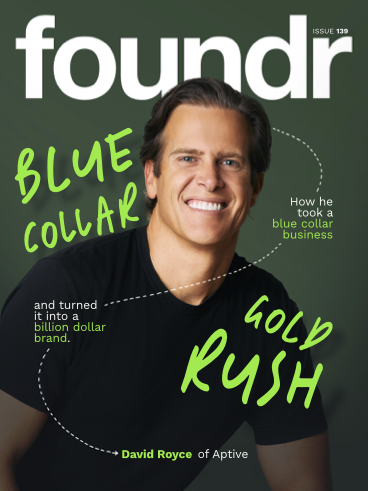
In the high-stakes world of American business, the most lucrative opportunities are rarely found in the polished boardrooms of Wall Street or the sleek glass towers of Silicon Valley. Instead, they are often buried in the "unsexy" corners of the economy—industries defined by blue-collar labor, recurring revenue, and a lack of innovation. David Royce, the founder and chairman of Aptive Environmental, has spent two decades mastering this terrain, building a residential pest control empire that has defied the skepticism of his peers and redefined what it means to be a stealth wealth builder.
Royce’s journey is a testament to a singular philosophy: success is not determined by pedigree, industry prestige, or initial aptitude. It is the product of a willingness to embrace the tasks others avoid, sustained over a period long enough to achieve mastery. Today, as the architect of one of North America’s largest private pest control companies, Royce stands as a masterclass in operational discipline, cultural design, and the art of the pivot.
The Genesis: From Schoolroom Struggle to Sales Floor
Long before he was a titan of industry, David Royce was a student who felt out of place. Plagued by an undiagnosed ADHD that made traditional academic environments feel like a cage, he struggled through his early years, internalizing the belief that he simply "wasn’t smart."
The trajectory of his life shifted in the sixth grade when a teacher, Mrs. Luft, recognized his potential before he could see it himself. Her belief served as the initial catalyst for his work ethic. However, it wasn’t until he entered the world of sales that Royce realized his cognitive differences were not a liability, but a competitive advantage. In environments that engaged his focus, his ADHD functioned as a "superpower," allowing him to hyper-fixate on complex problems while his peers faltered.

His formal education in business did not occur in a lecture hall, but on the front porches of Sacramento. Encouraged by a friend’s success, Royce entered the pest control industry as a college student. His start was disastrous; he spent his first week in the field enduring "free cardio," failing to make a single sale while others flourished.
Refusing to accept failure, Royce did not quit. He spent his weekends studying sales psychology, clocking 90 minutes of deliberate practice daily. By the end of that summer, he was the top sales rookie out of 200 representatives. This experience solidified a core tenet of his career: "Persistence is genius in disguise."
Chronology: Building and Scaling the Empire
Royce’s ascent is marked by a series of strategic maneuvers that transformed small operations into massive capital events.
- The Early Foundation: After graduating with a finance degree, Royce faced a crossroads: join an investment bank or start his own company. Choosing the latter, he used $300,000 in savings—money earned through his summer sales efforts—to launch his first venture.
- The Three-Exit Model: Royce’s early career was defined by a repetitive, high-efficiency model. He built companies, scaled them, and executed strategic exits to the same buyer. His strategy was surgical: he sold the recurring revenue (the customers and the technicians) while retaining his core leadership team and operational infrastructure. This allowed him to immediately launch a new, better-capitalized venture with a seasoned "family" of employees, bypassing the typical startup friction.
- The Rise of Aptive: Aptive represents the culmination of this learning curve. By leveraging his background in finance, he treated a blue-collar service as a high-growth SaaS-like business, implementing sophisticated CRM software, gamified sales tournaments, and a data-driven training program that saw new recruits outperform industry veterans by 70%.
Supporting Data: Why "Boring" is the New "Brilliant"
The data supports Royce’s contrarian approach. According to his analysis of wealth demographics, roughly 43% of the top 0.1% of income earners in the United States operate in "boring" blue-collar industries.

The Financial Reality
Royce’s growth was not without its "near-death" experiences. In his first year in Los Angeles, he grew at a rate that threatened to bankrupt the business. Because the company paid salesperson commissions upfront—before the recurring revenue from the contract was fully realized—he faced a massive cash-flow crunch.
This taught him a critical lesson: "Revenues are vanity, profits are sanity, but cash flow is reality." By securing temporary financing from his own top performers, he bridged the gap and learned to restructure his funding to support hyper-growth.
The AI-Proof Advantage
While tech-heavy industries grapple with the disruption of Artificial Intelligence, the pest control sector remains largely shielded. As Royce points out, while AI can automate legal analysis or coding, it cannot physically service a home or treat a termite infestation. This creates an "essential service" moat that protects the business from economic cycles. "Recessions come and go," Royce notes, "but bugs don’t read The Wall Street Journal."
Official Perspectives and Cultural Philosophy
When asked about his success, Royce is quick to pivot the conversation toward the people he has mentored. He credits his organizational culture—often criticized for its intensity—as the primary driver of retention.

Culture by Design
Drawing inspiration from Tony Hsieh’s Delivering Happiness, Royce realized that culture cannot be a passive byproduct of "vibes." It must be engineered. He invested heavily in experiences, from international retreats to extreme sports, but he maintains that the true "protein" of his culture is the professional development program.
His most significant act as a leader was the decision to distribute 25% of the company’s equity to his employees. During the sale of his business, this resulted in nine-digit wealth transfers to his team, many of whom used the funds to pay off mortgages and debt. "Ownership is a far better retention tool than ping-pong tables," he reflects.
Implications: The Shift from Hero to Architect
Perhaps the most difficult transition in Royce’s career was moving from the role of the "hero" to the "architect." For years, he was the primary engine of the company’s sales. Learning to delegate, however, was essential for the company to survive his eventual exit.
The Cost of Misalignment
Royce’s story also includes cautionary tales. His attempt to bring in a high-level CFO from a billion-dollar tech company proved disastrous. The mismatch in operational understanding—where a corporate executive lacked the granular knowledge of how expenses impacted a field-based business—nearly derailed a $1.6 billion sale. This taught him that resumes do not run companies; people with a deep understanding of the business’s specific DNA do.
The Legacy of Leadership
Today, Royce emphasizes that the "number" is always a moving target. In the eyes of a true entrepreneur, there is no final summit; there is only the next climb. His ultimate legacy, he argues, is not the valuation of Aptive or the volume of his exits, but the number of leaders he successfully cultivated.
For the next generation of founders, Royce’s story offers a clear directive: stop chasing the image of success in high-visibility sectors. Instead, look for the unsexy, essential, and overlooked industries where discipline and process can create extraordinary wealth. Success is not about the "what," but the "how"—and the willingness to be the person who does what everyone else is too afraid or too proud to do.