











Sales and marketing misalignment rarely presents itself as a singular, catastrophic event. It doesn’t arrive with a warning siren. Instead, it manifests as a slow, corrosive friction within the organization: “qualified” leads that sales teams quietly ignore, marketing campaigns that leave sales reps puzzled, and a revenue pipeline that appears robust on a dashboard but feels hollow during end-of-quarter reviews.
To uncover the reality of modern go-to-market (GTM) dynamics, Unbounce surveyed over 500 SMB GTM professionals. The resulting data exposes a glaring discrepancy: while 87% of teams acknowledge that better alignment is the key to unlocking performance, only 56% claim to be “highly aligned.”
This article explores the anatomy of that gap, the hidden costs of misalignment, and the operational shifts required to bridge the divide between those who generate demand and those who close it.
The Great Expectation: The State of GTM Alignment in 2026
The headline from the Unbounce research is clear: there is a profound "expectation-reality" chasm. While nearly nine out of ten professionals view alignment as a performance multiplier, the majority of the industry remains stuck in a cycle of surface-level cooperation.
What "Highly Aligned" Actually Means
The 56% of teams that identify as "highly aligned" are often misinterpreting the term. In many organizations, alignment is confused with simple communication. They have a shared Slack channel, they attend the same weekly meetings, and they share a CRM dashboard.

However, true alignment is not a meeting cadence; it is an operating model. It is characterized by integrated workflows, shared lead-scoring logic, and a singular definition of success. When teams fail to move beyond the "meeting" layer, they encounter the "alignment paradox": they are talking more, but they are still arguing over why the revenue numbers don’t match. Marketing counts the lead, sales counts the close, and the organization is left with two conflicting versions of reality.
The Perception Gap: A Study in Hierarchical Dissonance
One of the most concerning findings in the report is the divergence between executive and non-executive perspectives.
- 69% of executives report strong alignment.
- Only 47% of non-executives agree with that assessment.
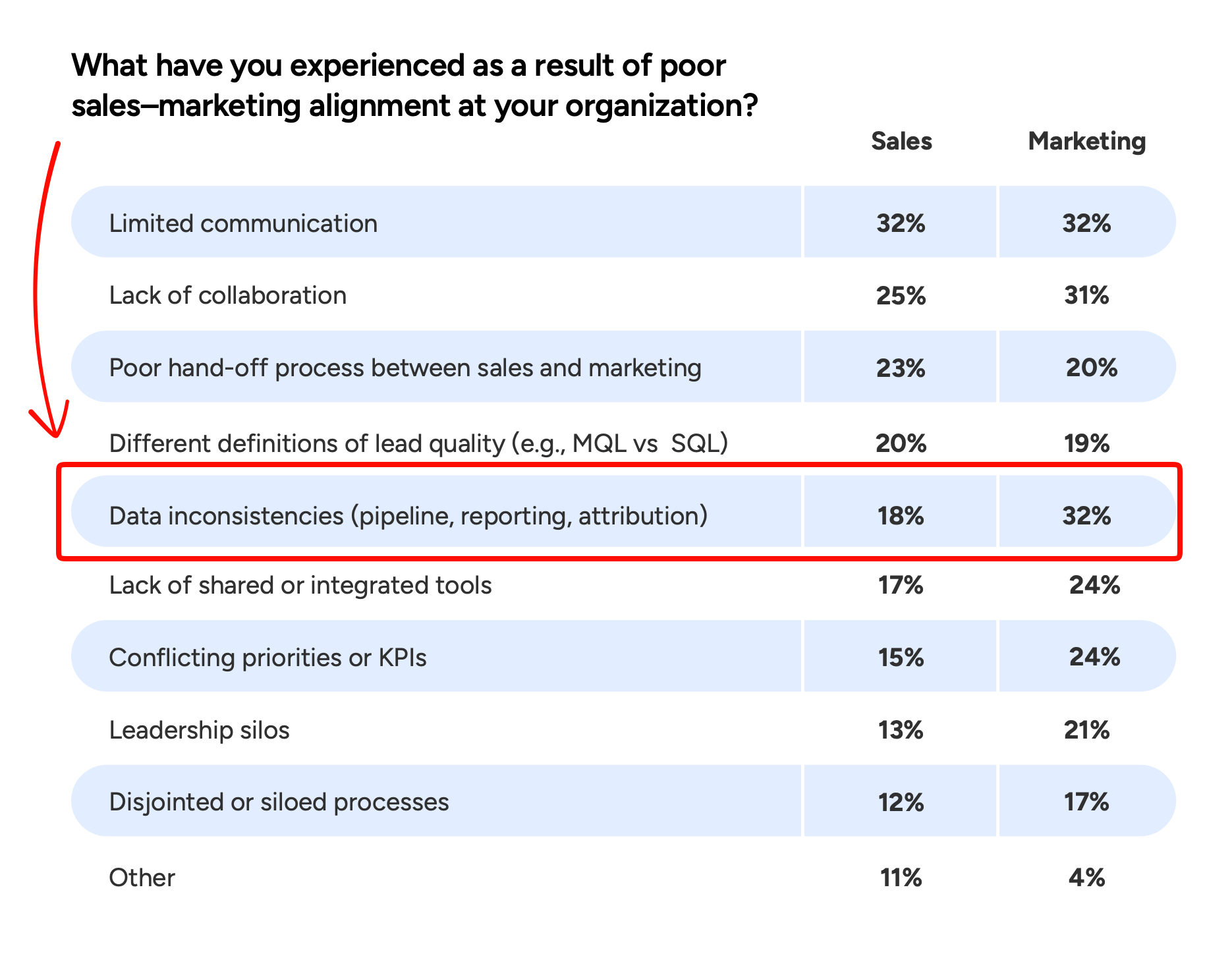
This structural information lag is a silent killer of growth. Executives often view alignment through the lens of strategic decks and high-level KPIs. Conversely, individual contributors experience alignment at the "coal face"—the friction of data inconsistencies, unclear messaging, and broken handoff processes.
When leadership believes the team is aligned, they stop investing in the necessary fixes. Meanwhile, the teams on the ground are left to navigate the barriers that prevent them from closing deals, leading to a compounding effect of frustration that widens as the company grows.
The True Cost of Misalignment: Beyond Employee Frustration
Misalignment is often dismissed as a "culture issue." In reality, it is a direct operational tax on revenue. When marketing and sales operate as silos, the costs manifest in three primary ways:

- Delayed Follow-up: Marketing generates a lead, but the process for handoff is so opaque that sales takes days to respond. In the current B2B landscape, a 48-hour delay is often a lost deal.
- Duplicated Effort: Without clear guidelines, marketers create content that sales doesn’t use, and sales reps spend hours crafting their own outreach materials that ignore the brand’s positioning. This is a massive drain on human capital and budget.
- Pipeline Leakage: When marketing and sales define "lead quality" differently, the funnel leaks. Marketing pushes for volume to hit targets, while sales filters out those leads to protect their time, resulting in a healthy-looking pipeline that fails to convert at the bottom.
The Root Causes: Why Communication Frequency Isn’t the Answer
The instinct for many managers is to "increase communication." If the teams are fighting, schedule more syncs. But the data shows this is a shallow fix. The root causes of misalignment are structural and operational, not conversational.
1. Siloed Data and Inconsistent Information
Data remains the primary battleground. While 40% of GTM teams report "excellent" data sharing, 68% admit to encountering regular data inconsistencies. Marketing relies on attribution models, while sales relies on rep-level pipeline signals. These two sets of data rarely reconcile, leading to finger-pointing when targets are missed.
2. Tool Bloat and the "Stack" Fallacy
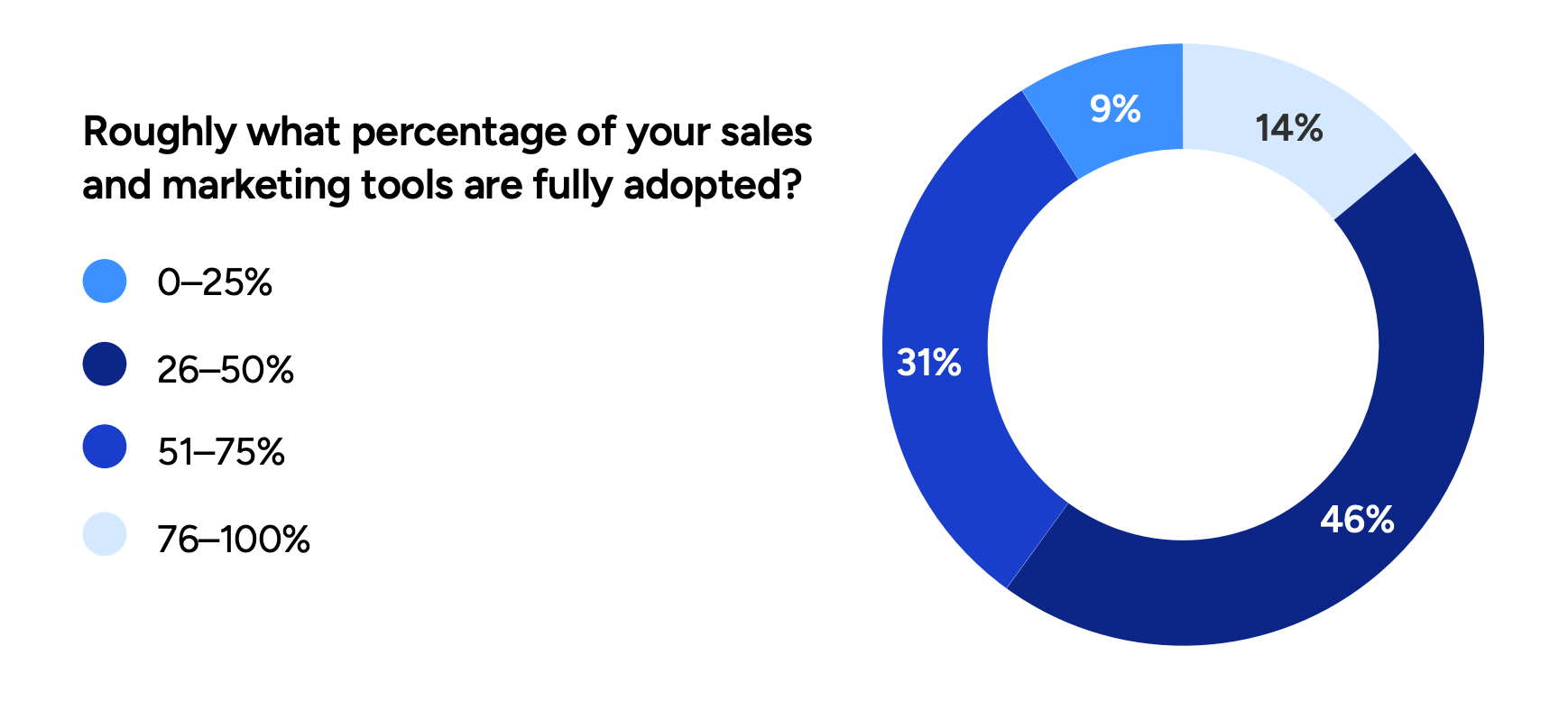
Teams often attempt to buy their way out of misalignment. The survey reveals that 56% of GTM professionals struggle with tool bloat. Alarmingly, 60% of teams use less than half of the tools in their stack. Each unused tool creates a new data silo and a new maintenance burden. The data is clear: leaner, well-adopted stacks consistently outperform complex, sprawling collections of software.
3. Misaligned Incentives
As Charlie Munger famously noted, "Show me the incentive and I’ll show you the outcome." When marketing is compensated on MQL volume and sales is compensated on closed revenue, they are structurally designed to be at odds. Without shared KPIs—such as Customer Acquisition Cost (CAC) or total revenue targets—these teams will never be truly aligned.
The Blueprint for High-Performing GTM Teams
The top-tier performers identified in the report do not just communicate more; they operate differently. They treat alignment as a product to be built, rather than a meeting to be attended.
Defining the Shared Buyer Persona
Aligned teams treat buyer personas as a "joint artifact." Instead of marketing developing a persona in a vacuum and handing it to sales, the two teams collaborate. They share call recordings, interview notes, and real-world objection handling. This ensures that the messaging in a top-of-funnel ad matches the conversation happening in a discovery call.
Operationalizing the Handoff
A functional handoff is not a notification in a CRM. It is a defined Service Level Agreement (SLA). It requires:
- Contextual Data: What did the lead say? What did they download?
- Timing: When must the follow-up occur?
- Accountability: Who is responsible if the lead goes cold?
Unifying the Tech Stack
Aligned teams are twice as likely to rate lead quality as "excellent" after they consolidate their tech stack. By focusing on a "single source of truth," these teams ensure that sales and marketing are looking at the same dashboards, the same conversion rates, and the same definitions of what a "won" deal looks like.
Implications for Future Growth
The findings of the 2026 report serve as a warning: the traditional "sales vs. marketing" model is an anchor dragging down SMB performance. As the market becomes more competitive, efficiency is no longer optional.
The path forward requires a shift in leadership mindset. Organizations must stop rewarding "marketing-only" or "sales-only" metrics and start incentivizing the entire revenue journey. By unifying data, rationalizing the tech stack, and building shared definitions of the buyer, teams can finally move from the "communication" layer of alignment to the "operational" layer where real revenue growth lives.
For SMBs, the message is simple: alignment is not about getting along. It is about building a system that allows both teams to win at the same time. If your organization is still spending its time in meetings debating whose fault it is that the pipeline is stalling, you are likely suffering from the alignment paradox. It is time to stop talking and start integrating.