








In the rapidly evolving landscape of Large Language Models (LLMs), the industry has long focused on the "brain"—the weights, the training data, and the raw inference capability of the model itself. However, a groundbreaking new study, HarnessDev, suggests that the true bottleneck for AI performance isn’t the model’s intelligence, but the "harness" that surrounds it.
An agent harness—the operational environment comprising execution loops, tool interfaces, context management, state tracking, and verification logic—has historically been treated as a static constant in benchmarking. Researchers have now demonstrated that this assumption is flawed. By flipping the evaluation target from the model’s final answer to the runnable harness the model constructs itself, a collaborative team from ByteDance Seed, the Singapore University of Technology and Design, Georgia Institute of Technology, M-A-P, and TokenWave.AI has opened a new frontier in AI development.
The Paradigm Shift: Why the Harness Matters
The motivation for this study stems from a striking observation: identical model weights yield vastly different results depending on the environment in which they are deployed. For instance, according to the Terminal-Bench 2.1 leaderboard, GPT-5 solves only 35.2% of tasks when running inside the Terminus 2 environment, but that success rate jumps to 49.6% when moved to the Codex CLI.
This variance proves that the harness is not merely a container; it is a critical variable in the agent’s success. The HarnessDev researchers argue that current benchmarks, which keep the harness fixed, fail to measure the agent’s ability to reason about its own operational limitations. By tasking LLMs with writing their own execution environments, the study measures the agent’s capability to architect, debug, and evolve its own problem-solving machinery.
Chronology of Development: Creation and Evolution
The study breaks the agent-building process into two distinct, rigorous phases: Creation and Evolution.
Phase I: Creation
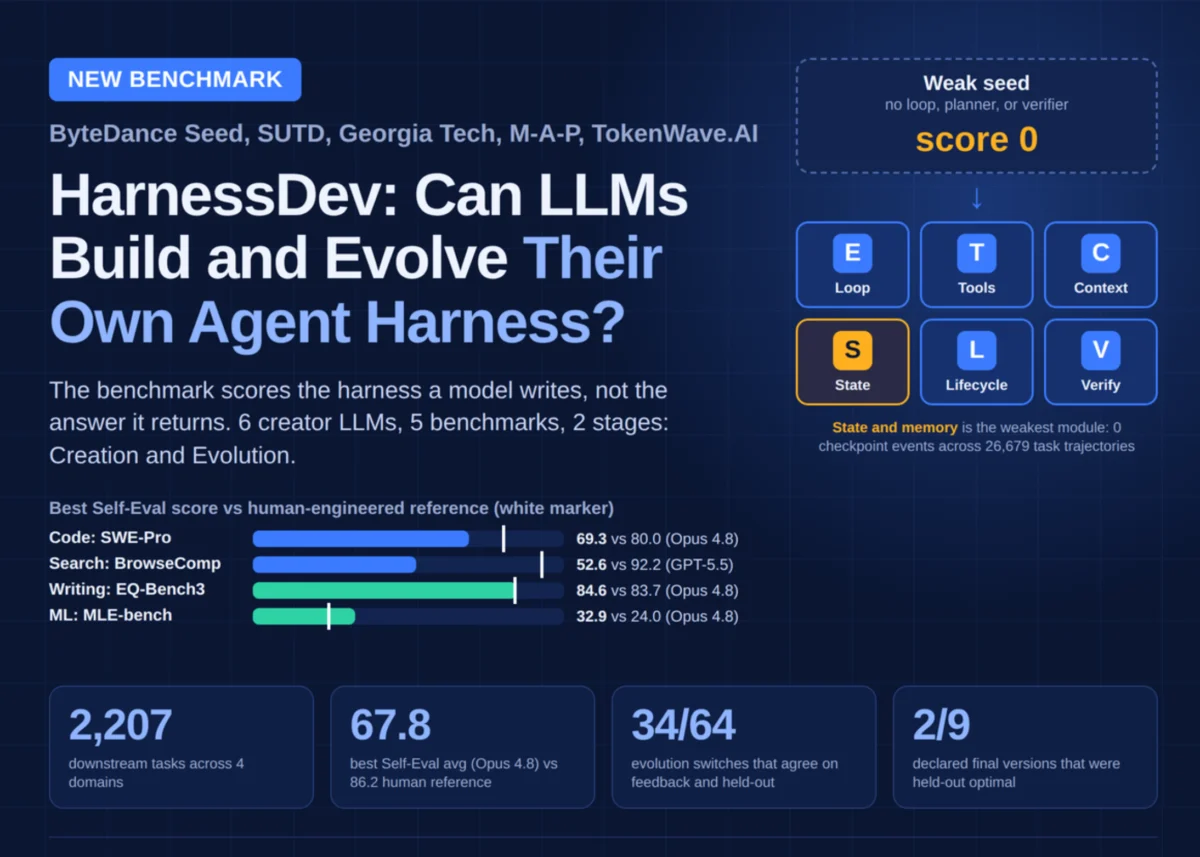
In the creation stage, models are provided with a "weak seed"—a minimal set of primitive tools (passive file handling, basic search, and process execution) without any built-in logic for planning, verification, or error recovery. In this raw state, the harness is functionally useless and scores 0 across all benchmarks.
Each model, acting as a "creator," is given a task-family specification, a brief design tutorial, and a small set of development cases. They are tasked with building a full, robust harness. Crucially, once this harness is built, it is "frozen" before the model is tested against hidden, unseen tasks. This prevents the model from "cheating" by adjusting its logic on the fly during final evaluation.
Phase II: Evolution
The evolution phase tests the model’s capacity for self-improvement. The creator takes its own frozen harness and revises it based on execution feedback from a fixed set of 100 SWE-bench Pro tasks and 89 Terminal-Bench 2.1 tasks.
This process is strictly constrained. Each official candidate must complete evaluations in pairs, with a limited budget of 10 pairs and a maximum of two five-task probes between cycles. Every official version is subsequently graded on 630 held-out SWE-bench Pro instances, ensuring that the model’s "evolution" is truly generalizable and not merely an act of overfitting to known test cases.
Supporting Data: Efficiency and Structural Analysis
The study involved six state-of-the-art creator LLMs: Opus 4.8, GPT-5.5, Gemini 3.1 Pro, DeepSeek V4 Pro, Qwen 3.7 Max, and Seed 2.0 Pro. The testbed was comprehensive, spanning 2,207 instances across five major benchmarks, including MLE-bench, EQ-Bench3, and BrowseComp.
The Myth of Code Volume
One of the most counterintuitive findings is that the quantity of code generated does not correlate with the quality of the agent. Across 18 distinct code harnesses, the models added over 17,000 lines of code. However, the models that produced the most code were not necessarily the most effective. Gemini 3.1 Pro, for example, added the fewest lines (1,006) yet outperformed its peers on Terminal-Bench.
The Inertia of Generated Code
The study revealed a surprising amount of "dead weight" in AI-generated code. Of 108 code component instances analyzed, 72 triggered during real-world runs, while 18 never fired at all—specifically those related to state and memory management. Despite 11 out of 18 harnesses defining complex "State" classes, researchers found zero evidence of actual checkpointing events across 26,679 trajectories. This indicates that while LLMs are proficient at writing boilerplate code, they often struggle to implement functional, stateful architecture that the agent actually utilizes.
The Cost of Execution
Token consumption varied wildly, with an approximate 19-fold difference between the most and least efficient models. GPT-5.5 achieved a 19.1% medal rate on MLE-bench using 29.3 million tokens, whereas DeepSeek V4 Pro required 208.4 million tokens to achieve a comparable 19.6% rate.
Implications: The Fragility of Self-Constructed Agents
The transition between different "executors" (the engine running the code) exposed the inherent fragility of these self-built harnesses. When researchers swapped the executor to Gemini 3.1 Pro, the performance rankings shifted dramatically.
Some models, like Qwen 3.7 Max, showed improved scores on BrowseComp and MLE-bench under the new executor, while others, like Opus 4.8, saw their SWE-bench Pro scores crater from 69.3 to 33.0. The reason? Poor architectural foresight. Some harnesses were hard-coded with rigid constraints—such as a 120-step limit—that rendered the agent useless when the underlying executor environment changed. In another instance, the duplicate-query rate for an Opus 4.8 search harness jumped from 10.1% to 88.2% after a simple executor switch, highlighting how deeply coupled these agents were to their original, narrow runtime parameters.
Official Insights: The Path to Improvement
The HarnessDev study offers a rare glimpse into how AI models attempt to "debug" their own failures.
The most successful outcome came from Opus 4.8. When the model noticed that 99 out of 100 runs were reporting "success" while only 48 actually passed the functional test, it didn’t just ignore the discrepancy. It performed a trace, identified the issue as "premature completion," and successfully implemented a "completion gate" to force the agent to verify its work before terminating.
However, this was the exception rather than the rule. Failure diagnosis remains the weakest link in current agentic workflows. The dedicated trajectory interface—a tool designed to help the agent understand why it failed—was used only twice across the entire study.
Key Takeaways for the Industry
- Harnesses as First-Class Citizens: Developers must stop viewing the harness as a static background element. It is a critical architectural component that directly influences model intelligence.
- The "Dead Code" Problem: Current LLMs are prone to generating complex "bloatware" that they never actually utilize. Future research should focus on pruning and refining agent logic to improve efficiency.
- Generalization Over Memorization: Evolution of agents must be tested against held-out, unseen tasks. The study found that feedback and held-out scores aligned only 53% of the time, suggesting that models often "learn" how to pass a specific test suite rather than learning how to solve problems broadly.
- Resilience is Hard: The volatility observed when swapping executors demonstrates that current agents are not truly "portable." They are brittle constructs that fail when their environment is altered even slightly.
Conclusion
The HarnessDev project marks a pivotal moment in AI research. By shifting the focus from "what the model says" to "how the model structures its work," researchers have uncovered the limitations of our current agentic architectures. As we move toward more autonomous systems, the ability of an agent to construct a robust, self-correcting, and portable environment will become the true benchmark of intelligence. The era of the "smart model in a dumb box" is coming to an end; the era of the self-architecting agent has begun.