






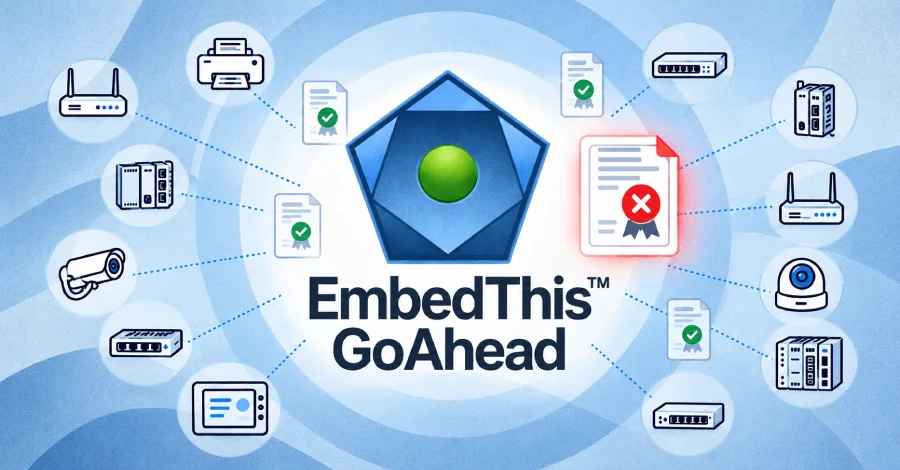
Global Supply Chain Warning: A trio of cryptographic vulnerabilities in the ubiquitous GoAhead embedded web server leaves countless industrial controllers, enterprise printers, routers, and IoT gateways exposed. Security researchers urge device manufacturers to expedite firmware patches.
Main Facts
The cybersecurity landscape faces a sweeping challenge following the disclosure of three high-severity Transport Layer Security (TLS) and authentication vulnerabilities affecting GoAhead, an exceptionally popular lightweight embedded web server developed by EmbedThis.
Running silently inside hundreds of millions of connected products manufactured by tech giants such as HP, Oracle, Siemens, Canon, Rockwell, D-Link, and Comcast, the GoAhead web server handles device management interfaces, administrative consoles, and local application routing.
Discovered and detailed by security researcher Sébastien Féry of the cybersecurity firm FoxIO, the flaws span specific cryptographic backend integrations, certificate verification oversights, and an alarming authentication bypass linked to a newly introduced password-hashing format.
Chief among the discoveries is a critical flaw identified as CVE-2026-115881 (carrying a vendor-assigned severity rating of 9.1 out of 10). In affected builds configured to utilize an OpenSSL backend with mutual-TLS (mTLS) enabled, the server loads a configured Certificate Revocation List (CRL) into memory upon startup, yet completely fails to enforce it. Consequently, revoked client certificates—such as those belonging to retired, compromised, or stolen administrative devices—are silently accepted during the cryptographic handshake. This grants unauthorized users full administrative access to sensitive management planes.
Beyond the OpenSSL CRL flaw, the research highlights two additional TLS defects:
- The LibreSSL Legacy Verifier Flaw (CVE-2026-115884, rated 7.4): Found in builds tied to older LibreSSL versions (3.2.x, 3.3.2 through 3.3.6), this bug allows a client certificate chain exceeding the standard 10-certificate limit to bypass security controls and authenticate successfully, even when issuer checking is disabled.
- The Mbed TLS Finite-Field DHE Flaw (Rated 5.9, CVE pending): A length calculation typo in Mbed TLS builds (versions 4.0.2 through 6.1.0) forces the server to transmit a truncated, 1-byte Diffie-Hellman value instead of a full 2048-bit key. Passive observers capturing network traffic can easily crack this weak key exchange, decrypting the session and exposing administrative credentials.
Compounding these cryptographic concerns, EmbedThis’s GoAhead 6.1.1 release notes disclose a total of 11 security advisories, including a critical login bypass. On configurations employing form-based login or HTTP Basic authentication, an attacker knowing only a valid username can bypass authentication entirely by supplying any arbitrary password, provided the target user’s credential is stored in the modern Blowfish format introduced in version 6.1.0.

Chronology of Discovery and Disclosure
Understanding the timeline of these discoveries underscores the meticulous coordination between security researchers and software vendors, as well as the inherent friction in the IoT patch management lifecycle.
- August 2, 2026: EmbedThis quietly releases GoAhead version 6.1.1 to registered device manufacturers and enterprise partners via its Builder portal, containing initial fixes for the compounding vulnerabilities without immediate public CVE documentation.
- October 12, 2026: EmbedThis publicly publishes the official software release for GoAhead 6.1.1 alongside formal security advisories, detailing the fixes for the OpenSSL CRL oversight, LibreSSL chain verification issues, and the Mbed TLS key-exchange flaw.
- October 26, 2026: Sébastien Féry and FoxIO publish a comprehensive technical write-up titled "Choose Your Backend: Three TLS Bugs in GoAhead," bringing widespread industry attention to the architectural oversights in the server’s multi-backend TLS implementation.
- October 27, 2026: EmbedThis formally applies for public CVE tracking identifiers (including CVE-2026-115881 and CVE-2026-115884) to be populated within the National Vulnerability Database (NVD). Concurrently, FoxIO releases diagnostic scripts and fingerprint signatures via its JA4Scan tool to assist operators in auditing their infrastructure.
- Present Day: Security teams worldwide race to determine whether their downstream device vendors have incorporated GoAhead 6.1.1 into active firmware distribution pipelines.
Supporting Data and Technical Breakdown
The vulnerabilities exposed in GoAhead highlight the complexities of maintaining a versatile codebase that must interface with multiple third-party cryptographic libraries (OpenSSL, LibreSSL, and Mbed TLS). Because GoAhead is designed for resource-constrained embedded systems, developers frequently customize compile-time parameters, leading to wildly divergent security postures across different product lines.
Vulnerability Comparison Matrix
| TLS Build / Backend | Nature of the Vulnerability | Affected Versions | Associated Identifier & Severity | Mitigation / Remediation Path |
|---|---|---|---|---|
| OpenSSL Backend (Default) | Revocation list is successfully loaded into memory at boot but never enforced, leading to the silent acceptance of revoked client certificates. | GoAhead 3.4.5 through 6.1.0 | CVE-2026-115881 CVSS: 9.1 (Critical) |
Upgrade immediately to GoAhead 6.1.1. No reliable interim configuration workaround exists in the advisory. |
| LibreSSL Legacy Verifier | Certificate chains longer than the 10-certificate limit are accepted when client certs are required and issuer checking is disabled. | GoAhead 6.1.0 and earlier (linked with LibreSSL 3.2.x, 3.3.2–3.3.6) | CVE-2026-115884 CVSS: 7.4 (High) |
Upgrade to 6.1.1, explicitly enable issuer checking with a trusted CA bundle, or migrate to OpenSSL / LibreSSL 4.x. |
| Mbed TLS Backend | A coding typo sends a 1-byte Diffie-Hellman value instead of 2048 bits, allowing passive traffic decryption. | GoAhead 4.0.2 through 6.1.0 | Unassigned CVSS: 5.9 (Medium) |
Upgrade to 6.1.1, disable finite-field DHE cipher suites, or switch to the OpenSSL backend. |
Deep Dive into the OpenSSL CRL Oversight (CVE-2026-115881)
From an engineering perspective, the OpenSSL revocation flaw represents a dangerous false sense of security. When setting up enterprise-grade mutual-TLS authentication, network administrators and security architects configure CRL files to explicitly block compromised keys.
During testing against GoAhead 6.1.0 paired with OpenSSL 3.6.2, FoxIO researchers observed that the server initialization routine reported zero errors upon parsing the CRL file. An operator reviewing server startup logs would reasonably conclude that revocation checks were active and operational. However, because the underlying backend logic failed to invoke the appropriate verification flags, presented certificates marked as revoked sailed through the handshake unobstructed.
The Mbed TLS Key Exchange Weakness
The Mbed TLS flaw presents a classic cryptographic implementation trap. In secure communications, Diffie-Hellman Ephemeral (DHE) key exchanges rely on robust prime numbers and adequate key lengths to prevent mathematical inversion. By inadvertently passing a 1-byte integer, the affected GoAhead builds produced key spaces trivial to brute-force or reverse-engineer.
It is worth noting that modern web browsers, current versions of Go, Java, and mainstream OpenSSL clients immediately reject such substandard parameters, forcing a negotiation fallback or dropping the connection entirely. Nevertheless, legacy clients, custom IoT scripts, and specialized embedded testing tools lacking strict minimum-key validation accepted the crippled handshake blindly—leaving sessions fully exposed to passive packet capture and decryption.
Official Responses and Vendor Guidance
EmbedThis has acted proactively to remediate these issues, releasing GoAhead 6.1.1 as a drop-in source code replacement designed to simplify the integration process for device makers.

In its official security advisories, EmbedThis emphasizes that the severity and exploitability of these flaws depend entirely on how a given manufacturer compiles the firmware. Devices utilizing default configurations—where mutual-TLS or legacy LibreSSL verifiers are turned off—are not immediately vulnerable to the specific TLS bypasses, though they remain susceptible to other component-level bugs fixed in the 6.1.1 package.
Recommended Remediation Steps for Operators and Manufacturers
- Firmware Updates: Downstream device manufacturers must compile and release firmware updates incorporating GoAhead 6.1.1. End-users and enterprise system administrators are urged to monitor their hardware vendors for patch availability.
- Post-Upgrade Hygiene: Following a successful upgrade to 6.1.1, EmbedThis strongly recommends that administrators:
- Terminate all active administrative sessions.
- Restart the web server daemon.
- Force a password reset for all user accounts utilizing the newly introduced Blowfish storage format to neutralize the form-login bypass vector.
- Cryptographic Hardening: Where immediate patching is impossible, operators should review their device configuration profiles to disable vulnerable cipher suites (such as finite-field DHE under Mbed TLS) or migrate management interfaces to secure internal networks inaccessible from the public internet.
Broader Implications for IoT Security and the Supply Chain
The GoAhead disclosure lays bare a systemic vulnerability inherent in the modern Internet of Things (IoT) ecosystem: firmware opacity and the slow trickle-down effect of supply chain patching.
Unlike traditional enterprise software—where an administrator can deploy a centralized patch or run an automated package manager—embedded web servers are statically linked into proprietary device firmware. An enterprise running thousands of enterprise routers, industrial gateways, or security cameras cannot simply patch GoAhead independently. They remain entirely at the mercy of the device manufacturer.
If a vendor has abandoned a product line, ceased firmware support, or deprioritized security maintenance, the devices running inside critical industrial environments, corporate offices, and smart homes will remain permanently vulnerable.
FoxIO’s release of JA4Scan fingerprints provides a valuable diagnostic mechanism for security teams attempting to map their internal attack surface by identifying servers running vulnerable GoAhead builds. However, researchers caution that fingerprinting only reveals the presence of the software stack, not whether specific compile-time flags or mutual-TLS settings have rendered a given device exploitable.
As cybercriminals increasingly target edge devices and embedded infrastructure as entry points into wider corporate networks, the GoAhead disclosure serves as a stark reminder that software dependencies must be tracked, managed, and audited with the same rigor applied to operating systems and cloud infrastructure.