







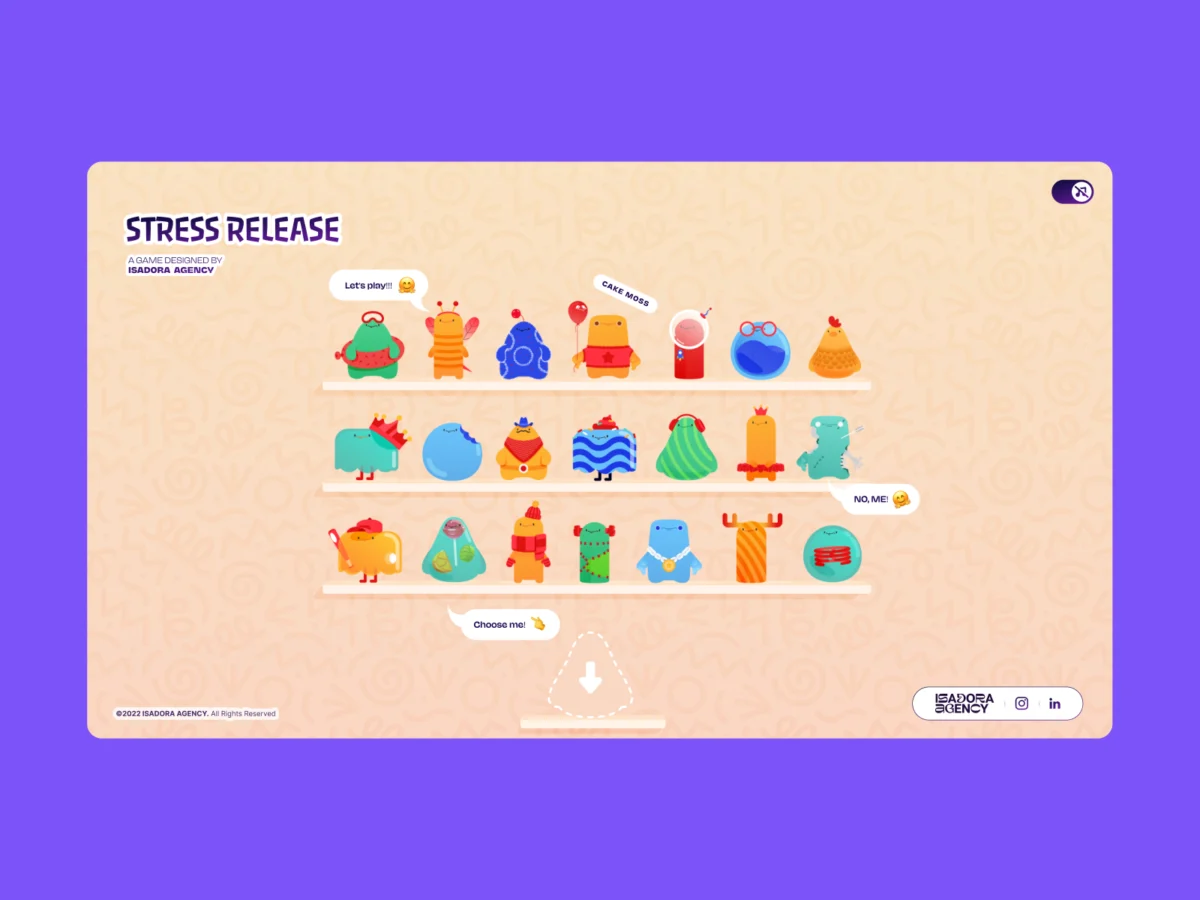
In the contemporary landscape of web development, the push for "immersive" experiences often leads developers toward a singular, well-trodden path: physics engines. When tasked with creating interactive, squishy, or destructive web elements, the default instinct is to reach for powerful libraries like Matter.js, Cannon.js, or high-octane WebGL shaders. However, a recent project by the Isadora Agency—Stress Release—challenges this industry standard, proving that sometimes the best way to handle complex motion is to abandon simulation in favor of absolute, frame-perfect control.
The Architectural Rationale: Art Direction Over Simulation
When the team at Isadora Agency set out to create Stress Release, a browser-based toy designed to help burnt-out creatives channel their frustration into satisfying, squishy digital interactions, they were faced with a fundamental architectural decision. The project required a highly tactile experience where every mouse click or screen tap yielded a specific, intentional, and satisfying reaction.
Initially, the team explored the conventional route of using physics engines. The logic seemed sound: physics engines provide the necessary "weight" and "bounce" required for a tactile interface. Yet, during the early prototyping phase, a critical realization emerged. Physics engines are designed to create plausible motion—unpredictable, gravity-defying, and reactive. The designers, however, had produced intentional motion.
The character animations, meticulously crafted as JSON-based Lottie files, were designed with specific frame-by-frame intent. A "mega squeeze" reaction, for example, required a precise 181-frame build-up sequence followed by a custom release. Using a physics engine would have effectively overridden these artistic choices with algorithmic approximations. To preserve the integrity of the design, the team made a bold choice: they scrapped the physics engine entirely, opting instead for a stack built on programmatic Lottie state control, standard DOM manipulation, and precise distance-based mathematics.
A Chronology of the Development Process
The development of Stress Release was not merely a coding exercise but a balancing act between artistic vision and technical performance. The process began with the definition of the "Intentional Motion" requirements. Because the animations were bespoke, the developers needed an architecture that would serve the animators’ work rather than dictate it.
Phase 1: Mapping the Hitbox
The first technical milestone involved bridging the gap between a user’s interaction (the click) and the Lottie animation engine. Instead of complex raycasting, the team utilized a radial input mapping system. By converting the click coordinates into the local coordinate space of the animated character, the developers could measure the exact distance from the center point of the object using the Pythagorean theorem.

Phase 2: Defining the "Squish" Logic
With the distance established, the team implemented a "concentric zone" system. Much like a physical dartboard, the distance from the center of the character determined the feedback intensity and the reward points. A click dead-center triggered a "bullseye" reaction, while peripheral clicks resulted in smaller, more subtle movements. This allowed the explosion animations to be dynamically positioned at the exact coordinates of the user’s click, creating a seamless connection between the input and the visual feedback.
Phase 3: State-Based Animation Sequencing
The final technical hurdle was controlling the Lottie runtime. Rather than letting animations loop indefinitely or play at random, the team defined specific "segments" within each Lottie file. Using a state-machine approach, the code would listen for a click, interrupt the current "idle" animation, force the playback to a specific frame range (e.g., "squeeze1" or "heavy reaction"), and then—upon completion—revert to the idle state.
Supporting Data: Optimizing Performance for the Web
One might assume that moving away from WebGL would simplify the performance profile, but the team faced a unique challenge: file size. With 21 distinct characters, each featuring multiple animation segments, the project threatened to become bloated.

To maintain a fluid experience, particularly on mobile devices, the team implemented an aggressive optimization strategy. They utilized Lottie’s setQuality and setSpeed parameters to balance visual fidelity with processor load. By setting the quality to 50% for background elements and 100% for the active character being interacted with, they ensured that the frame rate remained consistent. Furthermore, by using CSS variables to handle responsive resizing, they bypassed the need for resource-heavy re-calculations of collision vectors or bounding boxes. The animations scaled naturally within the DOM, ensuring that the visual integrity remained intact regardless of the user’s viewport size.
Implications for Future UX Engineering
The success of Stress Release carries significant implications for the future of UI and UX design. It highlights a growing tension between "realistic" interactive environments and "designed" interactive environments.
The Return of Deterministic Design
The core takeaway from this project is that technology should be subservient to art direction. When developers rely on physics engines, they often lose the ability to fine-tune the "personality" of an animation. By choosing to build a system that respects frame-by-frame timing, Isadora Agency proved that deterministic control is often more valuable than realistic simulation in a commercial or creative UI context.

The DOM as a Canvas
The project also serves as a testament to the power of the DOM and SVG-based animation. By treating the DOM not just as a structural container, but as a responsive, interactive canvas, the team was able to create a high-fidelity experience without needing to step into the more complex world of Canvas or WebGL development. This approach lowers the barrier to entry for many designers and developers, allowing them to leverage their existing knowledge of CSS and standard web APIs to create highly sophisticated, "game-like" interactions.
The Human-Centric Feedback Loop
Perhaps the most important implication is the concept of the "tight click-feedback loop." In Stress Release, the delay between the user’s action and the animation response was minimized to near-zero, creating a tactile sensation that feels immediate. This is a critical lesson for any developer building interactive interfaces: users perceive "feel" not through complex physics, but through the temporal alignment of their input and the system’s reaction.
Conclusion: Let the Design Dictate the Tech
As the web continues to evolve into a more tactile and gamified space, the temptation to use the most "powerful" tool will always be present. However, the experience of building Stress Release provides a powerful counter-narrative. By opting for programmatic state control over emergent simulation, Isadora Agency delivered an experience that was not only performant and responsive but deeply respectful of the animators’ original vision.

The project concludes with a vital reminder for the development community: technology should not be an end in itself. When we prioritize the designer’s intent, we open the door to experiences that are more cohesive, more personality-driven, and ultimately, more satisfying for the user. By mapping Lottie’s native timeline capabilities to the DOM, developers can achieve the same level of immersion as a game engine while maintaining the absolute, pixel-perfect control that modern digital art demands.
Whether you are building a simple stress-relief toy or a complex data visualization, the lesson remains the same: define the motion you want first, and then choose the architecture that enables it—even if that architecture requires a bit of math, a bit of clever logic, and the courage to build it your own way.