



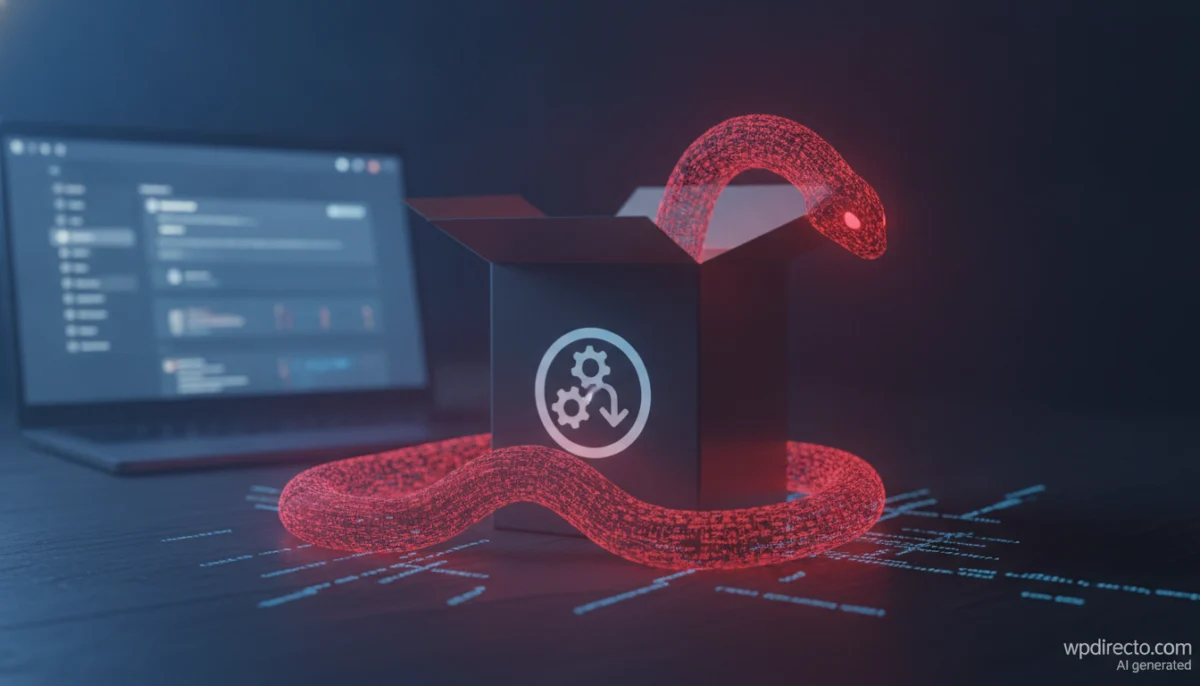
A massive software supply chain breach has shaken the WordPress ecosystem. Popular optimization tool Rank Math has confirmed that specific copies of its Rank Math SEO PRO plugin, version 3.0.123, were laced with malicious code—a sophisticated backdoor capable of granting total administrative control over affected websites.
The incident, which security researchers have formally cataloged as CVE-2026-111862 with a maximum severity rating of 9.8 out of 10 on the CVSS scale, highlights the growing vulnerabilities inherent in third-party software distribution outside the official WordPress repository.
Security firms Patchstack and Wordfence were among the first to sound the alarm, identifying that the malicious payloads were embedded directly into the official distribution packages. This meant that users did not fall victim to a traditional web-application vulnerability; rather, the threat was delivered straight to them through official update mechanisms.
Main Facts at a Glance
- Vulnerable Product: Rank Math SEO PRO (Paid Version Only). The free plugin hosted on WordPress.org is entirely unaffected.
- Affected Version: 3.0.123 (Specific packages downloaded or updated between October 15, 2026, at 22:02 and October 16, 2026, at 09:12 Spanish peninsular time / 20:02 UTC to 07:12 UTC).
- Vulnerability Identifier: CVE-2026-111862 (CVSS Score: 9.8 – Critical).
- Nature of the Attack: Software supply chain compromise introducing an unauthenticated backdoor.
- Malicious Infrastructure: Communicated with the external domain
rank1cdn.com. - Remediation: Version 3.0.124 has been released as a clean replacement. However, simply updating is insufficient if the compromised plugin was actively running.
Chronology of the Incident
The timeline provided by Rank Math and security auditors paints a picture of a tightly bounded, highly targeted infiltration window.
October 15, 2026 (22:02 Spanish Peninsular Time)
The compromised build of Rank Math SEO PRO version 3.0.123 goes live on the company’s distribution servers. Unbeknownst to the developers or the early adopters, the installation archives have been altered to include a persistent PHP backdoor.
October 15–16, 2026 (The Exposure Window)
For roughly eleven hours, webmasters around the globe download or auto-update their premium installations to the tainted 3.0.123 build. Because the plugin is distributed independently via customer accounts on rankmath.com rather than the centralized WordPress.org plugin repository, standard automated security checks are bypassed.
October 16, 2026 (09:12 Spanish Peninsular Time)
Rank Math detects the discrepancy, pulls the malicious packages offline, and immediately pushes out a secure, sanitized version: 3.0.124.
Immediate Aftermath
Security platforms like Wordfence and Patchstack issue emergency advisories. They note that while the window of distribution was narrow, the potential damage to individual websites is catastrophic due to the stealthy and persistent nature of the injected payload.
Technical Analysis: What the Malware Actually Did
Security telemetry and analysis from Wordfence reveal that the backdoor remained dormant unless the plugin was actively enabled on a WordPress installation. However, once activated, the malware systematically stripped away the site’s security posture.
1. Persistence and Self-Replication
The backdoor was engineered to establish deep, persistent access. Every time a visitor loaded a page on the compromised site, the script would communicate with the external command-and-control (C&C) server—identified as rank1cdn.com—and dynamically regenerate hidden PHP backdoors. This meant that simply deleting an obvious malicious file was futile; the system would rebuild the threat autonomously.
2. Credential Harvesting and Data Exposure
The malware did not just sit quietly; it actively scraped sensitive data. It was capable of exposing:
- Core WordPress user credentials.
- Database connection strings and login details.
- Third-party API keys.
- Any other server-readable secrets stored in the environment.
3. Privilege Escalation and Backdoor Accounts
Once inside, the payload could autonomously spin up unauthorized administrator accounts—often camouflaged with prefixes such as wpsupport_—to ensure continuous access even if the original vector was patched. It could also schedule rogue system tasks (cron jobs) to execute malicious routines at predetermined intervals.
Indicators of Compromise (IoCs)
Administrators running forensic audits on potentially impacted servers are advised to search for the following definitive markers:
- Outbound connections to
rank1cdn.com. - Specific anomalous entries in the
wp_optionsdatabase table:_uf6qdn2hmm,t8krdk990phb, and_np5pvf754c. - Unauthorized administrator accounts beginning with the prefix
wpsupport_. - The presence of a suspicious file located at
wp-includes/class-wp-cache-util.php.
Action Plan: What to Do If You Use Rank Math SEO PRO
If your website utilizes the premium tier of Rank Math, immediate action is required. However, the appropriate response depends entirely on how and when the plugin was handled during the exposure window.
Scenario A: Downloaded and Activated Version 3.0.123
If you installed and activated the plugin during the compromised timeframe, your website must be treated as fully compromised.
- The Golden Standard: The safest remediation strategy is to restore both your website files and your MySQL database from a verified clean backup created prior to October 15, 2026, at 22:02 (Spanish peninsular time).
- Manual Cleanup (If No Backup Exists): Because the malware continuously self-replicates, you must clean the server in a strict, methodical order:
- Revoke and change all database passwords, WordPress user passwords, and FTP/SSH credentials.
- Purge unauthorized administrator accounts (checking specifically for the
wpsupport_prefix). - Locate and delete injected files (such as
wp-includes/class-wp-cache-util.phpand modified core files). - Clean the database options table of malicious entries (
_uf6qdn2hmm,t8krdk990phb,_np5pvf754c). - Finally, install the clean 3.0.124 update.
Scenario B: Installed Version 3.0.123 But Never Activated
If the plugin was installed on your staging or production server during the window but was left in an inactive state, you are safe from execution. The malware required activation to trigger. Simply delete the plugin files, clear your cache, download version 3.0.124 directly from your Rank Math account, and run a comprehensive security scan.
Scenario C: Downloaded the ZIP File Without Installing It
If you downloaded the package to your local machine or cloud storage but never uploaded or installed it onto a live WordPress environment, there is zero risk of compromise. You may discard the ZIP file and download the fresh 3.0.124 release.
Note: Rank Math has issued a strict security reminder: always navigate directly to rankmath.com by typing the URL into your browser. The company has explicitly stated that they never send direct download or login links via unsolicited emails. Treat any email claiming to offer an "emergency patch link" as a phishing attempt.
Industry Implications and the Broader Threat Landscape
The Rank Math incident is far from an isolated event; it lays bare a systemic vulnerability in how the modern WordPress economy operates.
The Fragility of the Premium Plugin Supply Chain
While free plugins hosted on the official WordPress.org directory undergo automated code sniffing and must match subversion (SVN) repositories with public checksums, premium commercial plugins live in the wild. They are distributed via proprietary client dashboards, custom licensing servers, and independent CDNs.
When a commercial vendor’s infrastructure or build pipeline is compromised—as seen earlier this year in the cyberattack targeting the Awesome Motive CDN—millions of sites are left exposed to supply chain injections. This has accelerated calls within the developer community for advanced supply chain monitoring tools (such as WP Beacon) that verify the cryptographic integrity of commercial updates before they touch production environments.
A Brutal Week for WordPress Security
This zero-day style software poisoning compounds an already disastrous week for WordPress administrators. The Rank Math disclosure follows closely on the heels of:
- The active exploitation of a critical remote code execution (RCE) vulnerability in Bricksforge.
- A widespread Cross-Site Scripting (XSS) campaign leveraging Ninja Forms to silently inject hidden administrative accounts into vulnerable databases.
As cybercriminals increasingly target the software supply chain rather than attacking individual website perimeters, developers and site owners alike must evolve their defensive strategies. Regular automated backups, strict file-integrity monitoring, and extreme caution regarding third-time-lucky commercial updates are no longer optional—they are the baseline for survival in the modern web landscape.