Transforming Energy Into Intelligence: Kazakhstan’s Rapid Ascent as a Global AI Powerhouse
Main Facts
Kazakhstan is officially transitioning its ambitious artificial intelligence ecosystem from abstract infrastructure blueprints to aggressive, large-scale deployment. This seismic shift spans the entire technology stack—encompassing next-generation data center infrastructure, localized foundational language models, autonomous physical robotics, and high-impact commercial applications.
The turning point for the Central Asian nation materialized during a high-profile visit to Astana by NVIDIA Founder and CEO Jensen Huang. The landmark diplomatic and technological exchange featured high-level meetings at the Akorda Presidential Palace with President Kassym-Jomart Tokayev, alongside a public fireside chat at the Alem.AI international center alongside Deputy Prime Minister Zhaslan Madiyev, who also serves as Kazakhstan’s Minister of AI and Digital Development.
Key milestones unveiled during the visit include:
A massive new multi-phase investment agreement by Firebird to deploy up to 45,000 NVIDIA Grace Blackwell GPUs, with a long-term vision scaling to 500 megawatts of total capacity.
Expanding computational deployments by Kazakhtelecom, incorporating high-performance NVIDIA H200, B300, and upcoming Vera Rubin architectures.
Strategic partnerships between global mobility and local players—such as inDrive and Pony.ai—to pilot autonomous robotaxi fleets in Astana.
NVIDIA’s direct venture investment into Higgsfield AI, a prominent generative media startup founded by Kazakh innovators.
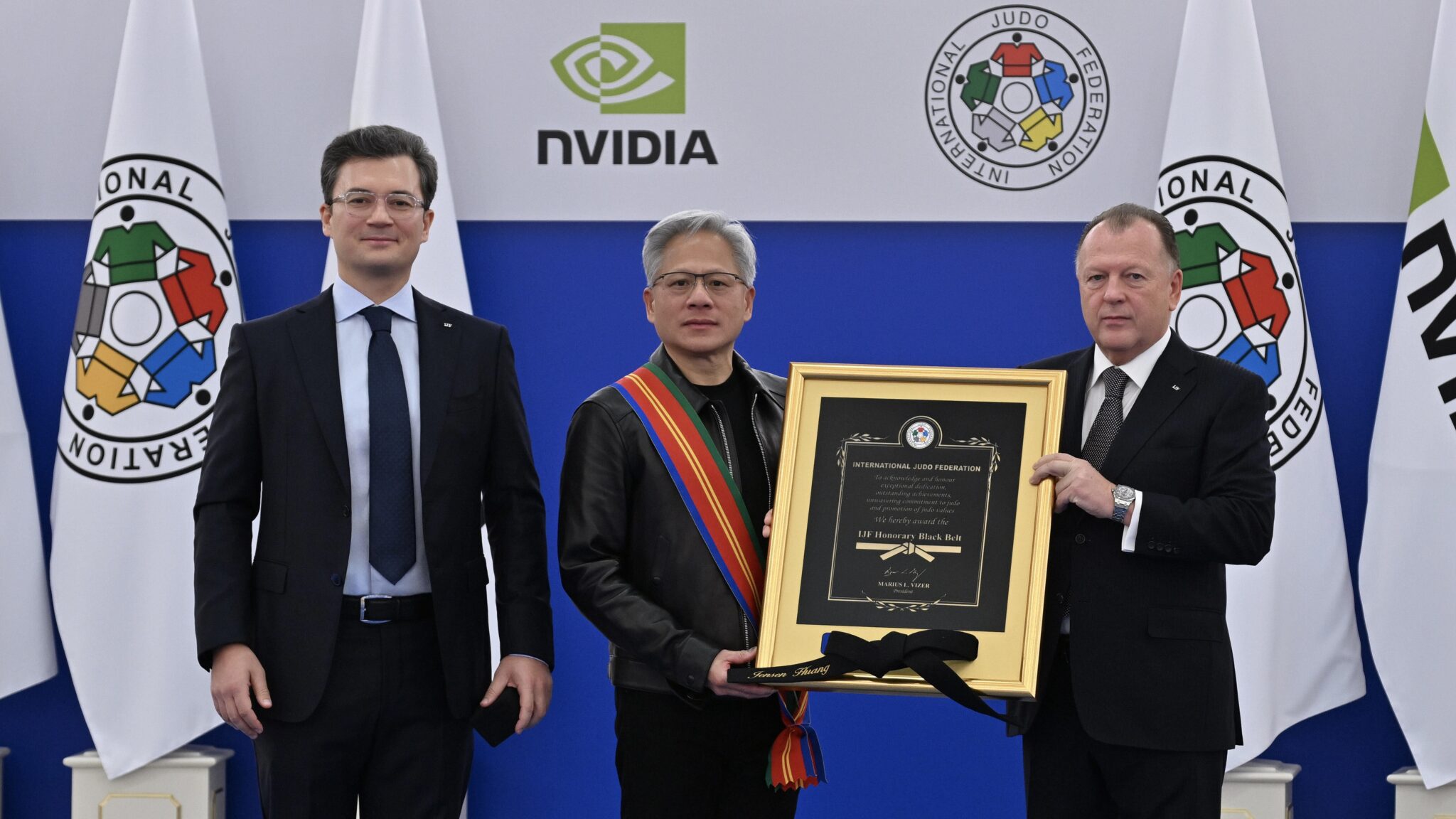
High-level state recognition for Jensen Huang, including the prestigious Order of Dostyk (First Class) presented by President Tokayev, alongside an honorary judo black belt from the International Judo Federation.
Chronology of Events
The Astana Summit: October 23
The convergence of global semiconductor leadership and Central Asian state ambition took place on Friday, October 23, in Astana. The day’s events marked a critical milestone in Kazakhstan’s pursuit of digital sovereignty.
Morning: The Presidential Palace Discussions
Jensen Huang arrived at the Akorda Presidential Palace for a private audience with President Kassym-Jomart Tokayev. The discussions centered on turning Kazakhstan’s abundant energy reserves into computational power. During this meeting, a historic signing ceremony took place, cementing Firebird’s multi-million-dollar infrastructure commitment to the country in partnership with the government. Recognizing his monumental contributions to the nation’s technological trajectory, President Tokayev formally invested Huang with the Order of Dostyk, First Class—an honor signifying peace, friendship, and international cooperation.
Afternoon: The Alem.AI Fireside Chat
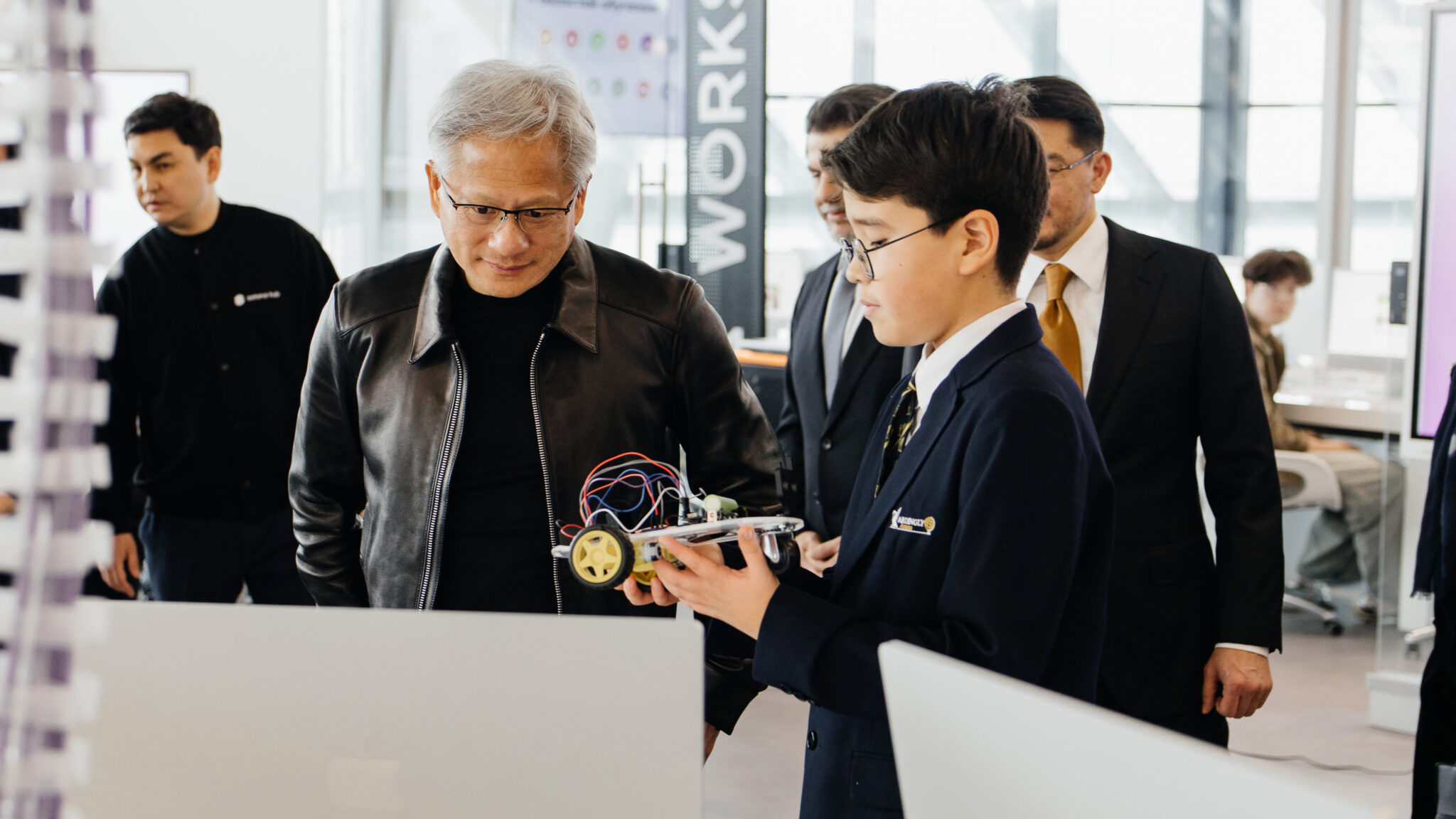
Following the governmental briefings, Huang joined Deputy Prime Minister Zhaslan Madiyev for an on-stage public fireside chat at Alem.AI, Kazakhstan’s premier international center for artificial intelligence. The dialogue drew crowds of local developers, students, and tech entrepreneurs eager to hear how the nation plans to scale its capabilities.
Madiyev emphasized the necessity of cultural preservation through technology, noting ongoing efforts to build native large language models that reflect the nuances of the Kazakh language and heritage. In response, Huang noted that a country’s native data is its most valuable natural resource: "Your country’s data is your natural resource. It belongs to you."
Evening: Developer Receptions and Martial Arts Honors
As the sun set, the delegations transitioned to a developer reception where hundreds of local engineers shared their visionary projects. The day culminated in a surprise cultural presentation: Marius Vizer, President of the International Judo Federation (IJF), alongside IJF Executive Committee member Timur Kemell, presented Huang with an honorary black belt embroidered in gold. The belt recognized Huang’s dedication to building a disciplined, rigorous, and globally competitive AI ecosystem mirroring the values of the martial art.
Supporting Data and Infrastructure Scaling
Kazakhstan’s digital transformation is anchored by concrete hardware commitments and data center expansion across strategic geographic hubs.
Firebird’s 500-Megawatt Vision
Building upon its successful deployment of an AI factory in Armenia, infrastructure firm Firebird is significantly expanding its footprint into Kazakhstan. Having successfully secured a U.S. export license for 45,000 NVIDIA Grace Blackwell GPUs, the company has broken ground on its first construction phase in collaboration with Kazakhtelecom at Data Center Valley. Commercial operations are slated to launch in the third quarter of 2027.
A planned second phase will dramatically scale Firebird’s total potential infrastructure capacity in the country to roughly 500 megawatts. Additionally, the firm is launching Firebird Labs Kazakhstan, an initiative designed to funnel grants, compute access, and research partnerships directly to local startups and academic institutions.
Kazakhtelecom’s Accelerated Deployment
Kazakhstan’s premier telecommunications provider, Kazakhtelecom, is rapidly building out domestic processing muscle. The company has already deployed 400 NVIDIA H200 and 480 NVIDIA B300 GPUs across data centers in Astana and Almaty. Looking ahead to the following year, Kazakhtelecom plans to deploy over 1,000 advanced GPUs within Data Center Valley, alongside a deployment of more than 1,000 NVIDIA Vera Rubin GPUs in the energy-rich Ekibastuz region. This multi-tiered infrastructure ensures that local businesses, academic institutions, and enterprise developers maintain access to cost-effective, high-speed computational power at scale.
AI-Native Startups and Autonomous Mobility
Beyond raw cloud and data center architecture, application-layer companies are leveraging local computing power to scale globally:
Higgsfield AI: The Kazakhstan-founded generative media startup is expanding its compute infrastructure by tapping into NVIDIA Vera Rubin architecture via cloud service providers, fueling surging global consumer and enterprise demand.
inDrive and Pony.ai: In a move toward physical AI, ride-hailing giant inDrive and autonomous driving pioneer Pony.ai announced a strategic collaboration to explore autonomous mobility services. Astana will serve as the launchpad for testing seventh-generation robotaxis on the inDrive app, fully integrated with the NVIDIA Hyperion sensor platform and secured by the NVIDIA Halos safety architecture.
Official Responses and Strategic Perspectives
Government Leadership: Cultivating Digital Sovereignty
Deputy Prime Minister Zhaslan Madiyev framed Kazakhstan’s national AI strategy around cultural authenticity and economic diversification.
"We want AI that understands and speaks Kazakh and captures cultural contexts and cultural specifics," Madiyev stated during the Alem.AI discussion, highlighting active investments into national large language models.
Madiyev also steered the conversation toward physical AI and industrial automation, querying how Kazakhstan’s massive industrial base—spanning heavy mining, mineral processing, agriculture, and complex transport logistics—could transform the nation into a global training hub for robotic systems.
NVIDIA Leadership: Transforming Energy Into Intelligence
Jensen Huang offered a transformative economic vision for Kazakhstan, arguing that the nation’s traditional geographic and energy advantages can be weaponized for the digital age.
"Instead of just exporting energy, in the future, you could transform energy into intelligence and export intelligence," Huang declared.
Addressing the nation’s broader ethos, Huang expressed profound optimism regarding the country’s human capital: "If you have ambition, and I believe you do, AI will lift your nation. AI will lift your people."
Commenting on NVIDIA’s venture investment into Higgsfield AI, Huang reiterated his philosophy on venture capital: "The first thing and the last thing is you invest in people, not companies."
Regarding safety and governance, Huang addressed growing concerns over autonomous agent security by highlighting NVIDIA’s OpenShell framework, which is engineered to securely isolate AI agents by strictly governing their tool access, file permissions, and real-time operational monitoring.
Industry Perspectives: Razmig Hovaghimian
Reflecting on the whirlwind timeline of Firebird’s partnership with the Central Asian republic, Firebird Co-Founder and CEO Razmig Hovaghimian emphasized the vital role of state vision in attracting foreign direct investment.
"What began as a seed of an idea 180 days ago has grown into a major investment in Kazakhstan’s AI future," Hovaghimian noted. "President Tokayev’s vision gave us the confidence to think bigger about what we can build together. With Jensen Huang here today, that ambition feels more tangible than ever. We’re building the infrastructure for Kazakhstan’s talent and ideas to reach the world."
Global and Regional Implications
1. Central Asia’s Emergence as a Global Tech Corridor
For decades, Central Asia was viewed primarily as a transit corridor for physical commodities, oil, and gas. By aggressively courting semiconductor heavyweights, securing top-tier hardware allocations (such as Grace Blackwell and Vera Rubin architectures), and establishing massive 500-megawatt power infrastructure projects, Kazakhstan is effectively carving out a new identity as a transcontinental hub for sovereign AI computation.
2. The Rise of "Sovereign AI" and Cultural Preservation
Kazakhstan’s insistence on building localized language models challenges the Western- and Anglo-centric hegemony over foundational AI research. By asserting that local data is a sovereign natural resource that must be protected, parsed, and translated into indigenous models, Astana is setting a blueprint for emerging economies worldwide. It proves that developing nations do not merely have to consume foreign AI systems—they can architect, train, and export models that reflect their distinct cultural heritage.
3. Bridging the Gap Between Digital and Physical AI
While many nations limit their AI aspirations to text-based chatbots and enterprise software, Kazakhstan’s strategic focus on heavy industry, robotics, mining, and autonomous robotaxis (via the inDrive and Pony.ai partnership) illustrates a holistic approach to the technology stack. By embedding AI directly into the physical economy—agriculture, manufacturing, and transport—the country is maximizing productivity gains across blue-collar and white-collar sectors alike.
4. Human Capital and the Educational Paradigm Shift
As Jensen Huang advised the hundreds of local students and developers gathered in Astana, the future belongs to those who look past superficial prompt engineering and deeply understand computational principles: "I envy being 18 years old today… because the world is changing so rapidly, and there’s a complete reset because of technology."
By coupling heavy hardware deployment with educational incubators like Firebird Labs and Alem.AI, Kazakhstan is actively engineering a generational pipeline of technical talent capable of competing on the global stage.