








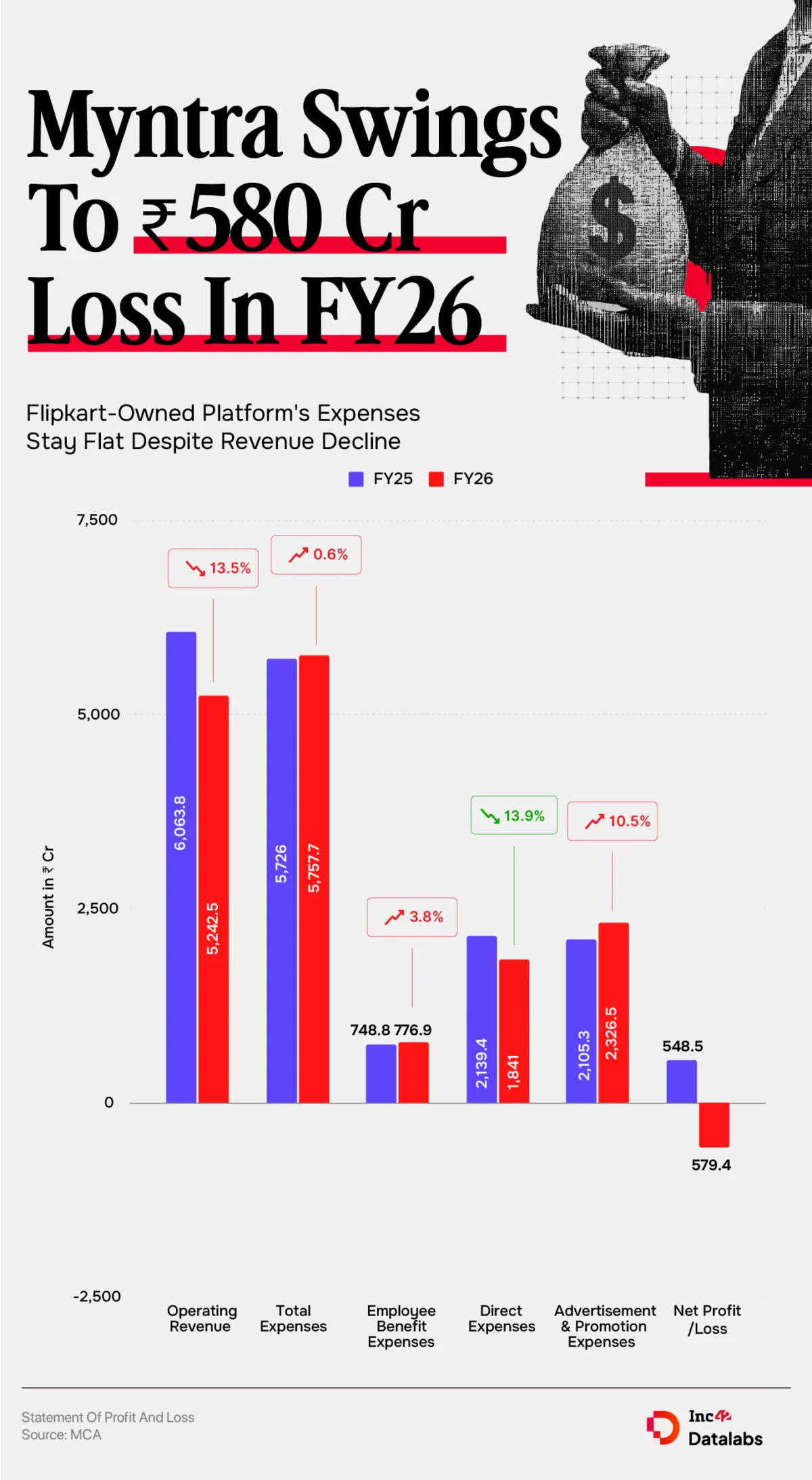
In a significant reversal of its financial trajectory, fashion e-commerce major Myntra has reported a net loss of ₹581.8 Cr for the fiscal year ended March 31, 2026 (FY26). This figure stands in stark contrast to the previous fiscal year (FY25), during which the company had successfully turned a profit of ₹546.3 Cr. The results, released alongside the consolidated performance reports of its parent entity, the Flipkart Group, highlight a period of consolidation and strategic recalibration for the Bengaluru-based fashion giant.
The financial performance of the platform, which has long been considered the crown jewel of India’s online fashion retail ecosystem, reflects a complex interplay between aggressive market competition, changing consumer spending patterns, and a fundamental restructuring of revenue streams.
The Financial Landscape: A Deep Dive into the Topline
Myntra’s operating revenue saw a contraction of 13.5%, dropping to ₹5,242.5 Cr in FY26 from the ₹6,063.8 Cr reported in the previous fiscal. When accounting for other income of ₹73.3 Cr, the total income for the fiscal year reached ₹5,315.8 Cr, marking a 13.4% decline compared to the ₹6,137 Cr recorded in FY25.
To understand this contraction, one must look at the granular breakdown of Myntra’s three core revenue pillars: marketplace services, advertising, and logistics.
- Marketplace and Collection Services: This remains the backbone of the company, contributing 50.7% of total revenue. Earnings here grew modestly by 3%, reaching ₹2,657.3 Cr, up from ₹2,580.2 Cr in FY25. This indicates that while the core business of facilitating third-party transactions remains stable, it is not currently offsetting the decline in other areas.
- Advertisement Services: Perhaps the most promising segment, advertising revenue surged by 35.2% to ₹1,236.4 Cr. This growth underscores Myntra’s increasing ability to monetize its platform through brand partnerships and sponsored visibility, a trend consistent with global e-commerce shifts toward retail media networks.
- Logistics and Shipping Services: This segment experienced the most dramatic downturn, falling by 53.2% to ₹1,119.2 Cr from ₹2,390.5 Cr in the previous year. This precipitous drop suggests a deliberate strategy—or perhaps a structural shift—in how Myntra manages its fulfillment network and shipping logistics, likely leaning into efficiencies or outsourcing models that do not reflect as direct revenue.
Despite the bottom-line losses, the company managed to narrow its EBITDA loss to ₹435 Cr in FY26, down from the ₹535.9 Cr reported in FY25. This suggests that while top-line growth has stalled, the company is maintaining a disciplined focus on operational efficiency.
Chronology of Evolution: From Startup to Corporate Titan
Founded in 2007 by Mukesh Bansal, Ashutosh Lawania, and Vineet Saxena, Myntra began its journey as a B2B platform for personalized gift items before pivoting to the burgeoning fashion e-commerce sector. Its growth trajectory was rapid, establishing it as the premier destination for branded fashion in India.

- 2014: A watershed moment occurred when Flipkart acquired Myntra for approximately $240 Mn. This acquisition allowed Myntra to operate as an independent entity while leveraging Flipkart’s vast logistics and capital backing.
- 2020-2024: During this period, Myntra solidified its dominance through high-decibel marketing campaigns like "End of Reason Sale" (EORS) and strategic partnerships with global brands.
- Early 2026: In a significant leadership reshuffle, Sharon Pais, formerly of Flipkart Fashion, was elevated to lead the Myntra marketplace. Simultaneously, the company signaled a focus on technological infrastructure by appointing former Instacart executive Pramod Adiddam as its Chief Technology Officer (CTO), aiming to modernize its backend capabilities to combat rising competition from quick-commerce and specialized fashion startups.
Contextualizing the Flipkart Group’s Performance
Myntra’s performance must be viewed through the lens of its parent, the Flipkart Group. Following its "reverse flip" to India, the Walmart-backed giant showcased a robust consolidated performance. The group reported an 18.2% jump in consolidated revenue from operations, hitting ₹1.45 Lakh Cr.
While the group’s overall loss narrowed by 2.1% to ₹8,468 Cr, the parent company noted that the improvement in Profit After Tax (PAT) was "moderated by higher finance costs, the derecognition of deferred tax assets recognized in earlier periods, and certain one-off exceptional items." This context is vital, as it suggests that Myntra’s loss is part of a broader group-level strategy that prioritizes long-term market share and infrastructure investments over immediate profitability for individual subsidiaries.
The Expense Structure: Where the Capital Went
Total expenses for the 2025-26 fiscal year remained remarkably flat, increasing by only 0.6% to ₹5,757.7 Cr. This flatlining of expenditure indicates that management enforced strict cost-control measures.
However, the composition of these expenses tells a story of a platform in transition. While logistics costs were curtailed, the company continued to invest heavily in technology and marketing to maintain its relevance in a market that is increasingly fragmented by social commerce and direct-to-consumer (D2C) brands. The appointment of a new CTO suggests that a significant portion of capital is being diverted toward AI-driven personalization and supply chain optimization—investments that are intended to yield returns in future quarters rather than the immediate fiscal period.
Implications for the Future of Fashion E-commerce
The FY26 results present a nuanced narrative for the Indian e-commerce sector. The primary implications of these figures are threefold:
1. The End of "Easy Growth"
Myntra’s double-digit revenue decline is a wake-up call for the entire e-commerce industry. The era of unchecked growth powered by heavy discounting is fading. Consumers are becoming more price-sensitive and brand-agnostic, often shifting loyalty to smaller, niche platforms that offer faster delivery or unique curation.

2. The Power of Retail Media
The 35% growth in advertising revenue is a clear indicator of where the future of profitability lies. For platforms like Myntra, the ability to act as a marketing engine for brands is becoming as important as the ability to move physical inventory. Expect to see deeper integration of ad-tech and data analytics in the coming months.
3. Structural Reorganization
The sharp decline in logistics revenue suggests that Myntra is moving away from a high-overhead, internal-heavy logistics model toward a more lean, agile structure. This is likely a response to the "quick-commerce" phenomenon, which has forced all major e-commerce players to rethink their delivery speed and cost-to-serve ratios.
Expert Analysis and Market Outlook
Industry analysts suggest that Myntra’s current losses are "strategic investments disguised as setbacks." By absorbing costs related to technological upgrades and internal restructuring, the company is attempting to future-proof itself against the rapid encroachment of new-age platforms.
"The shift in leadership and the emphasis on technological capability under the new CTO, Pramod Adiddam, indicates that Myntra is moving away from a ‘scale-at-all-costs’ mindset," says a retail analyst familiar with the Flipkart Group’s strategy. "The revenue contraction is painful, but it reflects a platform that is cleaning up its balance sheet and prioritizing high-margin revenue streams like advertising over low-margin, high-logistics-cost transactions."
Looking ahead, the market will be watching to see if Myntra can stabilize its topline in FY27. With the festive season approaching and consumer sentiment showing signs of a rebound, the efficacy of the new leadership team will be tested. The company’s ability to balance its traditional strength in fashion retail with the emerging demands of digital-first consumers will determine whether this fiscal year was a temporary dip or the beginning of a structural transformation for one of India’s most iconic internet companies.
In conclusion, Myntra’s FY26 report serves as a microcosm of the broader Indian digital economy: a sector transitioning from the euphoria of rapid expansion to the sobering reality of sustainable, profitable growth. While the net loss is significant, the underlying shift toward high-margin services suggests a company that is intentionally shedding its skin to survive in a more competitive, demanding, and sophisticated market.