







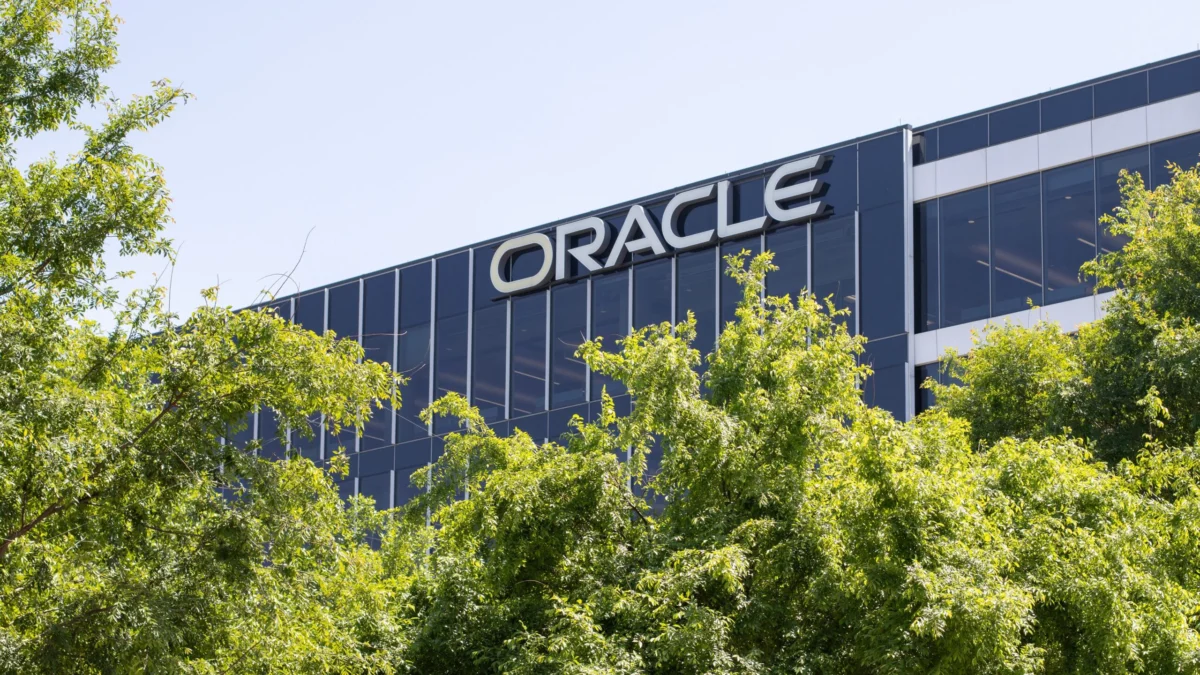
LAS VEGAS — In a major move to solidify its position in the competitive enterprise data infrastructure market, Oracle has announced a sweeping suite of updates to its Autonomous AI Lakehouse. Unveiled at the company’s annual AI World conference, the enhancements are engineered to address some of the most persistent hurdles in enterprise artificial intelligence: data ambiguity, fragmented planning systems, and the heavy operational overhead of data movement.
The centerpiece of the announcement is the introduction of a Business Semantic Layer designed specifically to give AI agents a consistent, context-aware understanding of complex corporate data. Alongside this capability, Oracle revealed a powerful new Business Simulation Engine—integrating the legendary Oracle Essbase technology directly into the lakehouse architecture—and significantly expanded support for Apache Iceberg.
Together, these updates aim to help global enterprises improve AI reliability, accelerate multi-dimensional planning, reduce data duplication, and scale autonomous applications with confidence. However, industry analysts and technology leaders note that these advanced capabilities will also introduce new governance responsibilities and integration challenges for chief information officers (CIOs) and data engineering teams.
1. Main Facts: Core Pillars of the Oracle AI Lakehouse Update
The newly announced capabilities are structured to tackle distinct operational bottlenecks within enterprise data ecosystems:
- The Business Semantic Layer: Built to ground AI agents in true business context, this layer leverages catalog annotations, SQL annotations imported from the Oracle AI Database, and AI-suggested analytic views. It creates reusable data models capturing dimensions, measures, hierarchies, calculations, and Key Performance Indicators (KPIs). These definitions integrate directly with natural-language querying tools like Oracle Select AI to ensure consistent analytical outputs.
- The Business Simulation Engine: By embedding Oracle Essbase natively into the Autonomous AI Lakehouse, this engine delivers advanced forecasting, what-if scenario modeling, write-back capabilities, dynamic hierarchy rollups, complex calculations, and allocations. Users can query the engine using natural language, build simulation reports, and perform native Excel-based analysis over data stored either in Oracle databases or external object storage.
- Expanded Apache Iceberg Support: Oracle is deepening its integration with the open table format, allowing data professionals to seamlessly create, populate, update, and delete Iceberg tables using standard SQL. This update enhances performance across both external catalogs and Oracle’s native AI Data Catalog.
2. Chronology of the Rollout and Strategic Context
The evolution of Oracle’s data management strategy has accelerated rapidly over the past year as businesses shift from experimental AI proofs-of-concept to large-scale, production-grade agentic applications.
- Initial Lakehouse Foundation: Earlier this year, Oracle debuted its Iceberg-compatible Autonomous AI Lakehouse, signaling its intent to bridge the gap between transactional databases, data lakes, and modern AI workloads.
- AI World Unveiling: At the company’s annual AI World conference in Las Vegas, Oracle executives formally showcased the next phase of the architecture, introducing the Business Semantic Layer and the Business Simulation Engine to address the critical need for governance and planning.
- Phased Availability Timeline: While the Business Semantic Layer is slated for a roll-out across the next 12 months, Oracle has not yet provided a definitive release date for the general availability of the Business Simulation Engine or the expanded Apache Iceberg management features.
3. Supporting Data and Industry Benchmarks
The rationale behind Oracle’s new architecture is rooted in the immense friction organizations face when reconciling disparate data sources and inconsistent AI outputs. Industry metrics underscore the scale of these challenges:
- Reduction in Reconciliation Time: According to case studies from IT consulting firm Kanerika, standardizing business definitions and modeling core entities drastically cuts operational drag. Amit Kumar Jena, AI development head at Kanerika, noted that when his team modeled over 40 entities and standardized more than 85 KPIs for a global pharmaceutical client using Microsoft Fabric (a rival platform), investigation and reconciliation time fell by approximately 70% before AI agents went live.
- Ecosystem Flexibility: By supporting native SQL operations on Apache Iceberg tables, Oracle enables data engineers to maintain a single copy of data while interacting interchangeably with platforms like Apache Spark, Snowflake, and Databricks. This cross-platform interoperability addresses a major pain point for CIOs seeking to eliminate storage bloat and redundant processing pipelines.
4. Official Responses and Expert Perspectives
Industry leaders, consultants, and enterprise architects have offered mixed reactions, praising the strategic vision while issuing pragmatic warnings regarding deployment complexity.
Enhancing AI Reliability and Scalability
For organizations attempting to scale artificial intelligence across disparate business units, semantic consistency is non-negotiable.
"These improvements in reliability will, in turn, help CIOs scale agentic applications across business functions and rely on AI-driven decision-making with greater confidence," said Manoj Chandra Jha, principal analyst at Nord-IQ Research.
Amit Kumar Jena echoed this sentiment, emphasizing that grounding AI agents in approved business metrics prevents erratic behavior. "That ability to ground AI agents in business context will help data professionals and developers build more reliable AI-driven analytics and applications by using approved business metrics and definitions, reducing the time spent investigating and reconciling inconsistent results," Jena explained.
Bridging Analytics and Planning
The integration of Oracle Essbase via the Business Simulation Engine brings financial planning and big data analytics under one roof, a convergence long sought after by enterprise CFOs.
"By bringing analytics and planning closer together, the engine could help finance teams and business planners run what-if scenarios using enterprise data without repeatedly moving it between separate systems," said Pareekh Jain, principal analyst at Pareekh Consulting.
Jain added that the architectural consolidation benefits both technical and business stakeholders: "For CIOs, that could simplify data architecture and accelerate decisions, while developers could spend less time building integrations between analytics and planning tools and more time developing applications that turn business insights into actionable workflows."
Streamlining Data Engineering with Iceberg
Data engineers stand to benefit significantly from the ability to manage open table formats using familiar query languages.
"The expanded Apache Iceberg support could further simplify data management for developers and data professionals by allowing them to create and modify Iceberg tables using familiar SQL, rather than relying on separate tools or workflows," Jha pointed out. "This means being able to work with a single copy of the data using SQL while retaining the flexibility to use Oracle alongside platforms such as Apache Spark, Snowflake, or Databricks on the same tables."
5. Implications: Opportunities, Challenges, and Vendor Dynamics
While the technical promise of Oracle’s expanded Autonomous AI Lakehouse is substantial, industry observers caution that implementation will require careful governance and strategic oversight.
The Governance Burden of the Semantic Layer
The Business Semantic Layer requires disciplined maintenance. Enterprises cannot simply turn on the feature and expect automated perfection; they must actively define and govern the underlying business rules.
"The Business Semantic Layer will require enterprises to define and maintain business metrics, relationships, and rules to ensure AI agents interpret data consistently," warned Jena. He noted that for CIOs, this introduces a profound governance responsibility: "If the models are incomplete or outdated, AI-generated insights could still be inconsistent or misleading, while expanding the layer across business functions could require sustained work from data teams to model and validate new metrics and relationships."
Navigating Competitive Planning Markets
With the inclusion of the Business Simulation Engine, Oracle is positioning itself more directly against dedicated, cloud-native planning platforms such as Anaplan, OneStream, and SAP Analytics Cloud.
Pareekh Jain highlighted that the primary hurdle for this tool will be integration friction: "The challenge will lie in how well it fits into existing enterprise workflows, supports established planning processes, and integrates with systems already in use."
Vendor Lock-In vs. Open Architecture
Although expanded Apache Iceberg support champions open data principles by reducing duplication and storage costs, experts caution that true platform independence remains nuanced.
"While open table formats can make data easier to access across platforms, enterprises may still depend on proprietary catalogs and semantic layers to manage and interpret it," Jha observed. Nevertheless, Jain noted that the reduction in data movement ultimately delivers immediate financial dividends: "That reduced data duplication, in turn, for CIOs, could reduce associated storage and processing costs, while giving greater flexibility to work across different data platforms."
Conclusion
Oracle’s latest enhancements to the Autonomous AI Lakehouse represent a mature approach to enterprise artificial intelligence—one that prioritizes structural context, financial modeling precision, and open-format flexibility over raw computational brute force. As organizations navigate the complexities of deploying autonomous agents at scale, tools that bridge the gap between chaotic raw data and disciplined business semantics will undoubtedly form the backbone of the next generation of enterprise architecture. However, success will ultimately depend on the rigor with which IT leaders manage governance, metadata, and cross-platform integration.