










The Indian smartphone landscape, a fiercely competitive arena dominated by global giants and agile domestic challengers, is set to witness a high-profile comeback. After a three-year hiatus, Alcatel—a brand synonymous with the early evolution of mobile telephony—is officially preparing to reclaim its foothold in the country. Spearheading this revival is the Alcatel V3 Ultra, a device that promises to marry the company’s storied heritage with modern display innovations and premium productivity features.
The Signal: Unboxing the Future
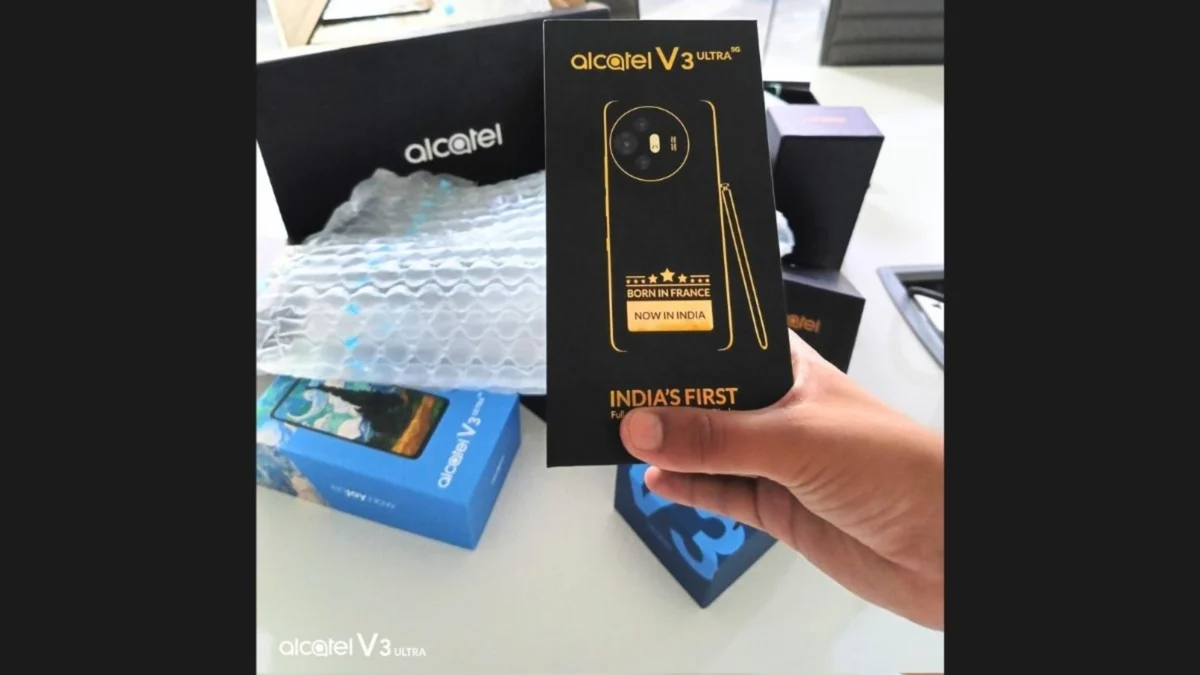
The anticipation surrounding the Alcatel V3 Ultra reached a fever pitch recently when Madhav Sheth, a key figure instrumental in the brand’s strategic operations in India, provided the first definitive look at the device. Through a social media reveal, Sheth showcased the retail packaging of the V3 Ultra, offering enthusiasts a glimpse into what the company describes as a "premium" hardware experience.
The packaging itself—a stark, sophisticated black box accented with bold yellow typography—signals a shift toward a more modern, lifestyle-oriented branding approach. Most notably, the box prominently displays a stylus icon, confirming that the V3 Ultra will be a productivity-focused handset. Furthermore, the imagery suggests a refined design language, featuring a prominent circular rear camera module that houses a triple-sensor array paired with a robust LED flash unit.
The inclusion of the stylus is a strategic differentiator. By catering to users who prioritize note-taking, digital art, and precise navigation, Alcatel is positioning the V3 Ultra against entrenched mid-range competitors. The blue-variant packaging hints at a device that is as much about aesthetics as it is about internal performance, with early design leaks pointing toward a sleek, flat-display profile equipped with a centrally located hole-punch cutout, ensuring a high screen-to-body ratio.
A Chronology of the Rebirth
The path to this launch has been calculated and methodical. Alcatel’s journey back to the Indian consumer consciousness began in early April, when the brand—now operating under the umbrella of TCL Communication—formally signaled its intent to re-enter the market.
- Early April 2025: Alcatel makes its formal announcement of a return to India, emphasizing a pivot toward the premium smartphone segment.
- Mid-April 2025: Strategic partnerships are solidified, most notably with Flipkart. A dedicated landing page is established on the e-commerce giant’s platform, teasing the upcoming series of handsets.
- Late April 2025: The company confirms its commitment to the "Make in India" initiative, outlining plans for local manufacturing facilities to ensure both supply chain stability and alignment with government economic policies.
- Early May 2025: Madhav Sheth provides the "first look" at the V3 Ultra, confirming the triple-camera setup and the integrated stylus.
This timeline reflects a brand that has spent its three-year absence conducting deep market research, ensuring that its return isn’t just an attempt to sell volume, but an effort to establish a sustainable, premium brand identity in one of the world’s most sensitive price-performance markets.
Technical Prowess: The NXTPAPER Advantage
At the core of the V3 Ultra’s value proposition is TCL’s proprietary NXTPAPER display technology. Unlike traditional OLED or LCD panels, NXTPAPER is engineered to provide a paper-like viewing experience. It minimizes glare, reduces blue light emission, and offers a matte-like texture that is significantly more comfortable for extended reading and writing sessions.
This technology is the linchpin of the V3 Ultra’s appeal. By integrating this into a stylus-enabled smartphone, Alcatel is targeting a specific niche: the "prosumer" and the student who demands a device that functions as a digital notebook without the eye strain associated with conventional glass screens. While full internal specifications—such as the processor, RAM, and battery capacity—remain under wraps, the focus on display technology suggests that the device will prioritize the user interface and content consumption experience above raw, benchmark-chasing performance.
The Strategic Partnership: Flipkart and the Ecosystem
Alcatel’s distribution strategy is equally deliberate. By partnering exclusively with Flipkart, the company gains immediate access to a vast, tech-savvy consumer base across India. The decision to leverage both the standard Flipkart retail platform and the hyper-local "Flipkart Minutes" service indicates an intent to capture the "instant gratification" segment of the market.
Beyond the hardware, the brand is investing heavily in the "post-purchase" ecosystem. A common pitfall for re-entering brands is the lack of a robust service infrastructure. Alcatel has addressed this preemptively by confirming the establishment of a pan-India service network. This commitment to customer support is a critical component of their "Make in India" strategy, designed to build trust among consumers who may be wary of purchasing a device from a brand that was absent for several years.
Market Implications and Competitive Landscape
The mid-range to premium segment (typically priced between ₹20,000 and ₹30,000) is currently the most contested territory in the Indian mobile industry. With the V3 Ultra expected to launch in the vicinity of ₹22,999, it enters a fray occupied by devices like the Motorola Edge 60 Stylus.
The Competitive Matrix:
- Target Demographic: Creative professionals, students, and users who value document annotation and reading.
- The Stylus Advantage: While many phones in this bracket offer high-refresh-rate screens and fast charging, very few offer a dedicated stylus. This gives Alcatel a "blue ocean" strategy, where it can compete on utility rather than just competing on camera megapixels or chipset scores.
- The "Make in India" Factor: By manufacturing locally, Alcatel is not only insulating itself from potential import tariff fluctuations but also resonating with the growing domestic sentiment for home-grown or locally manufactured products.
However, the challenge remains significant. The brand must overcome the "legacy perception" that some consumers hold. Modernizing the brand image while retaining the reliability associated with the Alcatel/TCL lineage will be the primary task for the marketing team in the coming months.

Looking Ahead: The Future of Alcatel in India
The launch of the V3 Ultra is merely the vanguard of a broader rollout. TCL Communication has hinted that the V3 Ultra will be the first in a series of devices, suggesting a tiered strategy that could eventually include budget-friendly entry-level models and even more sophisticated flagship offerings.
The success of this launch will likely be measured by two metrics: the initial adoption rate of the NXTPAPER display technology and the consumer sentiment regarding the brand’s long-term service commitment. If the V3 Ultra performs well, it could set a new standard for mid-range handsets, forcing competitors to rethink their own displays and value-added accessories.
As the launch date approaches, the industry is watching closely. The revival of a brand as iconic as Alcatel serves as a reminder that the Indian market is not static; it is a space where historical legacy can be leveraged if paired with the right modern technology. With the V3 Ultra, Alcatel isn’t just trying to sell a phone; it is trying to redefine the "mid-range premium" experience in India, shifting the conversation from pure hardware specs to tangible, user-centric innovations like the paper-like display and the stylus.
Whether the Alcatel V3 Ultra becomes a catalyst for a larger comeback or remains a niche productivity tool will depend on the final execution of the marketing rollout and the real-world performance of its unique display technology. For now, however, the message from the brand is clear: Alcatel is back, it has done its homework, and it is ready to write the next chapter of its Indian journey with a stylus in hand.



