










SEATTLE — In a major development for cloud architects, DevOps engineers, and enterprise IT leaders, Amazon Web Services (AWS) has announced the public preview of the AWS Well-Architected Agent. This groundbreaking, AI-powered service is designed to autonomously analyze cloud environments, offering targeted, context-aware recommendations to optimize applications across cost, security, performance, and resilience.
Moving far beyond traditional manual audits, generic static checklists, or broad rule-based alarms, the AWS Well-Architected Agent functions much like a seasoned, human cloud architect. By dynamically correlating telemetry, resource configurations, and application topology against established Well-Architected best practices spanning over 65 AWS services, the service bridges the gap between high-level architectural standards and granular code-level execution.
Delivered as part of AWS Support, the public preview is currently available for setup in select regions—specifically US East (N. Virginia), US East (Ohio), and US West (Oregon)—while retaining the capability to ingest and onboard workloads from any AWS commercial region worldwide.
Main Facts: What is the AWS Well-Architected Agent?
The AWS Well-Architected Agent represents a paradigm shift in how organizations maintain cloud hygiene, security posture, and financial efficiency. Rather than forcing teams to manually cross-reference complex cloud environments with hundreds of pages of documentation, the agent automates the diagnostic and prescriptive phases of cloud governance.
Core Capabilities
- Holistic Environment Analysis: The agent assesses live infrastructure by correlating utilization metrics, resource configurations, and application topology.
- Goal-Driven Customization: Instead of applying rigid templates, the agent evaluates environments against declared business goals, prioritizing recommendations based on what matters most to the enterprise—whether that is aggressive cost containment, rock-solid resilience, lightning-fast performance, or air-tight security.
- Cross-Pillar Trade-Off Analysis: Architectural decisions rarely happen in a vacuum. A change to improve performance might inadvertently increase costs or impact security. The agent explicitly surfaces these cross-pillar trade-offs, enabling informed decision-making.
- Ready-to-Implement Fixes: Every insight generated by the agent is coupled with an implementation package, transforming high-level feedback into actionable, automated remediation paths.
Chronology: From Static Checklists to Autonomous Cloud Agents
The evolution of cloud architecture reviews has been steady, marked by a transition from manual spreadsheets to automated static analyzers, and now, to autonomous generative AI assistants.
The Traditional Era: Manual Questionnaires
For years, the foundational tool for architectural health was the AWS Well-Architected Tool. Introduced to help builders evaluate workloads against established best practices, it relied heavily on human participation. Teams would sit in rooms, review dozens of questions, and manually check whether their architectures aligned with cloud principles. While effective, this process was time-consuming, point-in-time, and prone to human blind spots.

The Rise of Infrastructure as Code (IaC) and Automated Scanning
As cloud footprints expanded to thousands of microservices, static code analysis tools emerged. Developers began scanning Infrastructure as Code (IaC) templates in tools like Terraform and AWS CloudFormation prior to deployment. While these tools successfully caught syntax errors and basic security misconfigurations, they lacked runtime context—they could not see how resources actually behaved under production workloads, nor could they adapt to shifting business priorities.
The Generative AI Leap: The Well-Architected Agent
Recognizing the cognitive load placed on modern engineering teams, AWS began developing systems capable of reasoning over complex operational data. The introduction of the AWS Well-Architected Agent synthesizes runtime metrics, historical utilization, static architecture definitions, and deep domain expertise into a single, cohesive engine. By integrating with modern developer workflows via the AWS Model Context Protocol (MCP) Server and various plugins, the agent bridges the gap between active cloud environments and AI-assisted coding tools.
Supporting Data and Technical Architecture
To understand the operational scope of the AWS Well-Architected Agent, it is vital to examine how organizations set up, feed context to, and interact with the service. The technical workflow is built around three foundational pillars: profiling, context enrichment, and multi-channel remediation.
1. Creating an Agent Profile
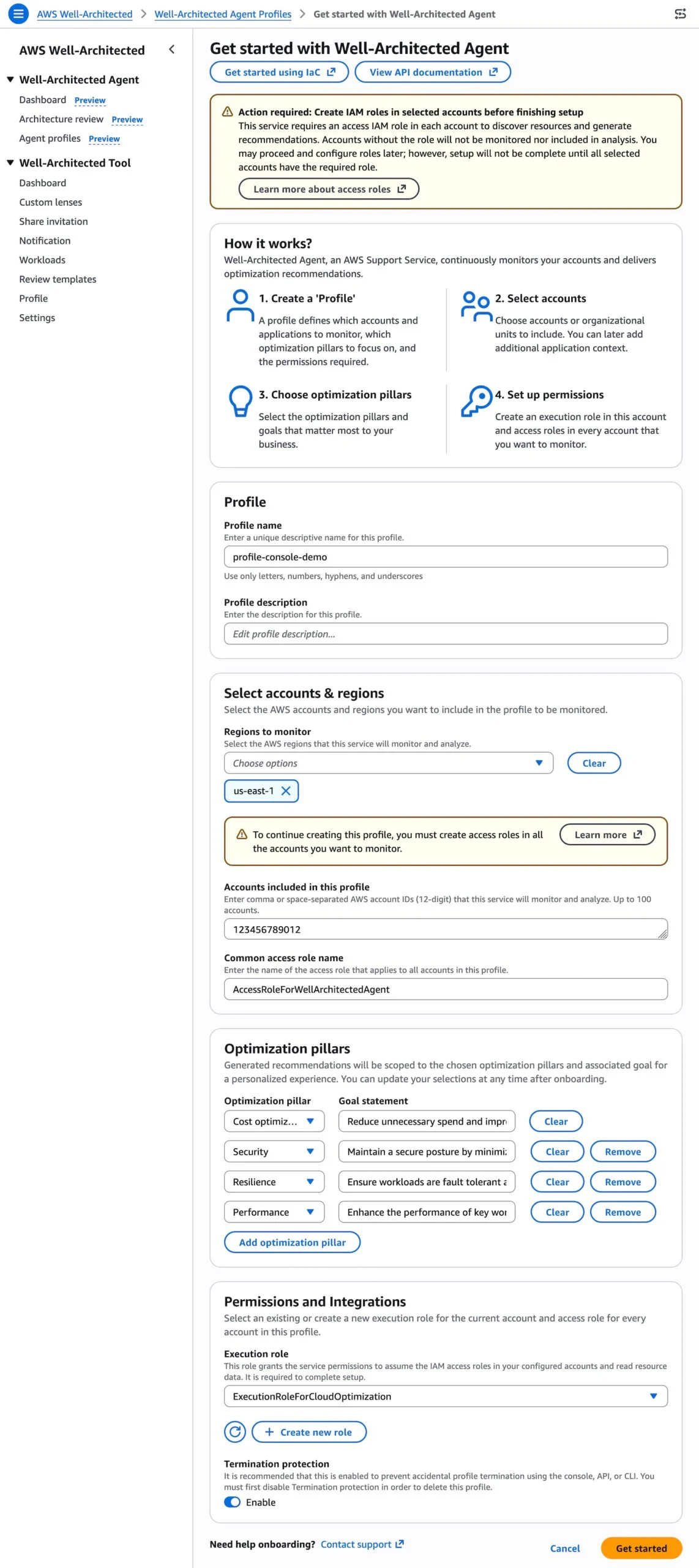
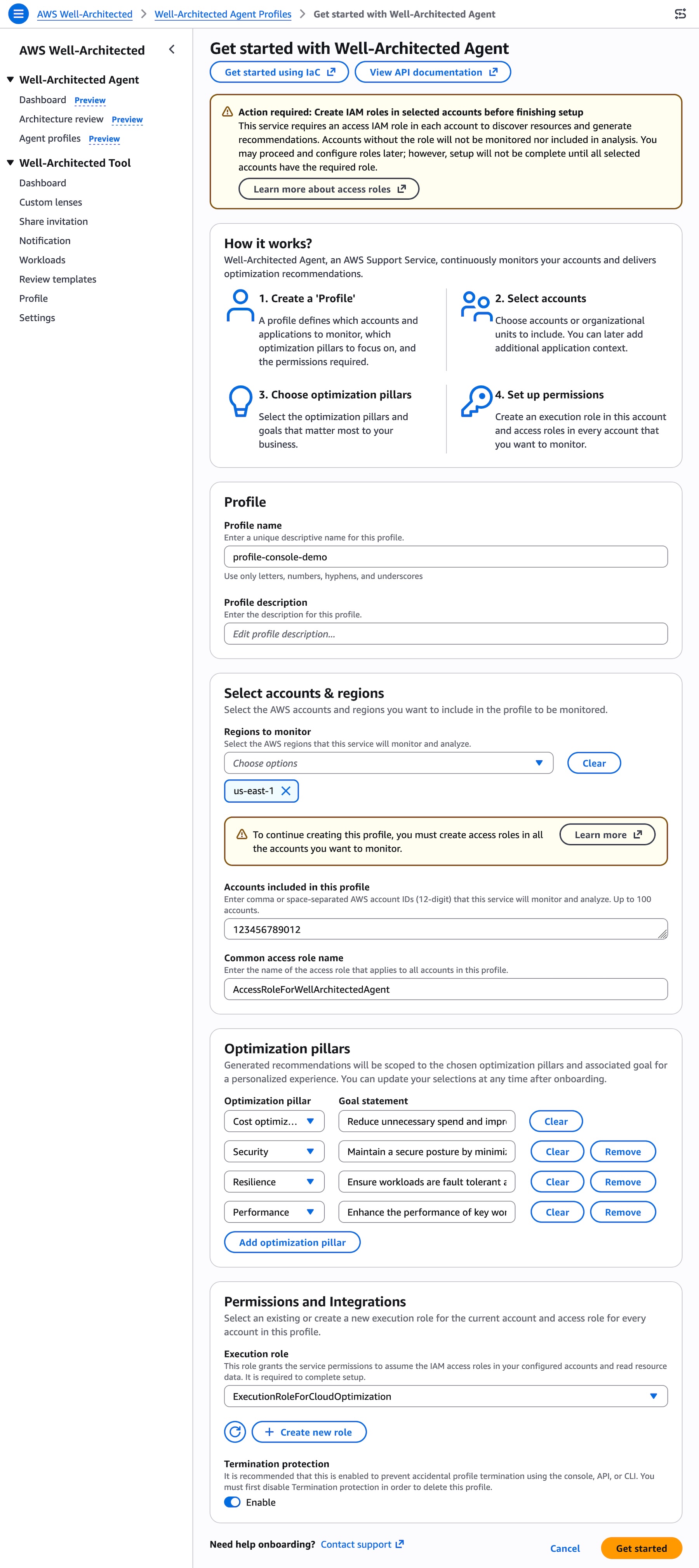
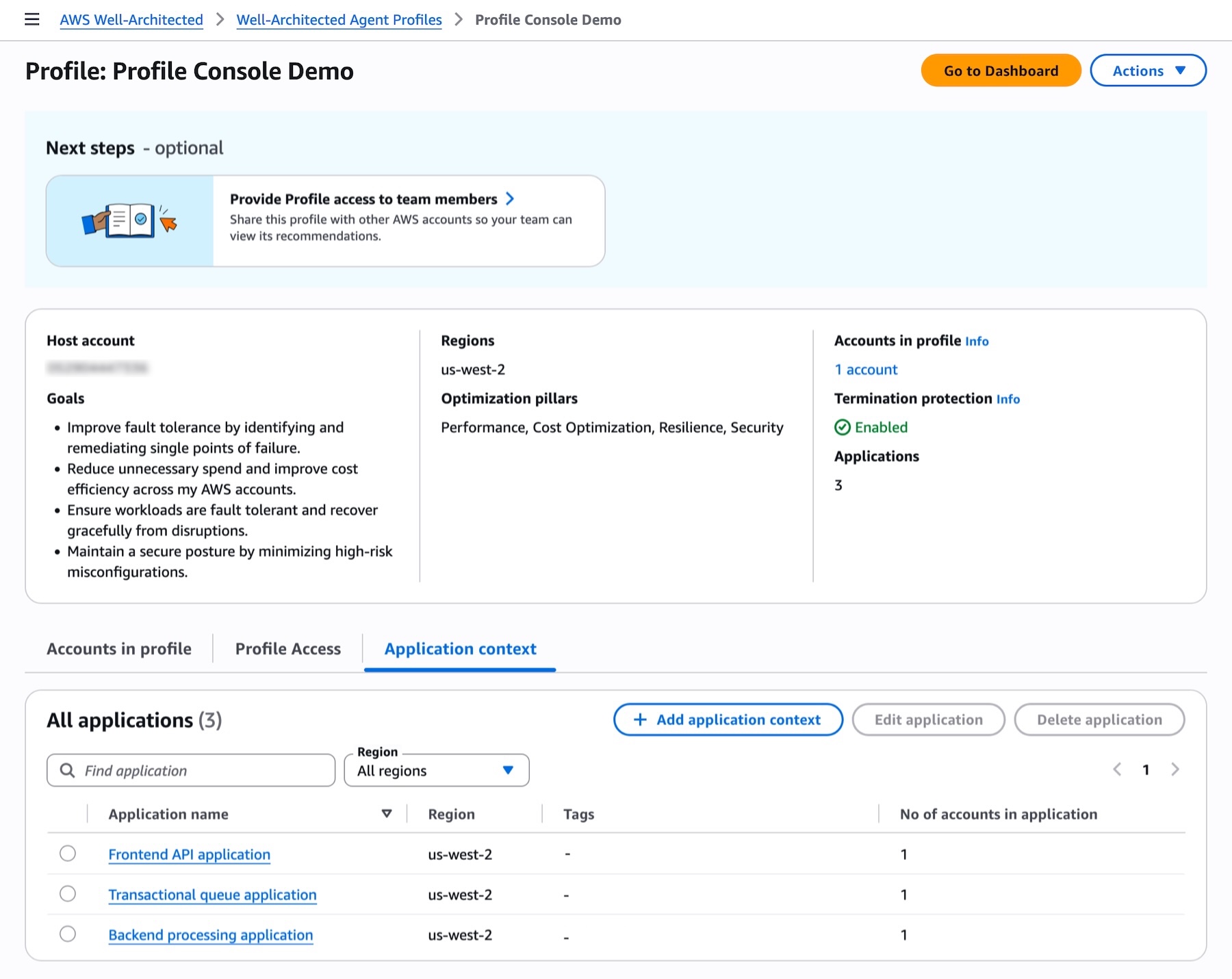
Getting started begins within the AWS Well-Architected console. Administrators define an Agent Profile to establish operational boundaries and permissions:
- Scope Definition: Operators select specific AWS accounts, individual AWS Regions, or designated groups of resources to monitor.
- Pillar Weighting: Teams select optimization pillars (Cost Optimization, Performance Efficiency, Reliability, Operational Excellence, and Security) and assign specific business targets to each.
- IAM Privileges: Customer-managed IAM roles are provisioned to grant the agent secure, read-only access to resource configurations, utilization metrics, and application topology.
Once configured, the agent initializes its analysis engine, generating comprehensive resource and application recommendations within 24 hours.
2. Pre-Deployment and Runtime Contextualization
The agent accommodates both live, running environments and pre-deployment codebases:
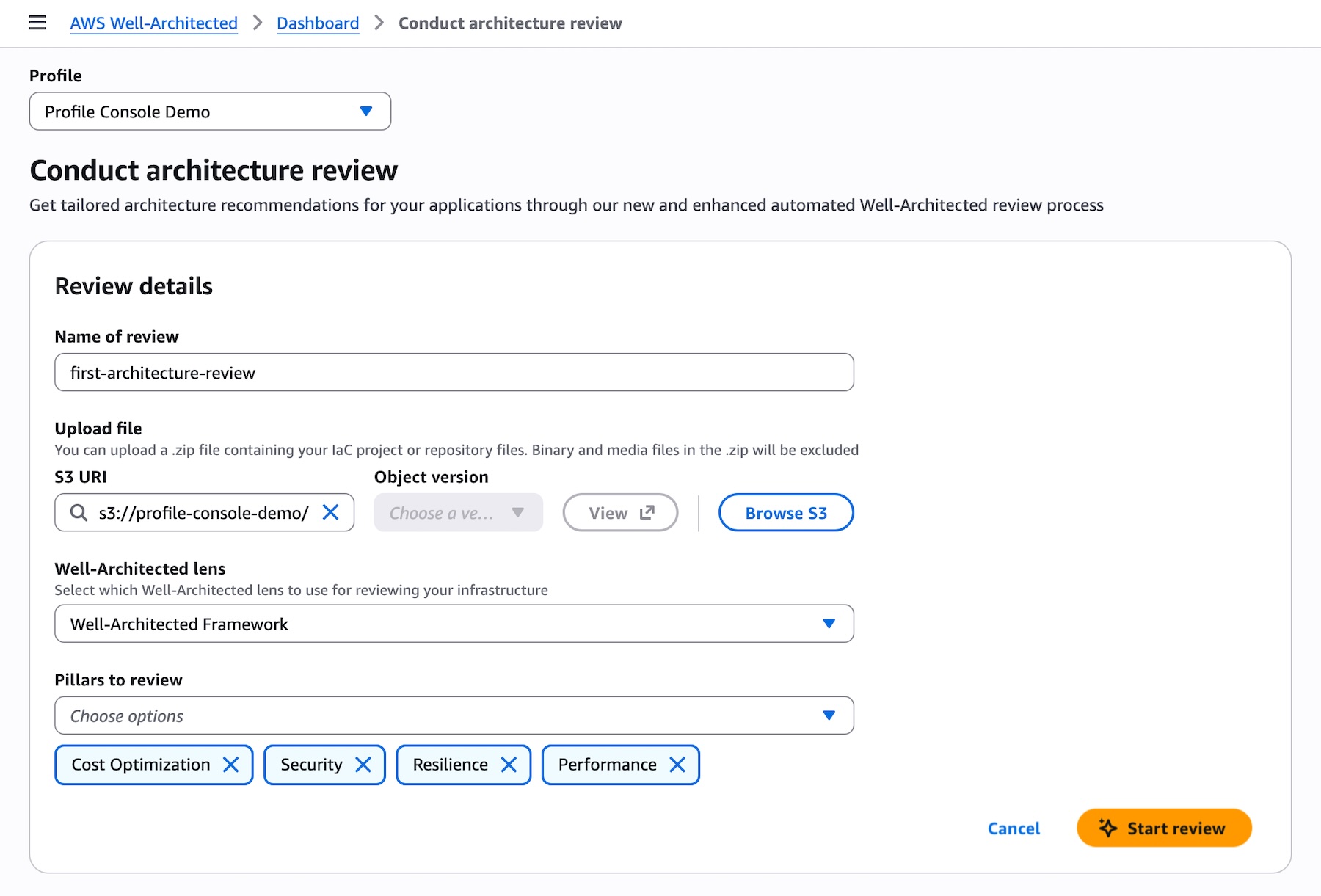
- Pre-Deployment Reviews: Engineering teams can upload a
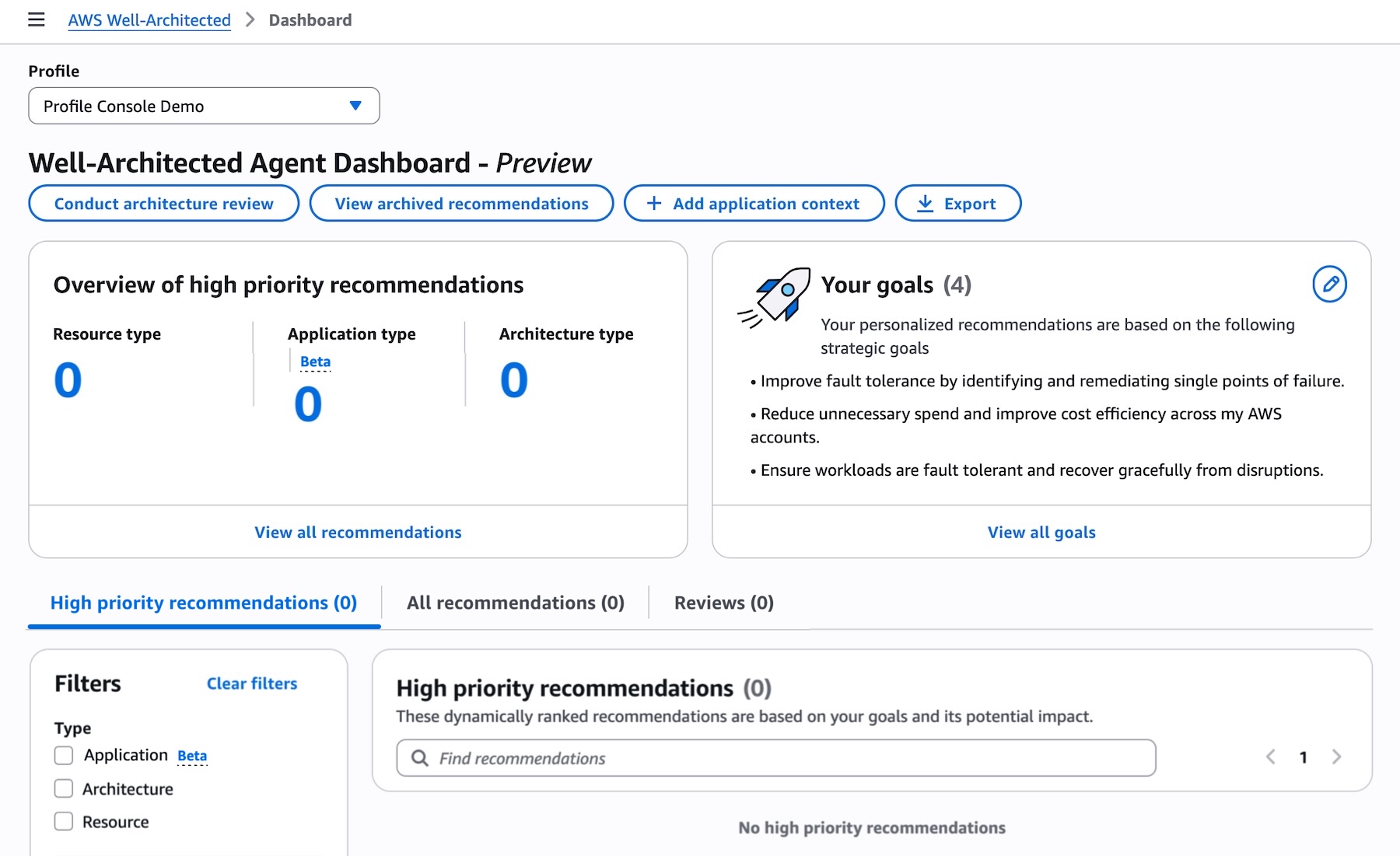
.ziparchive containing an Infrastructure as Code project—built in Terraform, AWS CloudFormation, or the AWS Cloud Development Kit (CDK)—directly into the dashboard. The agent analyzes these blueprints against chosen Well-Architected lenses before a single resource is provisioned in production. - Application Context Integration: To maximize relevance, teams can use the "Add application context" feature. By associating specific applications with AWS accounts, regions, services, and resource tags, users narrow the agent’s focus, ensuring recommendations align directly with business-critical domains.
3. Granular Remediation Paths
Once findings are surfaced, prioritized, and ranked against declared goals, users can dive into individual recommendations. The agent provides deep insights into why a particular change is suggested, detailing expected impacts, trade-offs, and affected resources.
Remediation is flexible, supporting multiple resolution types:
- AWS Management Console: Step-by-step navigational guides to fix issues directly through the web interface.
- CLI Commands: Copy-and-pasteable AWS Command Line Interface scripts for rapid batch execution.
- Updated IaC Templates: Automatically generated code snippets (such as updated AWS CDK functions or CloudFormation blocks) that engineers can paste directly into their source code repositories.
- API and Developer Workflow Integration: Through the AWS MCP Server and IDE plugins, developers can query recommendations, search documentation, and interact with the agent programmatically inside their preferred AI coding assistants.
Official Responses and Strategic Implications
The introduction of the Well-Architected Agent addresses a persistent enterprise challenge: cloud sprawl and the difficulty of maintaining optimal architecture configurations at scale. As organizations migrate increasingly complex workloads to the cloud, the sheer volume of data, configuration options, and security advisories often overwhelms internal platform and DevOps engineering teams.
Bridging the Skills Gap
Industry analysts note that automated governance tools like the Well-Architected Agent effectively democratize elite cloud architecture expertise. Junior and mid-level engineers gain access to real-time, context-aware mentorship that explains not just what needs to be fixed, but why the trade-off matters for the broader business.
Maintaining the Human-in-the-Loop
While the agent is powered by advanced AI and capable of generating code-level fixes, AWS has deliberately structured the service around a "human-in-the-loop" model. The agent suggests, prioritizes, and drafts remediation packages, but final execution and deployment remain strictly under the control of the engineering organization. This ensures that automated systems do not introduce unintended breaking changes into production environments.
Coexistence with Existing Tools
AWS has confirmed that the new agent does not deprecate existing utilities. Enterprises can continue using the traditional AWS Well-Architected Tool for manual evaluations, custom user-defined lenses, and formal milestone reviews. The Well-Architected Agent acts as an intelligent, continuous, and proactive layer operating alongside these foundational tools.
Conclusion and Getting Started
The public preview of the AWS Well-Architected Agent marks a significant milestone in the evolution of cloud management. By blending deep infrastructure telemetry with contextual AI reasoning and automated remediation generation, AWS is helping organizations move from reactive troubleshooting to proactive, continuous architectural optimization.
Key Takeaways for Cloud Practitioners:
- Availability: Currently available for setup in US East (N.Virginia), US East (Ohio), and US West (Oregon), with the ability to monitor workloads across all commercial AWS regions.
- Prerequisites: Delivered as part of AWS Support; accessible to customers maintaining an active AWS Support plan.
- Next Steps: Cloud architects and engineering leaders can begin exploring the service immediately by navigating to the AWS Well-Architected console, creating an initial agent profile, and providing feedback through standard AWS Support communication channels.



