In the modern digital economy, the completion of an online transaction is no longer marked by the final click of the "buy" button. Instead, for the contemporary European e-commerce merchant, the purchase cycle extends well into the post-delivery phase. Returns have evolved from a logistical inconvenience into a central pillar of the customer experience, representing both a significant operational hurdle and a critical opportunity for brand differentiation. As European consumers become increasingly accustomed to frictionless shopping, the management of reverse logistics has become a defining factor in determining the profitability and long-term viability of online retailers.
1. The State of Play: An Overview of European Returns
E-commerce in Europe is a mosaic of diverse consumer behaviors and regulatory environments. Unlike the more homogeneous market landscape of the United States, European retailers must contend with localized preferences, varying tax jurisdictions, and distinct expectations regarding service quality.
Statistical Insights: The Cost of Convenience
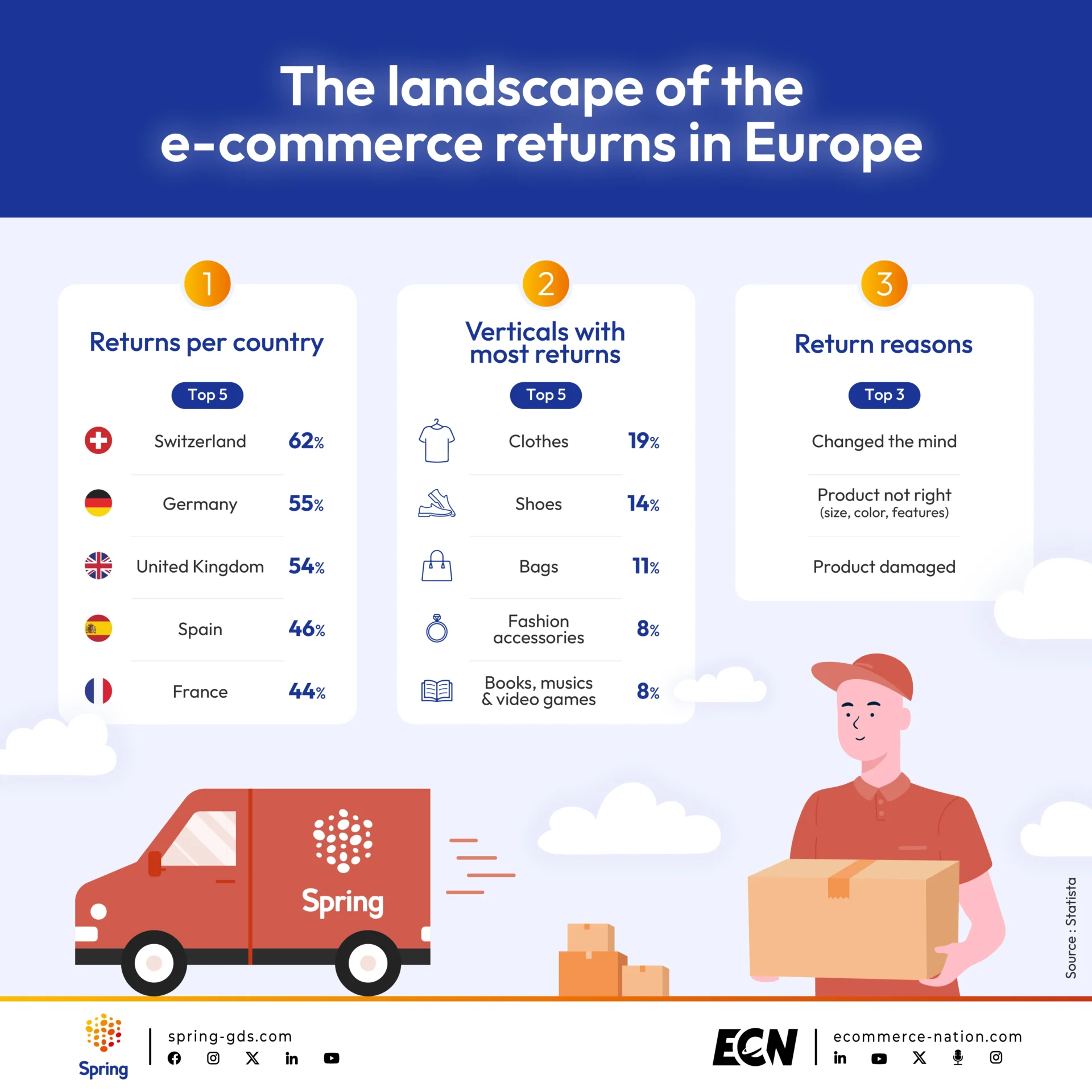
The scale of the issue is significant. Industry data suggests that the average return rate across the European continent hovers between 30% and 40%. However, these averages mask a volatile reality. According to recent findings from Statista, Switzerland leads the European market with an astonishing 62% return rate per online buyer. Germany and the United Kingdom follow closely, with 55% and 54% respectively.
These figures are not merely numbers; they represent billions of euros in lost revenue, handling costs, and environmental impact. For many retailers, the high cost of processing returns—ranging from inspection and cleaning to restocking or liquidation—has forced a strategic pivot. A growing number of major brands are now moving away from the "free returns" model, opting instead to charge fees to curb the "bracketing" phenomenon, where consumers order multiple sizes or colors with the intent to return the majority.
The Impact on Profitability and Consumer Trust
The tension between profitability and customer experience is the defining conflict of modern retail. On one hand, a rigid, costly, or complicated return process acts as a deterrent, driving potential customers to competitors. On the other hand, the financial erosion caused by high return rates can threaten the very existence of small-to-medium-sized enterprises.
Strategic leaders are now viewing returns as a touchpoint for loyalty. When a customer encounters a problem—be it a sizing issue or a minor defect—an efficient, transparent, and empathetic return process can transform a frustrated shopper into a repeat customer. The return, in this sense, is not the end of the relationship, but a critical test of brand integrity.
2. Chronology and Evolution: From Afterthought to Strategic Priority
To understand the current state of returns, one must look at how the e-commerce landscape has shifted over the past decade.
- 2010–2015: The "Free Return" Era. During the initial boom of e-commerce, free, no-questions-asked returns were used as a primary marketing tool to build trust in online shopping, which was then in its infancy.
- 2016–2020: The Scaling Challenge. As e-commerce volume exploded, the sheer volume of returned goods began to overwhelm logistics centers. Companies realized that the "reverse flow" of goods was creating a parallel, and often inefficient, supply chain.
- 2021–2023: The Sustainability Reckoning. Post-pandemic, the environmental cost of reverse logistics entered the public consciousness. Consumers and regulators began scrutinizing the carbon footprint of "shuttle-cocking" products across borders.
- 2024–Present: The Optimization Phase. Merchants are now deploying AI-driven analytics, localized return hubs, and stricter return policies to balance the books while maintaining service standards.
3. The Anatomy of Return Drivers: Why Consumers Send Goods Back
Understanding the "why" is the first step toward mitigation. While each industry has its nuances, the primary drivers of returns in Europe include:
- Subjective Preferences (The "Fit" Factor): Particularly in the fashion and apparel sectors, the inability to try on clothes leads to the highest return rates.
- Bracketing Behavior: Consumers intentionally order multiple variants of the same product to compare them at home, creating an artificial return spike.
- Information Asymmetry: Inadequate product descriptions, low-quality imagery, or missing size guides force customers to "guess" their purchase, leading to inevitable dissatisfaction.
- Logistical Failures: Damaged goods, shipping delays, or incorrect items sent are often within the merchant’s control and represent the most preventable category of returns.
4. Challenges: The Complex Web of Reverse Logistics
The hurdles faced by European merchants are multifaceted, encompassing technical, financial, and environmental domains.
The Cross-Border Regulatory Maze
Operating within the European Union provides the benefit of the Single Market, but the reality of cross-border returns remains complex. Merchants must navigate disparate VAT rules, customs requirements for non-EU returns (e.g., Switzerland or the UK), and varying consumer protection laws. Failure to align with local regulations can lead to costly border delays, where packages sit in warehouses, depreciating in value and incurring storage fees.
The Ecological Footprint
The "green" challenge is perhaps the most pressing. Every return trip generates carbon emissions. Furthermore, the practice of destroying returned goods—which were often deemed too expensive to re-process—has come under intense fire from environmental groups and the EU Commission. The industry is currently under pressure to adopt circular economy principles, where returned goods are refurbished, resold, or recycled rather than sent to landfills.
Managing Expectations in a "Prime" Culture
Modern consumers are conditioned by market giants to expect instant gratification. A customer who waits two weeks for a refund is significantly less likely to return. The challenge for the mid-market retailer is to provide an "Amazon-level" experience with a fraction of the infrastructure. This requires local return addresses, automated label generation, and rapid notification systems.
5. Strategic Optimization: A Roadmap for Merchants
To survive and thrive in this landscape, merchants must transition from reactive to proactive management.
Data-Driven Product Intelligence
Data is the most powerful tool in the arsenal. By analyzing return codes, merchants can identify patterns. If a specific dress has a 40% return rate due to "sizing," the solution is not to change the logistics, but to update the product page with a better sizing chart or customer reviews regarding the fit. When data is treated as a diagnostic tool rather than just a cost report, returns can be reduced at the source.
Technological Integration
Modern Return Management Systems (RMS) allow for the automation of the entire reverse flow. These platforms can:
- Generate automated shipping labels.
- Provide real-time tracking for both the merchant and the consumer.
- Integrate with inventory management software to immediately update stock levels once a return is initiated.
Ecological Responsibility as a Brand Pillar
Sustainability is no longer a "nice-to-have"; it is a consumer expectation. Brands that emphasize eco-friendly packaging, encourage the use of consolidated shipping for returns, or offer "keep the item" options for low-value products are seeing higher customer loyalty. By educating the consumer on the environmental impact of returns, retailers can foster a more responsible shopping culture.
6. Implications for the Future
The future of e-commerce returns in Europe will be defined by three trends: localization, digitalization, and circularity.
As the cost of transportation rises, retailers will increasingly rely on local "hub-and-spoke" models, where returns are consolidated in regional centers before being processed in bulk. Digitalization will move beyond basic tracking to predictive analytics, where machine learning models flag high-risk customers or products before the purchase is even completed. Finally, the move toward a circular economy will see the rise of robust secondary markets for returned goods, effectively turning a "loss" into a secondary revenue stream.
Conclusion
Returns are an unavoidable reality of the European e-commerce market, but they are not a terminal diagnosis for profitability. By viewing the return process as a critical component of the customer journey—and by applying rigorous data analysis and sustainable logistics strategies—merchants can transform a logistical headache into a competitive advantage. The winners in the coming decade will be those who manage to balance the convenience the consumer demands with the operational and environmental realities the planet requires.