










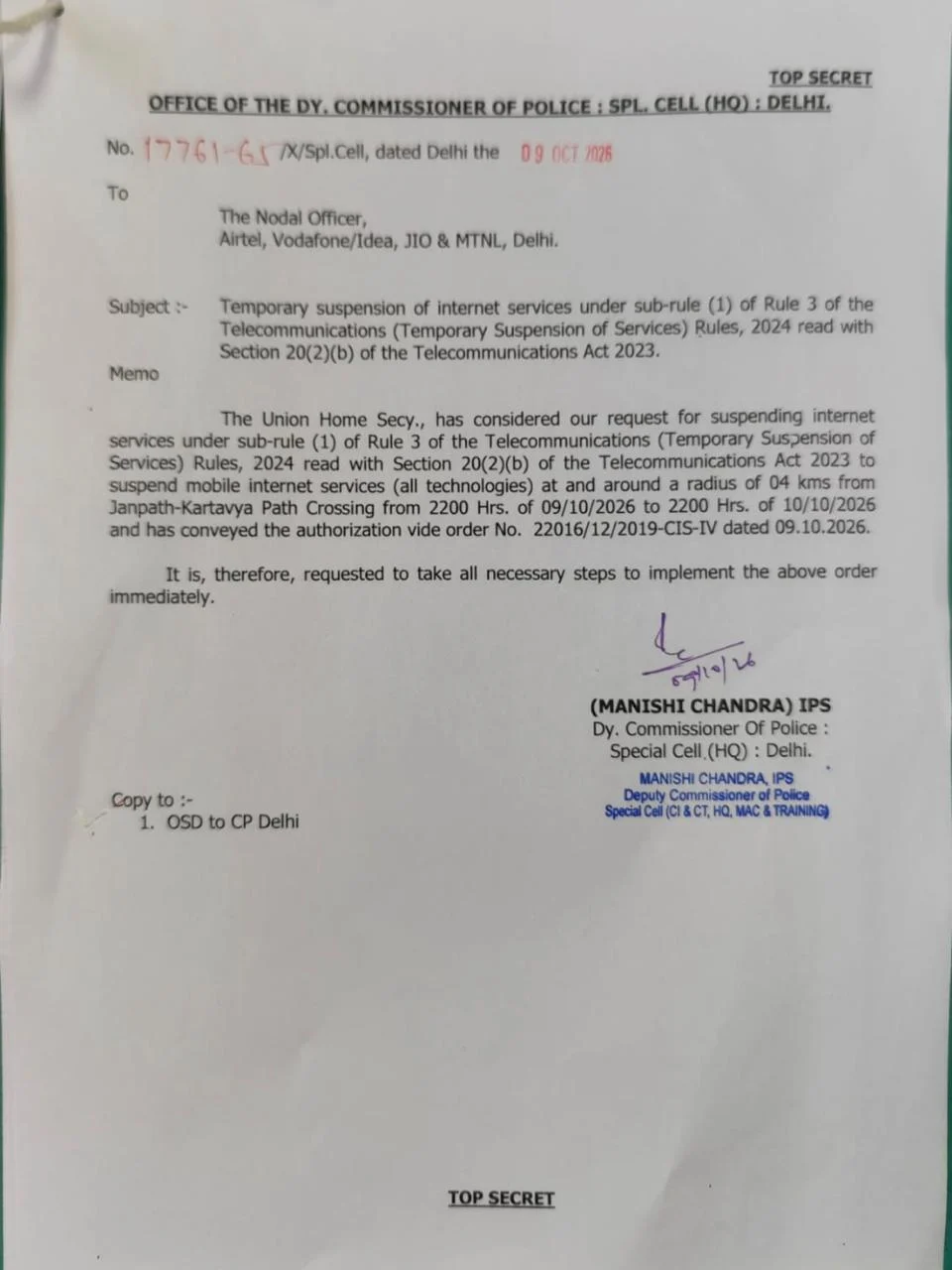
New Delhi — In a move that has reignited debates over digital rights and state transparency, the Ministry of Home Affairs (MHA) has issued a "top secret" directive mandating a complete suspension of mobile internet services in a 4-km radius surrounding the Janpath–Kartavya Path intersection. The order, which was effective from 10:00 PM on October 9 to 10:00 PM on October 10, marks a significant escalation in the state’s use of localized connectivity blackouts to manage public order.
The directive, addressed to nodal officers of major telecom service providers including Reliance Jio, Bharti Airtel, Vodafone Idea, and MTNL, was circulated without prior public disclosure. The lack of an official explanation or transparent justification has drawn sharp criticism from civil society organizations and digital rights activists, who argue that the sudden nature of the shutdown leaves residents, businesses, and essential service providers in a state of communication paralysis.
The Context: A Brewing Political Confrontation
The timing of the blackout coincides with a planned protest by the Cockroach Janata Party (CJP). The party had announced its intention to hold a demonstration in the heart of the national capital on October 10, demanding the resignation of Chief Election Commissioner (CEC) Gyanesh Kumar. The CJP’s grievances center on alleged irregularities in the Special Intensive Revision (SIR) process of electoral rolls, a claim that has fueled a series of protests in recent weeks.
The Delhi Police, citing procedural lapses, denied the party permission to protest, stating that applications for such demonstrations must be submitted at least 10 days in advance. Despite this denial, the government’s preemptive decision to sever internet connectivity across a massive 4-km zone suggests a high-security posture, treating the digital landscape as a frontline in its efforts to contain political dissent.
Chronology of Escalating Digital Control
The October 9 directive is not an isolated incident but rather the latest chapter in a broader strategy of using connectivity shutdowns to stifle organizational efforts.
- July 2026: A period marked by sustained, though intermittent, digital restrictions as political tensions regarding the electoral process began to simmer.
- October 2, 2026: The MHA enforced a 12-hour internet suspension within a 1.5-km radius of Jantar Mantar. During this time, protesters gathered to demand the resignation of the CEC. This initial localized blackout served as a pilot for the more aggressive measures seen later in the month.
- October 4, 2026: Following reports that protesters were utilizing the encrypted messaging app "BitChat" to circumvent surveillance and coordinate movements, the government moved swiftly. Exercising powers under Section 69A of the Information Technology Act, the Ministry of Electronics and Information Technology (MeitY) ordered both Apple and Google to remove BitChat from their respective app stores. Furthermore, the application’s website was blocked, effectively cutting off a vital communication channel for demonstrators.
- October 9, 2026: The MHA issued the "top secret" order for the 4-km radius blackout, marking a 2.5x increase in the affected geographical area compared to the October 2 shutdown.
Supporting Data: The Expanding Footprint of Blackouts
The shift from a 1.5-km radius on October 2 to a 4-km radius on October 9 signifies a strategic expansion in the government’s "digital containment" policy. By widening the radius, the authorities have effectively paralyzed a larger portion of New Delhi’s central district, impacting not only protesters but also thousands of uninvolved residents, tourists, and commercial establishments.

The lack of public transparency regarding the criteria for these shutdowns remains a point of contention. The official notice failed to articulate the specific threats or operational requirements that necessitated such an extensive disruption. In a digital-first economy, where mobile internet is the primary medium for banking, navigation, and emergency communication, such closures impose severe, unquantified economic and social costs.
Official Responses and Transparency Concerns
One of the most alarming aspects of this recent shutdown is the shroud of secrecy surrounding the decision-making process. The order, labeled "Top Secret," was never made public by the Ministry of Home Affairs. It only came to light when media outlets, notably MediaNama, reported on the existence of the directive, and the news agency ANI subsequently shared the document publicly.
The government has remained largely silent on the record regarding its policy of issuing "top secret" internet suspension orders. When such directives are issued, they often bypass the standard public discourse that should accompany any restriction on fundamental rights. The absence of a "reasoning" clause in the order leaves the public without recourse to understand why their access to the global internet is being curtailed.
Implications for Democracy and Digital Rights
The recurring use of internet shutdowns as a tool of administrative control carries profound implications for the health of India’s democratic framework.
1. The Erosion of Communication Rights
The Supreme Court of India, in the landmark Anuradha Bhasin v. Union of India case, established that access to the internet is a fundamental right. The court mandated that any suspension must be "necessary, proportional, and temporary." Critics argue that the current MHA policy—which involves preemptive, wide-radius, and secret orders—fails the test of proportionality. By treating the internet as a "switch" that can be turned off to manage protests, the state risks normalizing the suppression of dissent through digital isolation.
2. Impact on the Digital Economy
New Delhi’s central district is a hub for government offices, legal chambers, and high-end hospitality. A 4-km radius blackout essentially shuts down digital payments, ride-sharing services, and high-speed enterprise connectivity. The cumulative loss to small businesses and the gig economy during these hours is substantial, yet these economic impacts are rarely considered in the "top secret" calculus of security agencies.

3. The "Censorship by App Store" Trend
The targeting of BitChat highlights a shift toward platform-level censorship. By leveraging Section 69A to force global tech giants like Apple and Google to remove specific applications, the government is creating a precedent where software functionality can be erased from the local ecosystem overnight. This not only affects the specific protest movement but undermines the security and privacy expectations of the broader user base.
4. Psychological and Social Costs
For the average citizen, being caught in an internet blackout causes significant anxiety. The inability to communicate with family members, access emergency services, or verify information during a period of civil unrest creates a "fear of the unknown." The lack of warning—the order was issued on the same night it was enacted—precludes citizens from making alternative arrangements.
Conclusion: A Dangerous Precedent
The October 9 blackout is a stark reminder of the fragile state of digital connectivity in the face of political unrest. While the government maintains that such measures are necessary to prevent the mobilization of protestors or the spread of misinformation, the lack of transparency, the absence of judicial oversight, and the expanding scale of these blackouts suggest a broader trend toward the centralization of control over the digital public square.
As the CJP continues to challenge the electoral process and the government continues to employ "top secret" directives, the tension between the state’s mandate for "law and order" and the individual’s right to connectivity is likely to intensify. The legal community and civil society observers are calling for a more transparent, predictable, and accountable framework for the suspension of telecom services—a framework that ensures the internet remains an open, accessible space for all, regardless of the political climate.
Without a move toward greater transparency, these blackouts risk becoming a permanent, albeit "secret," feature of the administrative playbook, further alienating the citizenry from the decision-making processes that directly impact their daily lives.



