











As artificial intelligence agents transition from experimental pilot programs to becoming the backbone of enterprise operations, IT leadership faces a critical paradigm shift. These agents are no longer just static scripts; they are dynamic, autonomous entities that connect to proprietary data, utilize complex toolchains, and interact with users across the organization. This newfound speed and autonomy present a daunting challenge: how does an enterprise govern a system that operates faster than traditional software development cycles?
This article, the final installment of the Economics of Agent Optimization series, explores the mandate of governing AI spend. It concludes our deep dive into the three-tiered optimization system within Microsoft Foundry, building upon previous discussions regarding request-path efficiency, workflow management, and context engineering. To govern effectively, organizations must shift from reactive billing reviews to proactive, policy-driven financial management.
The Core Mandate: Why AI Governance Must Evolve
In traditional enterprise IT, governance is synonymous with security, compliance, and lifecycle management. However, in the age of AI, governance is also fundamentally a financial discipline. Without a unified strategy, individual teams often make siloed decisions regarding model selection, tool integration, and capacity limits. These small, fragmented inefficiencies scale exponentially, leading to bloated operational costs that often remain invisible until the monthly invoice arrives.

Effective governance is defined by three pillars: visibility, containment, and accountability. IT leaders need the ability to attribute every token to a specific project; finance departments require budget guardrails that prevent unexpected overages; and developers need control mechanisms that operate at the speed of the AI agent itself.
Chronology of the Optimization System
To understand how to govern these systems, one must view AI optimization as a three-speed, continuous loop. Microsoft Foundry organizes this into a structured lifecycle:
- Runtime (The Request Level): In the first phase, optimization occurs at the point of request. By leveraging intelligent model routing, strategic deployment choices, and prompt caching, the system reduces the overhead of individual interactions.
- Workflow (The Temporal Level): Over days and weeks, the system evolves. Through context engineering, memory management, and hosted tool utilization, the agent becomes more efficient at completing complex, multi-step tasks.
- Governance (The Systemic Level): This is the final, perpetual layer. It governs the entire estate by attributing consumption, enforcing hard-coded limits, and validating the business value generated by the AI portfolio.
Seeing the Spend: From Aggregation to Attribution
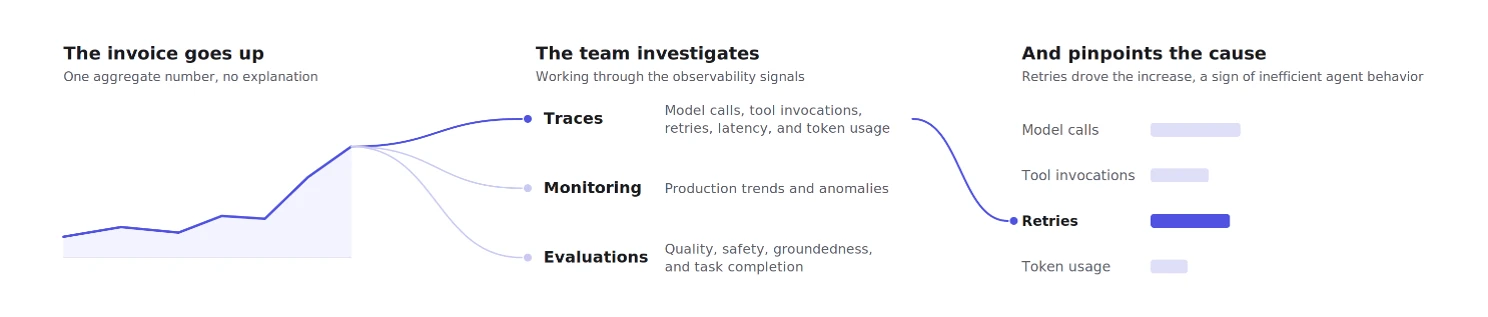
The primary obstacle to effective AI cost management is data opacity. Often, a single enterprise deployment serves dozens of agents, each utilizing multiple models and toolsets. When costs are aggregated into a single line item, the business context is lost.

Microsoft Foundry addresses this by embedding cost awareness into the system architecture. By utilizing project-level tagging, organizations can automatically associate usage metrics with specific business units or workloads. This allows for granular visibility into:
- Token Consumption: Identifying exactly which models or tools are driving the highest costs.
- Execution Patterns: Distinguishing between necessary compute and inefficient retry loops.
- Business Context: Linking cost data to specific project goals, allowing for a clear separation between R&D experimentation and production-grade revenue generation.
By utilizing the AI Gateway within Azure API Management, teams can now emit token metrics by product, user, and subscription. This telemetry provides the raw data required to diagnose whether rising costs are the result of increased customer demand or architectural inefficiencies.
The Three Layers of Spend Control
Visibility is merely the diagnostic phase; the curative phase requires active containment. Microsoft Foundry provides a tripartite control system designed to operate at different scopes and speeds.
1. Request-Path Enforcement
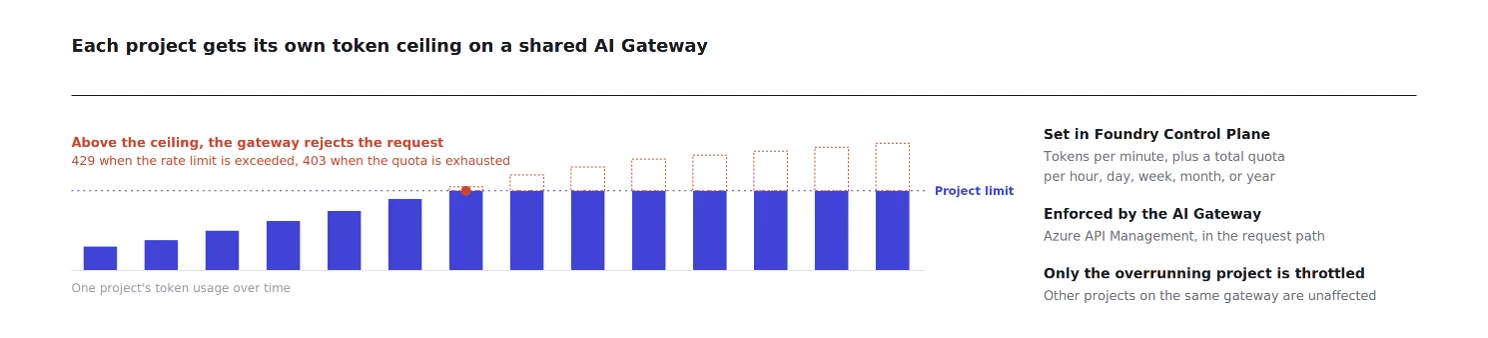
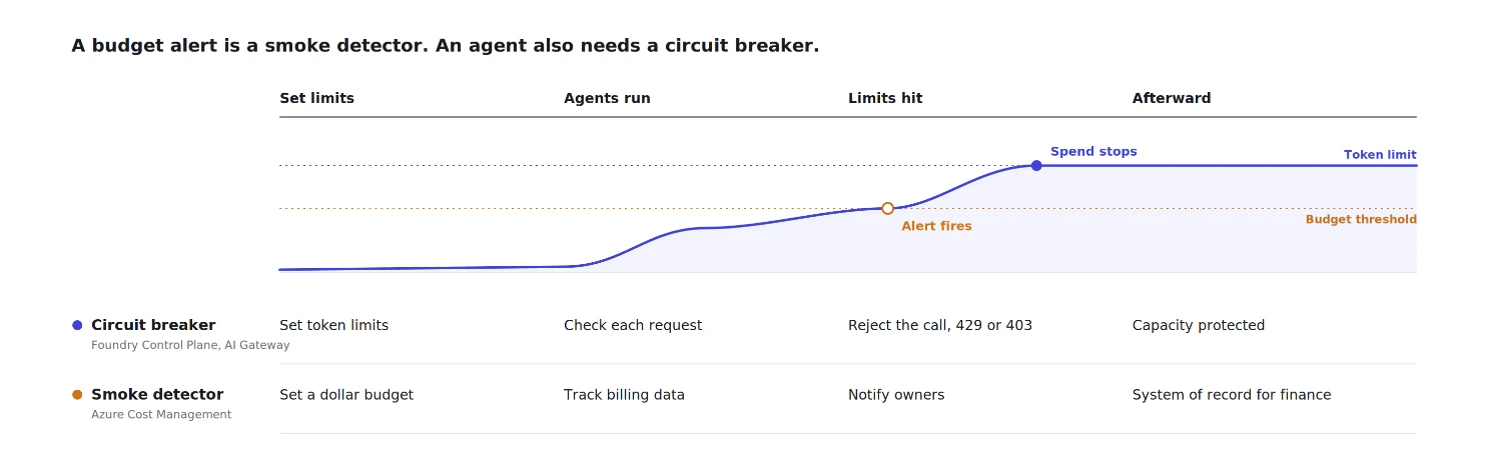
Unlike traditional financial alerts, which act as a "smoke detector" after the fact, Foundry allows for the implementation of a "circuit breaker" in the request path. Through the Foundry Control Plane, administrators can enforce strict tokens-per-minute rate limits and total token quotas. If an agent exceeds these bounds, the system returns a 429 Too Many Requests or 403 Forbidden error. This immediate feedback loop prevents a single rogue agent or an infinite retry loop from exhausting shared capacity.
2. Cross-Provider Policy Application
Modern enterprises rarely rely on a single model provider. The llm-token-limit policy in Azure API Management allows for unified governance across OpenAI-compatible APIs, the Anthropic Messages API, and even custom-built MCP servers. By centralizing these policies, IT leaders can ensure that the same security and cost constraints apply regardless of the underlying model, effectively standardizing the cost profile across a heterogeneous AI estate.
3. Financial Budgets and Escalation
While token limits protect technical capacity, Microsoft Cost Management budgets provide the financial oversight necessary for organizational accountability. These tools integrate directly with Azure billing, incorporating actual prices, credits, and purchasing commitments. By linking these budgets to Azure Monitor action groups, organizations can trigger automated workflows—such as opening IT service tickets or notifying finance teams—when spending approaches critical thresholds.
Measuring Value: The ROI of Autonomous Agents
The most significant error an enterprise can make is treating all AI costs as negative. An agent that costs more to run but significantly improves customer satisfaction or reduces manual labor is an asset, not a liability. Therefore, the ultimate metric for AI governance is Return on Investment (ROI).
Microsoft Foundry is currently piloting a framework that bridges the gap between technical consumption and business outcomes. By defining success criteria—such as task completion rates or case deflection metrics—organizations can assign a "value" to agent actions. The system then calculates:
- Net Value: The difference between the revenue/savings generated and the compute costs incurred.
- ROI Percentage: A comparative metric to determine which agents deserve increased investment and which should be retired.
This moves the conversation from technical performance (e.g., "This model uses fewer tokens") to strategic impact (e.g., "This model produces more net value"). It empowers developers to defend their architectural choices to executive stakeholders using the language of business.
Implications for the Modern Enterprise
The transition to an agentic enterprise necessitates a clear division of labor. The FinOps and developer teams must leverage the levers provided by Foundry to maintain cost predictability. Simultaneously, IT and security teams must govern the broader digital estate.
The implications of this shift are profound:
- Efficiency by Design: Future AI architectures will be evaluated not just on accuracy, but on cost-efficiency as a primary technical requirement.
- Predictable Scaling: By replacing unbounded usage with policy-driven quotas, enterprises can scale their agent fleets without fear of "bill shock."
- Accountability: The ability to trace every dollar spent to a specific business outcome transforms AI from a speculative expense into a managed investment.
Conclusion: Running AI as a Managed Investment
The series on The Economics of Agent Optimization has underscored a singular truth: the goal of AI governance is not to minimize spending at all costs. Instead, it is to run AI with the same level of discipline applied to any high-stakes infrastructure investment.
By combining observability, request-path enforcement, and outcome-based ROI tracking, organizations can move from the "wild west" of early AI experimentation to a mature, managed state. Microsoft Foundry provides the necessary scaffolding to ensure that agents are efficient by design, controlled as they scale, and held accountable for the value they generate. As the technology continues to evolve, those who master the economics of their agents will be the ones who define the future of the enterprise.
Getting Started:
If your organization is currently deploying agents, begin your governance journey today by:
- Auditing Visibility: Enable project-level tagging and token-metric reporting.
- Implementing Circuit Breakers: Configure token limits in the AI Gateway to prevent runaway costs.
- Defining Value: Identify the top three business outcomes your agents are meant to drive and begin tracking ROI.
- Reviewing the Series: For a comprehensive guide, revisit the earlier installments on Strategy, Runtime Optimization, and Context Engineering.



