Inside Salesforce’s "Customer Zero" Strategy: How Tableau Solved the Four Pillars of Agentic Analytics at Enterprise Scale
SAN FRANCISCO — As enterprise data architectures continue to scale across multi-cloud environments, putting a capable, conversational analytics agent in the pocket of every employee is no longer a technical data-access hurdle. Instead, according to enterprise software leader Tableau, it has fundamentally transformed into a governance and trust challenge.
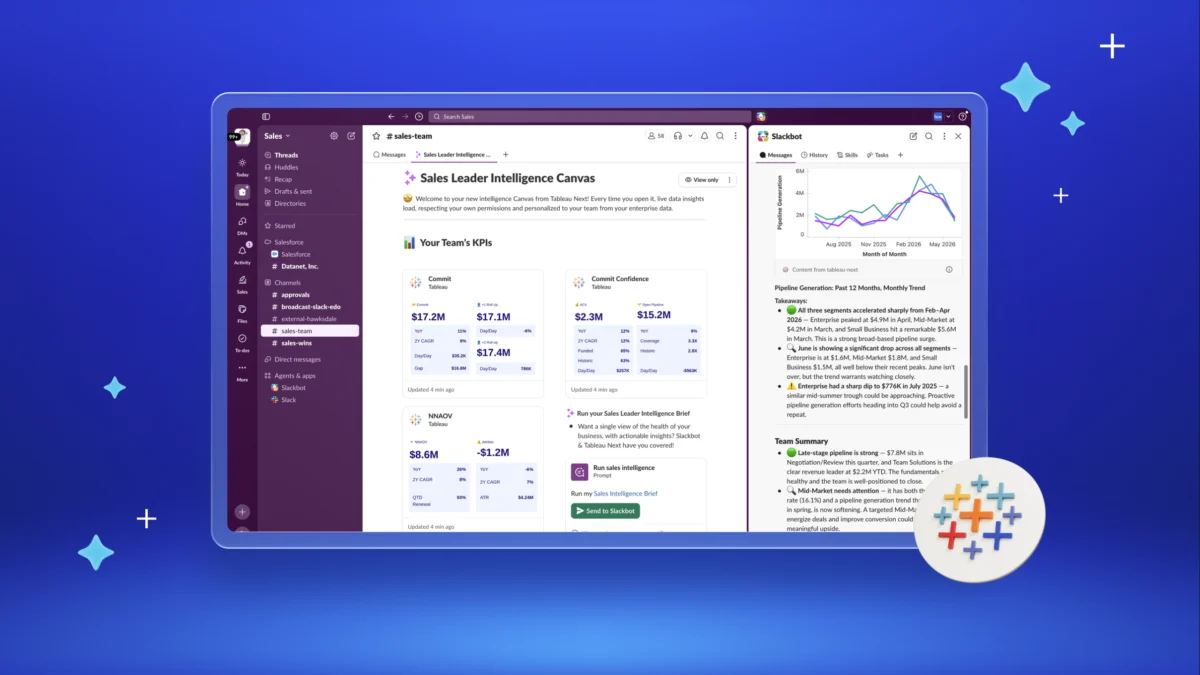
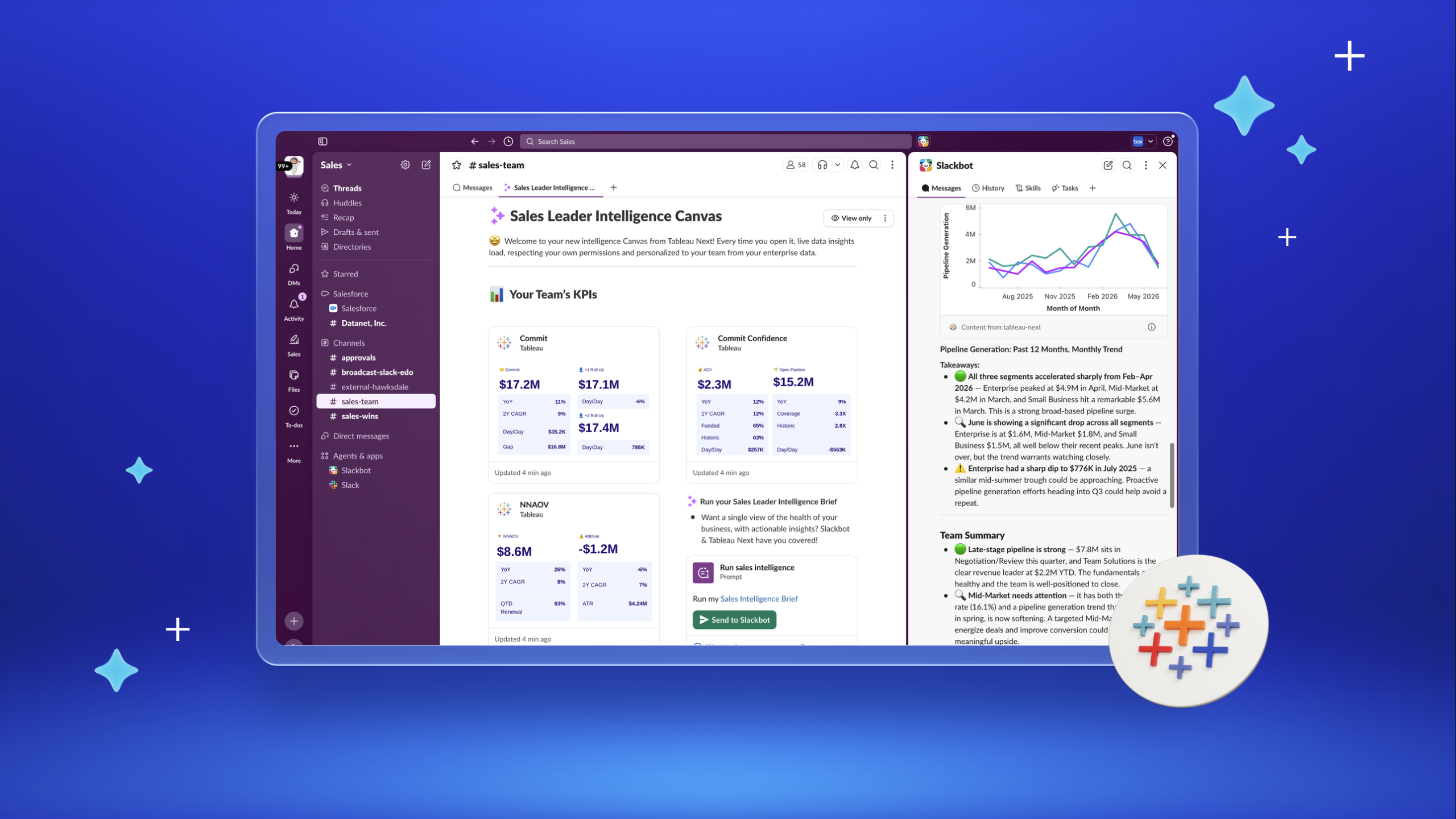
Before rolling out its new agentic analytics system to a single external client, Tableau deployed the technology internally as part of its rigorous "Customer Zero" program. Tens of thousands of Salesforce employees began utilizing the system to manage pipelines, track accounts, and analyze quarterly deals on the go.
The insights gleaned during this massive internal deployment shaped the architecture of Tableau’s latest product iterations. By examining how internal sales teams interacted with conversational metrics via Slack, Tableau engineers realized that raw artificial intelligence speed is a liability without rigorous semantic grounding. The resulting enterprise framework addresses four critical data leadership hurdles: semantic governance, content governance, predictable total cost of ownership (TCO), and operational monitoring.
Main Facts: The Anatomy of Tableau’s Agentic Deployment
Tableau’s internal agentic analytics rollout was designed to solve a ubiquitous enterprise problem: helping sales representatives answer the daily operational question—"How am I doing, what changed, and what should I do about it?"—without forcing them to wait on a data analyst.
To deliver this, the architecture was built on standard, enterprise-ready components:
The Front Door: Slack served as the primary user interface, utilizing Slackbot Skills for connective tissue.
The Capabilities: The system packaged proactive daily briefings, dashboards rendered directly within chat interfaces, and freeform conversational Q&A.
The Routing Engines: Behind the scenes, these skills routed queries to whichever system held the governed source of truth—utilizing the Tableau Next Model Control Protocol (MCP) for Tableau Next semantic models, or the Tableau MCP for Tableau Cloud and Server.
Initially, without a governed semantic layer, the underlying Large Language Model (LLM) was forced to guess business definitions at runtime. Terms like "pipeline," "win rate," and "coverage" yielded a dismal pre-launch accuracy rate of just 30% to 45%.
By introducing a robust semantic layer—branded as Tableau Knowledge—which integrated business preferences, verified Q&A, and strict definitions, Tableau drove pre-launch accuracy above 85% across evaluations of over 200 real user questions. More importantly, it eliminated repeat ad-hoc requests for analysts and established deep trust among sales leadership.
Chronology: From Concept to Customer Zero Rollout
The path to deploying agentic analytics at Salesforce scale required a deliberate, phased developmental timeline:
Phase 1: The Initial Blind Spot & Low Accuracy Realities.
During early internal trials, LLMs were connected directly to data environments without semantic constraints. The lack of standardized definitions for core metrics caused the agent to frequently hallucinate or provide conflicting answers when asked identical questions on different days.
Phase 2: Introducing "Tableau Knowledge" and Grounded Semantics.
Recognizing that the bottleneck was not model capability but structural context, engineers integrated semantic models, business preferences, and verified Q&A structures. This drastically elevated system precision, pushing evaluation accuracy past the 85% threshold.
Phase 3: The Internal Executive Briefing Pilots.
Tableau deployed executive intelligence briefs to internal Salesforce teams. Initial stress tests revealed operational gaps, including dropped foreign accounts due to currency conversion errors, inaccurate totals stemming from mismatched field names, and automated schedules failing silently.
Phase 4: Architectural Maturation & Universal Integration.
Having resolved internal data gaps by tying workflows strictly to governed semantic layers, Salesforce expanded the deployment to tens of thousands of employees. Today, building a custom, fully governed dashboard skill for a new sales leader takes mere minutes, turning ad-hoc requests into secure, enterprise-grade visualizations automatically.
Supporting Data: Overcoming Enterprise Hurdles
Enterprise data leaders evaluating agentic AI typically encounter systemic roadblocks. Tableau’s internal data from the Customer Zero deployment highlights how these challenges were systematically neutralized:
30%–45% vs. 85%+ Accuracy: Un-grounded LLMs operating on raw data warehouses struggled with severe hallucinations due to ambiguous business metrics. Grounding the agent in Tableau’s semantic layer more than doubled reliability.
97% Fortune 500 Baseline: Tableau leverages the reality that 97% of Fortune 500 companies have already encoded their business logic into published Tableau data sources, workbooks, and metrics.
Multi-Surface Flexibility: The architecture successfully unified outputs across dashboards, automated briefings, and conversational chat interfaces without fracturing metric definitions.
Official Responses and Perspectives
According to Tableau engineering leadership, the primary takeaway from the Customer Zero initiative is that an AI agent is only as reliable as the data structure beneath it.
"As enterprise data architectures scale, putting a capable analytics agent in every employee’s pocket isn’t a data access problem — it’s a governance and trust problem," enterprise representatives noted in the foundational framework release.
"Without a semantic model to serve as an authoritative source of truth, interpreting core business concepts is left entirely to the LLM at runtime. The unlock wasn’t a better model; it was a governed source of truth."
Tableau emphasized that organizations cannot afford to treat AI-generated insights as a black box. Businesses require complete visibility into how an AI model generates an answer, ensuring that speed never outpaces accountability.
Implications: Solving the Four Critical Challenges for Data Leaders
For Chief Data Officers (CDOs) and Chief Information Officers (CIOs), Tableau’s Customer Zero framework offers a blueprint for navigating the four foundational pillars of agentic analytics:
Without centralized definitions, every department quietly develops its own private definitions for critical metrics like ACV, win rates, and pipeline coverage, leading to conflicting reports. Tableau’s semantic layer anchors every query to an approved, organization-specific definition, ensuring consistency regardless of whether the user queries a dashboard, an automated brief, or a chat window.
2. Content Governance: Taming AI-Generated Chaos
While generative AI can build dashboards and visualizations in seconds, speed without review introduces severe compliance risks. Tableau addressed this by implementing strict guardrails: stopping AI skills from guessing data structures from scratch, grounding them in a unified semantic layer, and establishing rigorous review workflows to catch data gaps, broken links, or currency conversion errors before content reaches stakeholders.
3. Predictable Total Cost of Ownership (TCO)
Unrestricted natural-language queries sent directly to cloud data warehouses can cause token and compute costs to spiral out of control. Tableau’s architecture optimizes compute at the edge, utilizing well-curated context to streamline processing. Good data structure acts as both an accuracy investment and a TCO control mechanism, reducing unnecessary token volume and maintaining predictable scaling costs.
4. Agentic Analytics Monitoring
Organizations deploying AI agents often fly blind regarding user queries and system accuracy. Tableau prioritized operational transparency, offering granular monitoring tools that track not just that the AI answered a query, but how well it answered and on what basis the conclusion was reached.
The Broader Picture: Why the Semantic Layer is the Ultimate Unlock
Ultimately, Tableau’s Customer Zero journey proves that the semantic layer is the indispensable bridge between raw enterprise data and trustworthy agentic AI.
By ensuring that Slackbot Skills, Tableau Next, Tableau Cloud, and Tableau Server all draw from the exact same pre-existing semantic structures, Salesforce avoided reinventing the wheel. Enterprises that have spent years refining their published data sources can now inherit robust security, row-level access controls, and trusted business logic on day one of their agentic AI deployment.
As organizations race to put conversational analytics into the hands of every worker, the dividing line between success and failure will not be the sophistication of the LLM, but the rigor of the data architecture beneath it. Tableau’s Customer Zero rollout demonstrates that with the right semantic foundation, enterprise AI can finally move past the demo phase and become a trusted, scalable operational asset.