










By Tech & Development Desk
Published: June 2026
Main Facts
Seven and a half years after the WordPress block editor (Gutenberg) first debuted in Core, the platform has introduced one of its most requested and debated developer features: the ability to build and register custom blocks using only PHP.
Rolled out officially in WordPress 7.0, this new capability removes the long-standing requirement for developers to master React, manage complex build pipelines, or configure NPM packages just to ship custom block logic. By introducing an autoRegister => true flag, WordPress can now dynamically generate the necessary client-side registration and editor previews behind the scenes.
While the feature dramatically lowers the barrier to entry for classic WordPress developers, it comes with strict architectural limitations regarding client-side reactivity and data handling. Consequently, industry consensus points to a single, highly strategic "killer use case" for the feature: migrating legacy PHP code, shortcodes, and widgets into modern block themes.
Chronology: The Long Road to PHP-Only Blocks
To understand the significance of WordPress 7.0, one must look back at the trajectory of the Gutenberg project:
- Late 2018 (WordPress 5.0): The block editor launches. Traditional block development requires a dual-registration model—once in PHP on the server, and once in JavaScript on the client. Building a custom block immediately demands proficiency in modern JavaScript frameworks (specifically React), Webpack or Babel build pipelines, and Node.js dependency management.
- 2021–2023 (The Full Site Editing Era): Block themes take center stage. While performant and flexible, thousands of legacy sites and theme developers remain anchored to classic themes. The primary bottleneck is the steep learning curve required to rewrite years of custom PHP widgets, template tags, and shortcodes into JavaScript-driven blocks.
- 2024–2025: Community pressure mounts for a server-side rendering pathway that bridges the gap between classic PHP paradigms and the block-based editing experience.
- June 2026 (WordPress 7.0 Release): WordPress introduces PHP-only block registration. For the first time, developers can define a block’s title, render callback, attributes, and supports entirely within a PHP function, signaling a broader core initiative to improve developer experience (DX) and ease the transition to block-based architectures.
Supporting Data & Technical Mechanics
Under traditional development paradigms, creating a custom block with editable options meant building a dual-sided application. WordPress 7.0 simplifies this by shifting the heavy lifting to the server via a streamlined registration syntax.
The "Hello World" PHP Block Example
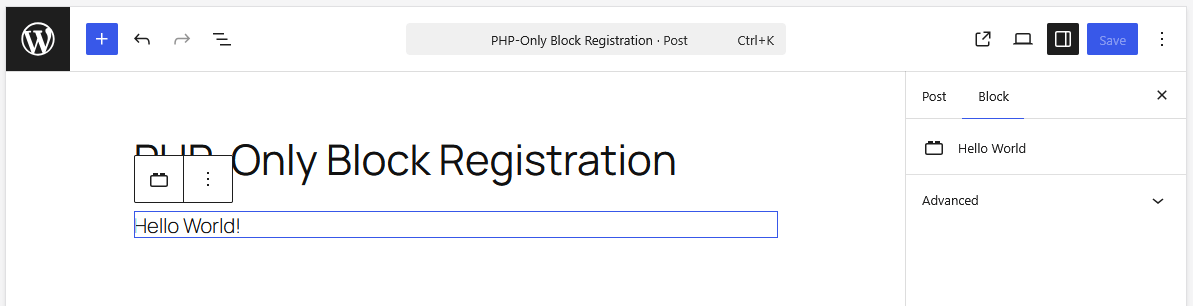
Implementing a basic block now requires nothing more than a standard PHP action hook:
function css_tricks_hello_world_block()
  register_block_type(
    'css-tricks/hello-world',
      [
        'title' => 'Hello World',
        'render_callback' => function ()
          return sprintf(
            '<div %s>Hello World!</div>',
            get_block_wrapper_attributes()
          );
        ,
        'supports' => [
          'autoRegister' => true,
        ],
      ]
  );

add_action('init', 'css_tricks_hello_world_block');
By adding the 'autoRegister' => true flag, WordPress automatically provisions the required client-side code and editor preview mapping.
Adding Attributes Without JavaScript
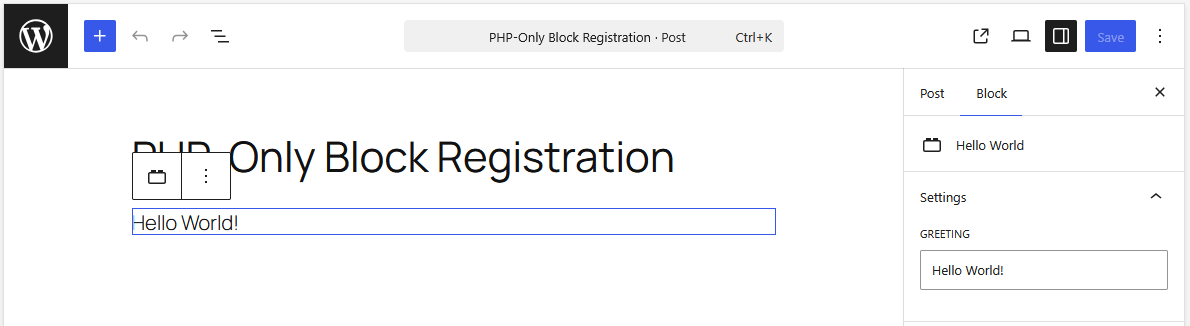
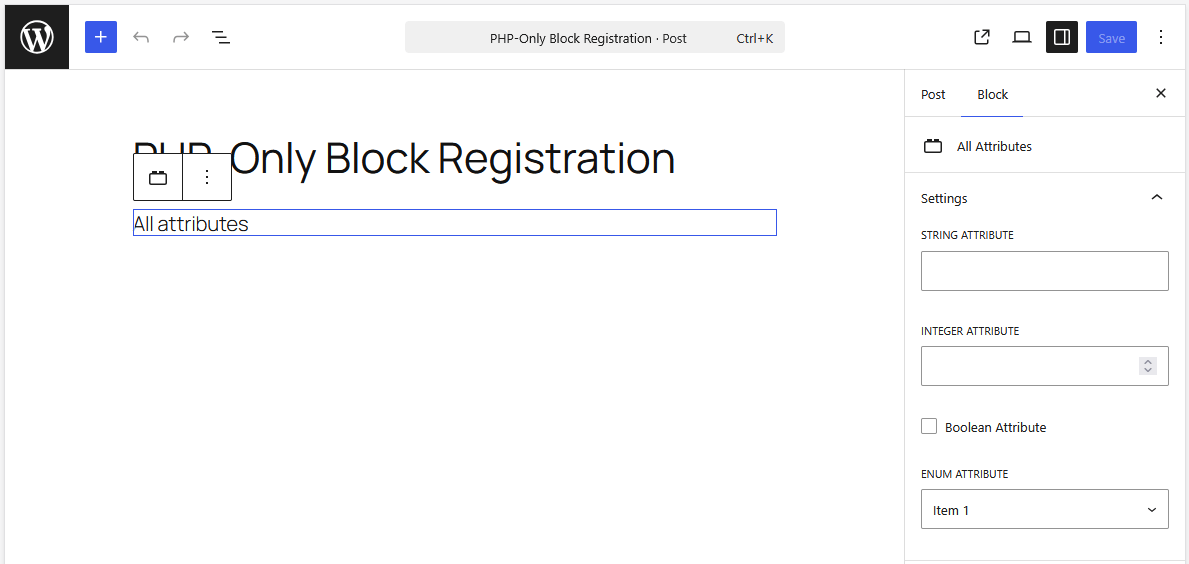
Attributes allow users to customize block behavior. In PHP-only blocks, input controls are automatically mapped in the block’s Settings sidebar based on data types defined during registration:
function css_tricks_hello_world_block()

  register_block_type(
    'css-tricks/hello-world',
    [
      'title' => 'Hello World',
      'render_callback' => function ($attributes)
        return sprintf(
          '<div %s>%s</div>',
          get_block_wrapper_attributes(),
          esc_html($attributes['greeting'])
        );
      ,
      'supports' => [
        'autoRegister' => true,
      ],
      'attributes' => [
        'greeting' => [
          'type' => 'string',
          'default' => 'Hello World!',
        ],
    ],
    ]
  );

add_action('init', 'css_tricks_hello_world_block');
Despite this ease of use, technical audits of WordPress 7.0 reveal strict parameters:

- Supported Attribute Types: Limited to strings, numbers, and booleans.
- Supported UI Controls: Text inputs, number inputs, checkboxes, and basic dropdowns. Essential visual editing controls—such as native image uploaders, rich text editors, and advanced date pickers—remain absent from the PHP-only API.
Official Responses and Developer Perspectives
Reaction across the WordPress ecosystem has been sharply divided between cautious optimism and technical realism.
Veteran core contributors and theme developers have largely praised the update for addressing a glaring gap in the platform’s migration path. For years, agencies managing massive enterprise portfolios of classic themes faced prohibitive cost barriers when pitching block theme migrations. The ability to wrap legacy headers, footers, and custom loops into server-side rendered blocks cuts migration timelines from weeks to hours.

Conversely, JavaScript-focused block engineers have sounded notes of caution, warning that developers must not treat PHP-only blocks as a permanent substitute for native JavaScript components. Because these blocks bypass the client-side JavaScript data store, they cannot interact dynamically with live edits happening elsewhere in the editor interface.
Architectural Limitations to Keep in Mind
While PHP-only registration is a powerful tool, understanding its constraints is vital for preventing architectural dead ends:

- No In-Preview Interactivity: Because the editor displays HTML returned by the PHP
render_callback, and updates via asynchronous REST API calls, you cannot attach reliable JavaScript event listeners or build rich, in-place editing experiences. All custom controls must live in the Settings sidebar. - Stale Data and the Client-Side Store: PHP-only blocks query the database directly during rendering. If a user modifies a post title or custom field inside the editor, the PHP block will continue showing stale database values until the post is explicitly saved and the editor is reloaded.
- Missing Post Context: REST API endpoints are stateless. Global template tags rely on global state (like The Loop), meaning standard functions requiring post context may fail in the block editor preview unless explicitly circumvented with URL parameter workarounds.
Implications for Theme Authors and the Ecosystem
The long-term implications of WordPress 7.0’s PHP-only block registration extend far beyond individual code snippets.
Breaking Down Block Theme Adoption Barriers
The single greatest roadblock to block theme adoption has never been a lack of appreciation for their performance or full-site editing capabilities; it has been the economic reality of rewriting thousands of lines of legacy PHP code. By neutralizing this obstacle, WordPress 7.0 is expected to accelerate migration metrics across the agency landscape.

A Cultural Shift in Core Philosophy
Historically, WordPress Core development has pushed the developer community decisively toward JavaScript, single-page application architectures, and headless implementations. The introduction of PHP-only blocks signals a pragmatic pivot. Core maintainers are explicitly acknowledging that millions of active sites rely on PHP-centric workflows, and that developer experience must accommodate practical realities rather than ideological purity.
Conclusion: Was the Wait Worth It?
If your goal is to build slick, highly interactive, standalone blocks from scratch—complete with rich-text inline editing and complex client-side state management—PHP-only block registration is the wrong tool for the job. JavaScript remains the undisputed king of modern block development.
However, if you manage legacy WordPress installations trapped in classic theme purgatory due to budget constraints, complex shortcodes, or custom PHP widgets, WordPress 7.0 is nothing short of a revelation.
You no longer need to learn React, configure Webpack, or rewrite your entire codebase to enjoy the structural advantages of block themes. By bridging the gap between legacy code and modern core standards, this feature proves that, for thousands of developers, the seven-and-a-half-year wait was well worth it.



