










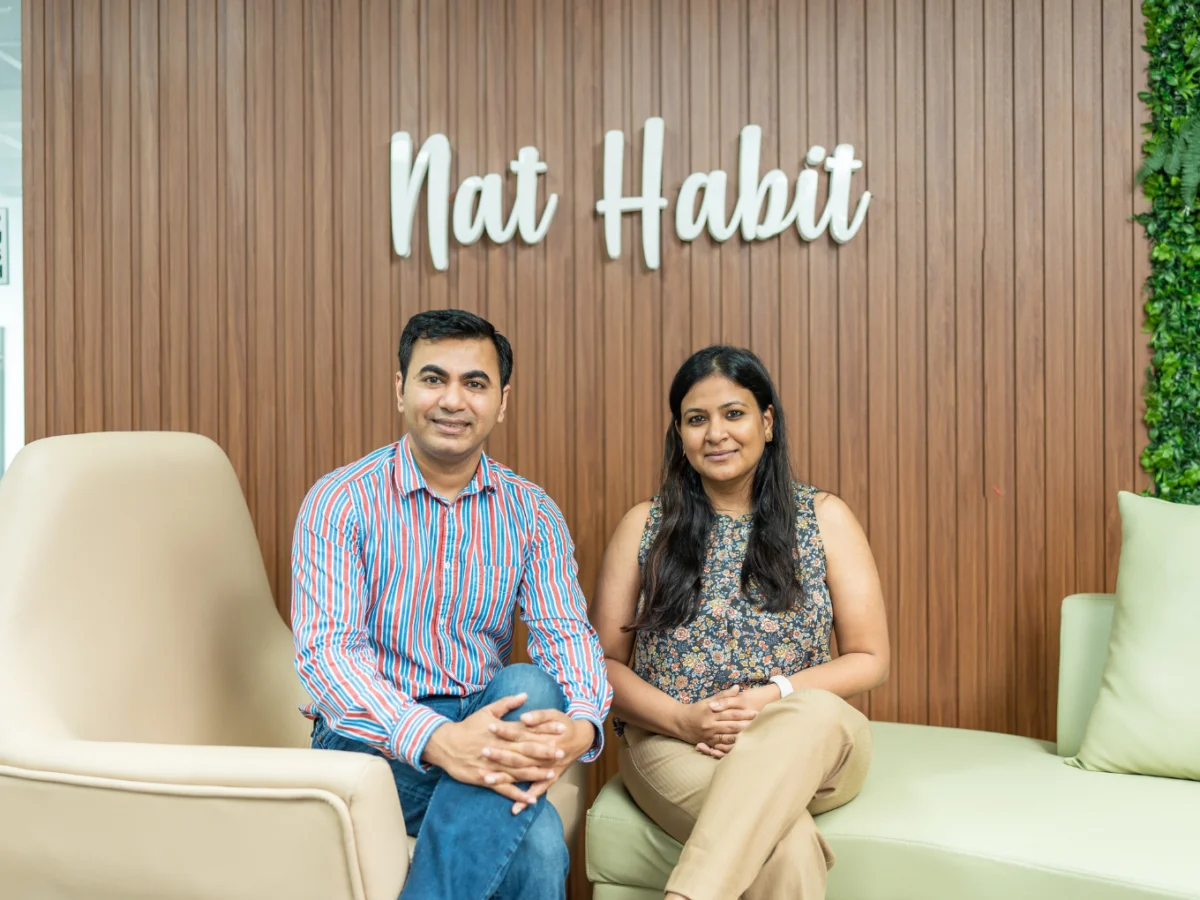
NEW DELHI – In a significant move that underscores the continued investor appetite for India’s burgeoning D2C (Direct-to-Consumer) personal care sector, Nat Habit has successfully closed a ₹142 Cr ($14.7 Mn) Series C funding round. Led by Trident Growth Partners, the all-primary capital injection marks a pivotal chapter for the startup as it transitions from a niche, premium-focused brand to a mass-market player aiming to capture the hearts and vanity cabinets of the "Bharat" consumer.
The funding round saw strong backing from existing investors, including Bertelsmann India Investments, Mirabilis Investment Trust, and Sharrp Ventures. Notably, the cap table was further bolstered by the entry of Physis Capital and Hero Family Office, signaling institutional confidence in the startup’s operational roadmap and its ability to navigate the increasingly competitive Ayurvedic personal care landscape.
The Strategic Roadmap: Scaling from Niche to Mass Market
Since its inception in 2019 by Swagatika Das and Gaurav Agarwal, Nat Habit has carved out a unique identity by positioning itself at the intersection of traditional Ayurvedic principles and contemporary scientific formulation. With a portfolio spanning hair oils, masks, scrubs, and baby care, the company has established a reputation for "fresh" personal care. However, the Series C round represents a fundamental shift in strategy.
Expanding the Retail Footprint
Nat Habit currently operates a retail presence across approximately 20,000 stores. The management has set an ambitious target: to scale this reach to 2 lakh stores over the next three years. This 10x expansion is not merely a numbers game; it represents a move into "modern trade"—the organized retail segment that has historically been the domain of legacy FMCG giants. By entering supermarkets, hypermarkets, and specialized beauty chains, Nat Habit aims to reduce its reliance on digital-only customer acquisition, which has become increasingly expensive due to rising ad-tech costs.
Targeting the "Bharat" Consumer
One of the most critical aspects of the new strategy is the pivot toward the "Bharat" consumer. Historically, Nat Habit’s product pricing and brand communication were tailored toward educated, higher-income urbanites. To reach a broader demographic, the company plans to:
- Adapt Pack Sizes: Introducing smaller, more affordable stock-keeping units (SKUs) to lower the barrier to entry.
- Localize Communication: Tailoring marketing language and brand messaging to resonate with tier-2 and tier-3 market demographics, moving away from high-end, aspirational jargon toward utility and value-driven messaging.
Chronology: A Trajectory of Growth
To understand the weight of this Series C round, it is essential to look at the startup’s financial evolution:
- 2019: Nat Habit is founded by Swagatika Das and Gaurav Agarwal, focusing on fresh, plant-based formulations.
- 2023: The startup secures $10.2 Mn in Series B funding. At the time, the focus was primarily on product diversification and initial brand building.
- 2024: The company reports an annualized gross revenue of ₹330 Cr, having served over 60 lakh households across India.
- 2025: Nat Habit successfully closes its Series C round of ₹142 Cr, signaling a transition toward aggressive offline distribution and R&D-led category expansion.
This trajectory reflects a common theme in the Indian D2C ecosystem: early survival through digital agility, followed by a mid-stage push into physical retail to sustain growth as customer acquisition costs (CAC) stabilize.
Supporting Data and R&D Focus
The fresh capital is earmarked for more than just retail expansion. Nat Habit is positioning itself for a massive R&D push. A significant portion of the funds will be directed toward entering categories where the brand has been absent, most notably sunscreens and specialized serums.
In the beauty and personal care (BPC) market, sunscreens and serums are high-growth, high-margin categories. However, they require rigorous testing and sophisticated formulation stability. By investing in its own manufacturing facilities and R&D capabilities, Nat Habit is attempting to move away from third-party manufacturing dependencies, ensuring greater control over quality and product freshness—a core pillar of their brand promise.
Furthermore, the brand is doubling down on quick commerce. With the rapid rise of platforms like Blinkit, Zepto, and Swiggy Instamart, Nat Habit plans to integrate its supply chain deeper into these networks to ensure its "fresh" products reach customers in minutes rather than days.
Official Perspectives: The Vision for "Freshness"
Reflecting on the milestone, co-founder Swagatika Das noted, "Our ambition now is to make our products accessible to many more households across India. We believe that the convergence of ancient Ayurvedic wisdom and modern, fresh-science formulations is not a luxury, but a necessity for the Indian consumer."
The leadership team has maintained that while the company is scaling rapidly, the core promise of using natural, additive-free ingredients remains non-negotiable. This "clean label" approach has been their primary differentiator, and the Series C funds are intended to help them maintain this standard even as they scale to 2 lakh retail touchpoints.
The Broader Industry Context
The Indian Ayurvedic and herbal wellness segment is witnessing a surge of institutional interest, but the path is not without its casualties.
The Competition
The market is crowded. Companies like Kapiva have recently raised $60 Mn in a Series D round, showcasing a similar ambition to dominate through R&D and international expansion. Kapiva’s recent launch of a ₹50 Cr innovation fund, which explicitly targets AI-integrated Ayurvedic research, highlights the "tech-first" approach that even traditional segments are now adopting to stay relevant.
The Risks of Over-Expansion
However, the road to scale is littered with risks. The recent closure of The Ayurveda Co. serves as a stark reminder of the dangers of over-expansion. After burning through capital and scaling too quickly without establishing sustainable unit economics, the brand ceased operations in July 2025. This failure has caused investors to look more closely at "profitable growth" rather than "growth at all costs."
Nat Habit appears to be aware of these pitfalls. By balancing its push into the mass market with a deliberate, phased strategy, it hopes to avoid the "over-expansion trap."
Implications: What This Means for the Market
The success of Nat Habit’s Series C round has three major implications for the Indian D2C landscape:
- The Institutional Shift to "Bharat": Investors are increasingly wary of startups that only serve the "top of the pyramid." Any D2C brand looking for late-stage funding must now demonstrate a clear, actionable plan to reach tier-2 and tier-3 markets.
- The "Freshness" Premium: Nat Habit’s ability to turn "freshness" into a scalable business model is being closely watched. If they succeed in managing the supply chain logistics of a fresh product at a 2-lakh-store scale, it will set a new operational benchmark for the industry.
- Omnichannel is the New Default: The era of "D2C-only" is officially over. The funding confirms that modern brands must be omnipresent—across e-commerce, quick commerce, and traditional brick-and-mortar retail—to remain competitive.
As Nat Habit moves into this next phase, the industry will be watching to see if they can maintain their brand identity while operating at a scale that typically dilutes the quality of "niche" products. For now, the infusion of ₹142 Cr gives them the necessary runway to prove that they are not just another fleeting D2C trend, but a durable, long-term player in the Indian personal care story.



