




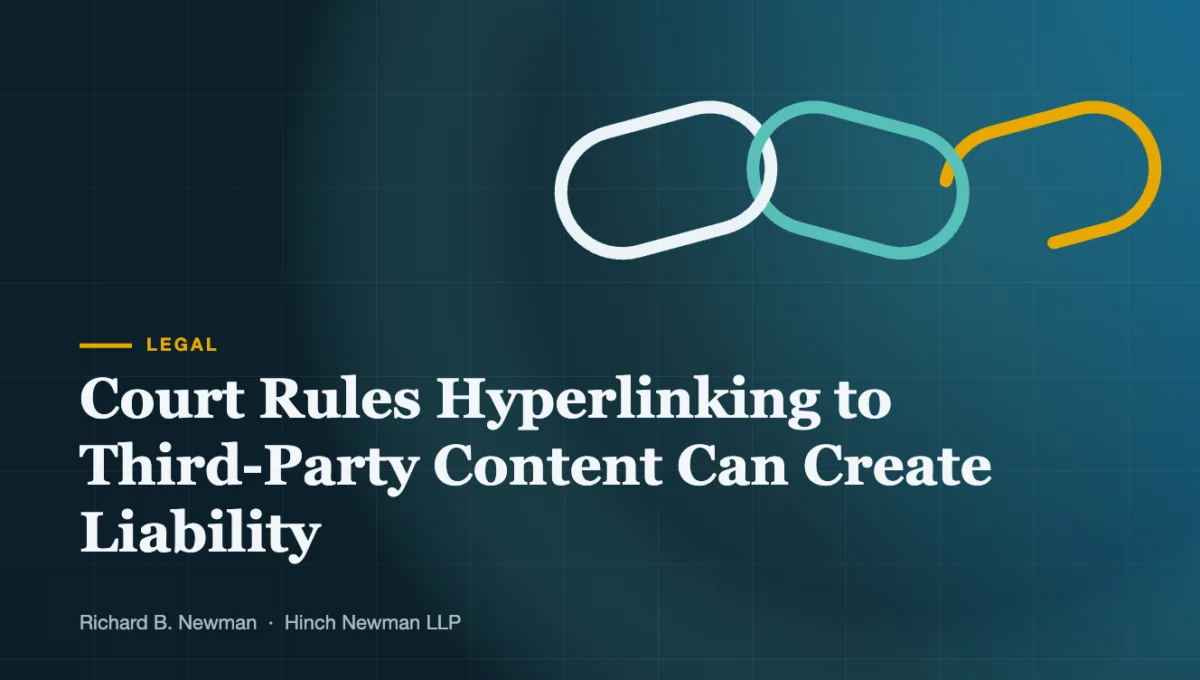
In an era where the internet is built upon a vast architecture of interconnected pathways, a recent ruling by the United States Court of Appeals for the Tenth Circuit has sent shockwaves through the digital marketing and legal communities. The decision in KetoNatural Pet Foods, Inc. v. Hill’s Pet Nutrition, Inc. (No. 24-3185, July 14, 2026) has fundamentally altered the interpretation of “commercial speech,” establishing that the digital breadcrumbs companies leave for consumers—in the form of hyperlinks—can now carry significant legal weight under the Lanham Act.
For decades, the hyperlink was often viewed as a neutral navigational tool, a bridge between two distinct digital domains. However, the Tenth Circuit has now signaled that when a company intentionally embeds a hyperlink to third-party content as part of a promotional narrative, it may be effectively “adopting” that content as its own. This paradigm shift means that businesses can no longer hide behind the “third-party” label when the content they curate is used to substantiate their own marketing claims.
The Case: KetoNatural Pet Foods v. Hill’s Pet Nutrition
The conflict at the heart of the ruling began as a typical commercial dispute between two competitors in the pet food industry. KetoNatural Pet Foods initiated litigation against Hill’s Pet Nutrition, alleging that the latter had engaged in false advertising. The core of the dispute centered not just on the claims made directly on Hill’s website, but on the content that Hill’s encouraged its customers to visit through specific, curated hyperlinks.
KetoNatural argued that Hill’s utilized these links to steer consumers toward third-party materials—such as scientific studies, expert opinions, or comparative reviews—that contained misleading or unsubstantiated information. The legal question before the Tenth Circuit was whether a company could be held liable for false advertising if the “falsehood” was contained not on the company’s own landing page, but at the destination of a hyperlink it explicitly provided.
The Tenth Circuit’s decision provides a definitive answer: Yes. The court held that if a company intentionally incorporates third-party materials into its own promotional message, those materials become part of the company’s commercial speech. By directing consumers to these resources, the company is effectively endorsing the claims made within them, making the entire "pathway" of information subject to the rigorous scrutiny of the Lanham Act.
Chronology of a Legal Shift
The evolution of this legal standard did not happen in a vacuum. To understand the gravity of the KetoNatural ruling, one must look at the trajectory of digital advertising law over the last several years:
- Pre-2020 Era: Digital marketing was largely viewed as a series of isolated advertisements. Liability was generally confined to the specific text, images, and video produced directly by the advertiser.
- The Rise of Influencer and Affiliate Marketing (2020–2024): As the FTC and state regulators increased oversight of influencer marketing, the concept of "attribution" began to expand. Advertisers were increasingly held responsible for the claims made by their paid endorsers.
- The Integration of Generative AI (2023–2025): The proliferation of AI-generated content led to complex questions regarding authorship and verification. As companies began using AI to aggregate information from across the web, the lines between “original content” and “curated content” blurred.
- The KetoNatural Decision (July 2026): The Tenth Circuit formally codified the idea that a company’s “promotional message” is not limited to the borders of its own domain. The court established that if a company uses links to curate a narrative, it bears the legal burden for the veracity of the entire narrative chain.
Supporting Data and Legal Reasoning
The legal reasoning in KetoNatural rests on the concept of "intentional incorporation." The court examined whether the hyperlink was merely a navigational convenience or a deliberate promotional tactic.
In the context of the Lanham Act, which prohibits false or misleading descriptions of fact in commercial advertising, the court noted that the purpose of the statute is to prevent consumer deception. If a company provides a link to a study that it knows (or should know) is flawed, and uses that link to support a claim that its product is “the healthiest on the market,” the company is engaging in a deceptive practice.
The Scope of Commercial Speech
Under existing First Amendment jurisprudence, commercial speech enjoys less protection than political speech. The Tenth Circuit’s ruling effectively expands the “scope” of what constitutes a company’s commercial speech. By treating the destination content as part of the “promotional package,” the court is essentially saying that marketers cannot outsource their truth-in-advertising obligations to third-party websites.
Official Responses and Regulatory Outlook
While the KetoNatural case is a private dispute between two companies, its implications are being closely watched by regulatory bodies. The Federal Trade Commission (FTC), which has been increasingly aggressive in its policing of digital marketing, is likely to see this decision as a powerful tool.
Legal experts suggest that the FTC and various state Attorneys General will likely leverage this precedent to broaden the scope of their investigations. If a company directs consumers to a third-party website as part of a campaign—even if that website is a seemingly independent blog or scientific journal—regulators may now argue that the company is responsible for the claims made on that site.
“For digital marketers, this decision is a wake-up call,” says Richard B. Newman, an advertising practices attorney at Hinch Newman LLP. “The days of linking out to ‘research’ without vetting the source are effectively over. Courts are no longer looking at the website in isolation; they are looking at the ‘promotional pathway’ as a whole.”
Implications for the Digital Marketing Industry
The KetoNatural ruling creates a new reality for brands, agencies, and content creators. The implications are far-reaching and necessitate a complete overhaul of how companies handle external linking strategies.
1. The Death of “Lazy” Linking
Many marketers use hyperlinks to provide “social proof” or “scientific backing” without thoroughly auditing the content at the other end of the link. This practice is now a major liability. Companies must perform due diligence on every third-party site they link to, ensuring that the content is accurate, substantiated, and compliant with consumer protection laws.
2. The AI Factor
As generative AI becomes more prevalent, the potential for liability increases. If a company’s AI-driven chatbot or automated marketing tool provides a link to an erroneous third-party source, the company could be held liable for the error. The court’s decision suggests that the “pathway” is judged regardless of whether it was created by a human or an algorithm.
3. Influencer and Affiliate Programs
Influencers often link to third-party reviews or “independent” articles to support their claims about a product. Under the new ruling, if an influencer is acting on behalf of a brand, the brand may be held liable for the content of those links. This necessitates stricter compliance guidelines in influencer contracts.
4. Need for Expert Legal Counsel
The complexities of this ruling mean that general marketing teams are ill-equipped to navigate the risks alone. Businesses must now involve FTC compliance counsel early in the campaign development phase. Legal review should include not only the primary landing page but also the entire chain of information the consumer is encouraged to follow.
Conclusion: A New Standard of Digital Responsibility
The Tenth Circuit’s decision in KetoNatural Pet Foods is a defining moment for the digital age. By refusing to treat hyperlinks as independent of the promotional context, the court has placed the onus of accuracy squarely on the shoulders of the advertiser.
The era of "click-and-hope" marketing—where companies could link to external data to bolster their claims without taking responsibility for that data—has come to an end. In its place, a new standard of digital responsibility has emerged. Advertisers who fail to vet the content they curate and the pathways they create for their consumers do so at their own peril. As the digital landscape continues to evolve, companies must recognize that every link is a reflection of their brand, and now, under the law, it is a reflection of their liability.
Disclaimer: Richard B. Newman is an advertising practices attorney at Hinch Newman LLP. This article is provided for informational purposes only and does not constitute legal advice. It is not intended to create an attorney-client relationship. Readers should consult with qualified legal counsel regarding their specific marketing practices and compliance obligations.