










In a significant stride toward autonomous, task-oriented artificial intelligence, Microsoft today announced the general availability of two new additions to its premier model series: GPT-6 Sol and GPT-6 Luna. These models are now integrated into the Microsoft Foundry ecosystem, joining the existing, high-performance GPT-6 Astra and GPT-5.6 Sol.
This expansion is not merely a quantitative increase in the number of models available to enterprise developers; it represents a strategic shift in how organizations should approach the economics and architecture of AI agents. By offering a tiered hierarchy of intelligence, Microsoft is empowering businesses to move away from the "one-size-fits-all" approach to large language models, favoring a precision-engineered strategy where the model matches the specific demands of the task at hand.
The Chronology of an Agentic Revolution
The journey toward this current milestone began with the initial push into "agentic" intelligence—AI that does not merely generate text, but performs complex, multi-step actions on behalf of users.
- Phase I: The Foundation. Microsoft introduced GPT-5.6 Sol, setting a new benchmark for cost-to-performance ratios in enterprise-grade coding and knowledge work.
- Phase II: Frontier Intelligence. The release of GPT-6 Astra brought advanced reasoning and computer-use capabilities to the forefront, allowing agents to navigate software interfaces and make nuanced, judgment-based decisions.
- Phase III: The Modular Ecosystem. With today’s launch, Microsoft rounds out the portfolio. GPT-6 Sol offers a balanced, mid-tier solution for complex workflows, while GPT-6 Luna serves as the high-speed, high-efficiency engine for routine, data-heavy operations.
This progression reflects a deeper understanding of the enterprise lifecycle. While early adoption focused on proving that LLMs could write code or summarize documents, the current phase focuses on "productionizing" these capabilities—ensuring they are reliable, secure, and economically viable at scale.
Strategic Model Selection: Matching Intelligence to Task
The core philosophy behind the expanded Foundry lineup is the concept of "Agentic Economics." Microsoft asserts that enterprise customers should stop measuring success by the cost per token and start measuring it by the "cost per task."
GPT-6 Astra: The Reasoning Powerhouse
Astra remains the flagship for high-stakes environments. It is designed for scenarios where the agent must act as a digital colleague—reasoning through complex software engineering tasks, executing computer-based actions, and exercising professional judgment. For organizations where accuracy and multi-step logic are non-negotiable, Astra serves as the primary engine.
GPT-6 Sol: The Workhorse for Complex Workflows
Sol sits in the "Goldilocks" zone. It is designed for production-level agents that require more than surface-level reasoning but do not demand the full, expensive power of the Astra frontier model. Sol is optimized for long-context analysis, multi-step reasoning, and tool-augmented workflows, making it the ideal candidate for teams migrating from legacy models or those just beginning to scale their AI operations.
GPT-6 Luna: Efficiency at Scale
Luna is the latest answer to the "latency and cost" problem. Recognizing that many enterprise workflows involve high-volume tasks—such as request routing, data extraction, and rapid-fire summarization—Microsoft developed Luna to be a smaller, leaner, and faster model. It allows developers to offload routine "grunt work" to a high-efficiency model, reserving the deep-reasoning capabilities of Astra for the specific, critical moments in a workflow that truly require it.
Supporting Data: The Case for Optimization
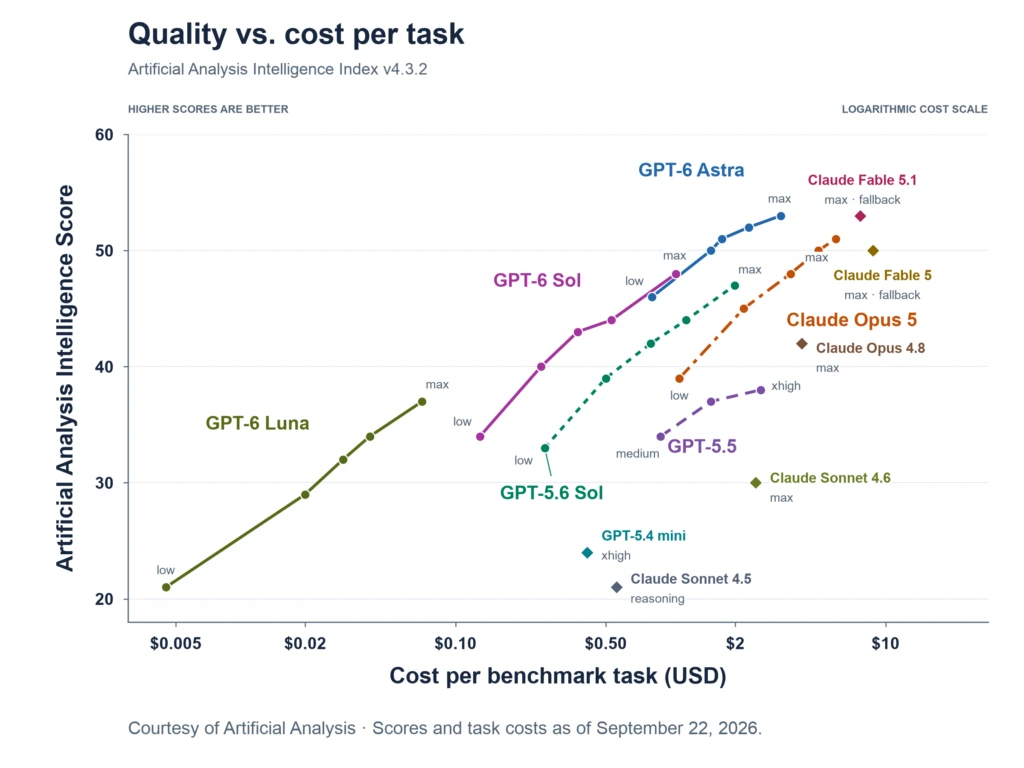
The shift toward this tiered model approach is supported by rigorous benchmarking. Microsoft’s latest internal data, reflected in updated performance charts, demonstrates that while Astra leads in absolute reasoning, the cost-per-task efficiency of Sol and Luna is substantially higher for their respective use cases.
For an enterprise, this is a bottom-line transformation. By intelligently routing requests, a developer can theoretically reduce their total AI spend by as much as 40–60% without sacrificing output quality. Instead of using a Ferrari to run a grocery errand, developers are now using the right vehicle for the specific distance and cargo of each request.
Official Responses and Industry Impact
The industry has taken note of the flexibility provided by the Microsoft Foundry stack. For companies building the next generation of autonomous agents, the ability to iterate quickly within a secure, governed environment is a major competitive advantage.
Insights from Manus
Manus, a leader in agentic workflows, has integrated these models into their core operations. Tao Zhang, Co-Founder and Product Partner at Manus, highlights the importance of this integration:
"Azure OpenAI models provide a core layer of intelligence powering Manus. Through Azure, we reliably integrate advanced models into our agentic workflows, enabling Manus to understand user intent, plan tasks, and execute complex work. Responsive Microsoft technical support and rapid access to new model capabilities help us iterate quickly and deliver a leading, reliable AI experience for our users."
Addressing Professional Rigor: Wolters Kluwer
For professional services, the challenge is not just intelligence, but accountability. Brian Diffin, CTO of Wolters Kluwer Tax & Accounting, emphasizes that for his firm, the "step-by-step" reasoning provided by these models is a regulatory necessity.
"Our customers work in domains where getting an answer isn’t enough; it has to be the right answer, and it has to hold up to scrutiny. The latest Azure OpenAI frontier models reason through a problem in steps we can follow, which is what makes it viable for the research and compliance workflows our professionals depend on."
The Foundry Advantage: Beyond the Model
The most critical takeaway from today’s announcement is that the "model" is only one piece of the puzzle. Microsoft Foundry is positioning itself as an end-to-end platform for enterprise AI, characterized by three key pillars:
- Deployment Flexibility: Whether a customer requires Global Standard deployments for flexibility, Data Zone support for regional residency requirements, or Provisioned Throughput for consistent latency, the platform provides a mature infrastructure layer.
- Safety and Governance: In an era of increasing AI scrutiny, security cannot be an afterthought. Foundry integrates safety at four distinct layers: training-time alignment, output guardrails, tool-use verification, and identity-based access controls.
- The Open Stack: By maintaining an interoperable, open stack, Microsoft allows developers to avoid vendor lock-in, enabling them to swap models or deployment configurations as their specific business needs evolve.
Implications for the Future of Enterprise AI
The expansion of the GPT-6 series marks the end of the "experimentation" era for Generative AI. We are now firmly in the "implementation" era. The implications for the workforce and corporate IT departments are profound:
- Shift in IT Skillsets: IT departments are moving from "prompt engineering" to "agent architecture." The focus is shifting toward how to chain these models together, how to monitor their reasoning, and how to govern their interactions with external software.
- Economic Realignment: As businesses move to production, the focus on "cost per task" will force a maturation of the AI market. Providers that cannot offer a mix of high-intelligence and high-efficiency models will struggle to compete with the granularity now offered by Microsoft.
- Increased Trust: By focusing on "traceable" reasoning—the ability to follow the steps an agent takes—Microsoft is helping businesses meet the rigorous compliance standards required in finance, healthcare, and law.
Conclusion: Building the Next Generation
As businesses evaluate their AI strategies for the coming year, the choice of platform is becoming just as important as the choice of model. By providing a clear roadmap from the high-reasoning capabilities of GPT-6 Astra to the high-efficiency throughput of GPT-6 Luna, Microsoft Foundry is offering a stable, predictable, and scalable foundation for the future of work.
For organizations looking to move from a "promising pilot" to a "production-grade agent," the path forward is clear: start with evaluations, optimize for the specific task, and build on a platform that offers the necessary security, residency, and performance controls. The age of the intelligent, autonomous agent has arrived, and it is built on the robust, multi-layered architecture of the Microsoft Foundry.



