










For decades, the archetype of the Chief Financial Officer (CFO) was etched in stone: the ultimate custodian of the ledger. Their domain was restricted to closing the books, ensuring regulatory compliance, managing cash flows, and serving as the primary gatekeeper for cost control. They were the "No" men and women of the corporate world, tasked with ensuring the numbers added up.
However, the modern business landscape—defined by rapid digital transformation, global volatility, and the relentless march of artificial intelligence—has shattered this narrow definition. Today’s CFO is increasingly a strategic co-pilot, a role that extends into the intricate webs of cybersecurity, mergers and acquisitions (M&A), environmental, social, and governance (ESG) mandates, and enterprise IT. Every corporate function, ultimately, carries a financial footprint. Whether it is evaluating the ROI of a new technology stack, de-risking a complex acquisition, or quantifying the fallout from a cyber breach, today’s financial leaders must look beyond the balance sheet to understand the very engine of the business.
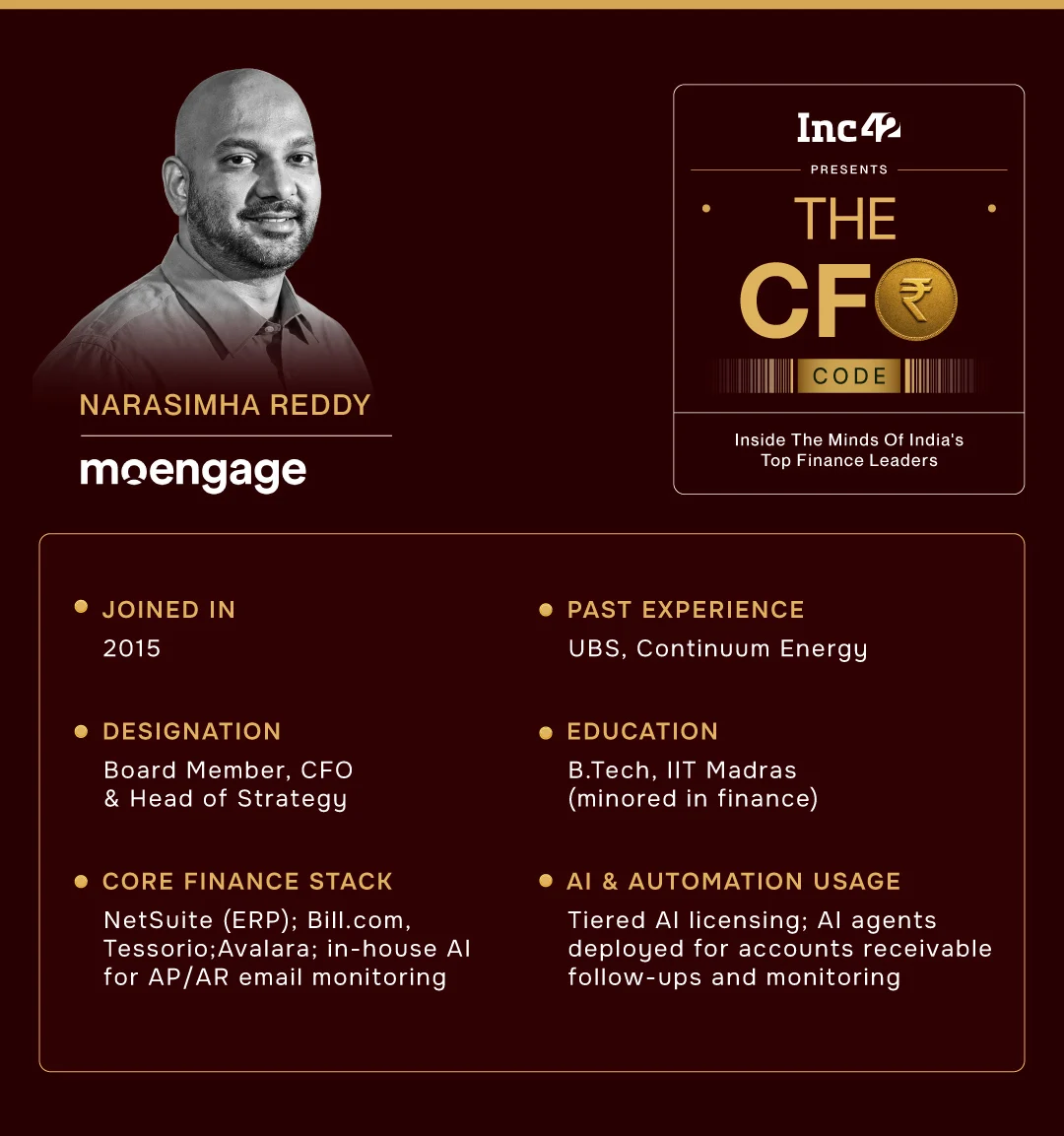
At MoEngage, this evolution was not a forced transition but a founding philosophy. At the center of this journey is Narasimha Reddy, who joined the company in 2015 when it was a lean startup of barely 15 people. Today, as MoEngage scales to serve over 1,300 global consumer brands—including giants like Starbucks, Coca-Cola, Flipkart, Domino’s, and OYO—Reddy’s remit has expanded to oversee not just finance, but strategy, human resources, and global partnerships.
The Making of a Startup CFO: A Decade of Resilience
Reddy’s tenure at MoEngage is a masterclass in the "all-hands-on-deck" nature of startup leadership. His path to the CFO chair was neither traditional nor linear. Having worked at UBS and Continuum Energy, Reddy possessed the rigorous technical training required for financial stewardship, but his entry into MoEngage was personal. He and founder Raviteja Dodda were roommates during their grueling preparation for the IIT entrance exams, a shared history that fostered the deep trust necessary to navigate the turbulent early years of a high-growth SaaS firm.
When Reddy joined in 2015, the company was still finding its product-market fit. There were no defined job descriptions; there was only the immediate, existential need to survive and scale.
The 2016-2017 Crucible
The defining moment for Reddy’s approach came during the 2016-2017 fiscal period. As capital availability in the venture market tightened, MoEngage found itself struggling to secure a Series B round. The conventional wisdom for startups at the time was to prioritize growth at any cost. Reddy, however, recognized that growth without a clear path to sustainability is a liability.
"You can’t continue investing in growth in the same way when capital availability is limited," Reddy recalls. "So the question becomes: how do you get closer to profitability, even if you’re not profitable yet?"
To survive, Reddy orchestrated a strategic pivot in the company’s revenue model. He moved enterprise customers from monthly postpaid contracts to annual prepaid plans. This was a radical departure for a young startup, and it faced significant internal resistance, particularly from the sales team, who feared it would alienate customers. Reddy’s solution was to lead by example. He joined sales calls with the company’s largest clients, personally negotiating and closing the first annual deals. By proving that the model was viable, he turned an unconventional experiment into the company’s standard operating procedure.
This infusion of upfront cash provided the runway MoEngage needed to weather the capital drought. Furthermore, Reddy’s leadership saw the company raise venture debt—a bold, non-traditional move at the time—which provided the necessary cushion to sustain growth until the Series B round was successfully closed in 2018.
Chronology of Strategic Evolution
The trajectory of MoEngage under Reddy’s financial stewardship highlights a shift from survival-mode tactics to long-term strategic planning:

- 2015: Narasimha Reddy joins MoEngage as it begins its startup journey.
- 2016-2017: The "Survival Phase." Facing a funding crunch, Reddy implements annual prepaid billing models to improve cash flow.
- 2018: Successful Series B raise, validating the company’s shift toward disciplined, cash-conscious growth.
- 2025: MoEngage achieves profitability in the December quarter, marking a major milestone in its maturity.
- 2026: The "Homecoming." The NCLT approves the reverse merger of MoEngage Inc. (US) into MoEngage India Private Limited, signaling a shift toward Indian public market readiness.
The Homecoming: Why India became the Strategic Hub
In January 2026, the Bengaluru bench of the National Company Law Tribunal (NCLT) approved the merger of MoEngage’s US-based parent entity into its Indian arm. This "reverse flip" was a significant strategic decision, one that defied the traditional trend of Indian startups migrating to US jurisdictions for IPOs.
Reddy explains that while the US was the logical choice for early-stage capital and customer acquisition, the perspective changed as the Indian capital markets matured. "If you look at US public markets, people are more sentiment-driven and not really financially driven," Reddy notes. He points to the recent obsession with AI-heavy narratives, where capital often flocks to hyped themes regardless of the underlying cash flow.
For MoEngage, which had reached nearly $100 Mn in ARR and achieved profitability, the Indian market offered a more rational and stable environment for a company of its stature. With SEBI easing listing norms—specifically removing the mandate for three years of prior profitability—the path to a domestic IPO became not only viable but highly attractive.
AI: Measuring Productivity over Hype
In an era where every board meeting is dominated by AI, Reddy maintains a grounded, finance-first perspective. He argues that the conversation should not be about whether AI is a "good" or "bad" investment, but rather about the granular productivity gains it unlocks per function.
"Finance teams, for instance, could ask whether AI allows one person managing 200 accounts to handle 250 or 350 without a corresponding increase in headcount," Reddy explains. His internal mechanism for AI adoption is rigorous: MoEngage does not issue universal licenses. Instead, expensive, high-powered models are reserved for specific teams where they can extract the most value from complex tasks, while cost-effective, smaller models handle day-to-day administrative efficiency.
Crucially, Reddy views AI as a tool for the "legwork" rather than a replacement for judgment. "AI can help answer almost every question regarding entering a new market—from size to competition—but whether the company should enter, and how much capital to commit, remains a human decision."
Implications for the Next Generation of CFOs
As the industry looks toward the next decade, Reddy believes the role of the CFO will continue to migrate toward the very heart of the business. No longer satisfied with reporting history, the CFO must be an architect of the future.
The New Rules of Engagement:
- Frameworks over Intuition: Every investment, whether in a new market or a product feature, must follow a pre-defined framework. This includes established gestation periods and clear KPIs for when to pull the plug.
- The Death of "Growth at Any Cost": Since 2022, investor appetite for burning cash has vanished. Reddy advocates for the "Rule of 40," where companies must balance growth and profitability. Founders who continue to burn 30-40% of revenue while growth slows are, in his view, courting obsolescence.
- Cross-Functional Fluency: A CFO who doesn’t understand HR, product development, and sales is a liability. Finance must now be the bridge between these departments to ensure that every dollar spent is aligned with the company’s long-term value creation.
Conclusion: The Business Leader with a Finance Lens
The story of Narasimha Reddy and MoEngage is a case study in how the CFO function has fundamentally changed. The modern CFO is less an accountant with a grand title and more a business leader with a finance lens. For Reddy, numbers remain the absolute language of business, but they are merely the data points that inform the strategic narrative.
As MoEngage prepares for its next chapter, the lessons from its journey—prioritizing cash efficiency, resisting the lure of "growth at any cost," and using technology to drive productivity rather than just to follow a trend—provide a blueprint for the next generation of financial leaders. The future belongs to those who, like Reddy, are willing to walk into the sales room, challenge the status quo, and make the difficult decisions that define a company’s destiny.



