









The JavaScript landscape is undergoing a period of intense architectural introspection. As the web platform matures, the tools we use to build it are shifting from incremental improvements to foundational rewrites. From the high-stakes migration of the Bun runtime to the ongoing debate over the necessity of polyfills, the community is currently defining the next decade of web development. This report synthesizes the latest developments, technical shifts, and philosophical disagreements currently shaping the industry.
I. Main Facts: The Great Migration and Architectural Shifts
At the center of this week’s technical discourse is a monumental shift for the Bun runtime. Jarred Sumner, creator of Bun, has officially announced the transition of the project’s core from Zig to Rust. This isn’t merely a refactor; it is a full-scale port that will serve as the backbone for Bun 1.4. The project, which involved the strategic use of AI-assisted coding—specifically, hundreds of instances of Claude Code—highlights a new era of developer productivity, with the porting process incurring an estimated $165,000 in API costs.
Simultaneously, the quest for lightweight, high-performance infrastructure continues. The introduction of Ant, a JavaScript runtime shipping as a mere 9MB binary, represents a departure from the industry-standard engines like V8, JavaScriptCore, and SpiderMonkey. By utilizing a custom C-based implementation, Ant aims to solve the "cold start" problem that plagues serverless and edge computing environments, all while maintaining compatibility with the npm ecosystem.

II. Chronology of Recent Innovations
To understand where we are, we must look at the rapid-fire succession of releases and announcements that have defined the last few weeks:
- The Bun Pivot: Following months of development, the transition of Bun from Zig to Rust reached a critical milestone, setting the stage for the imminent release of Bun 1.4.
- The Wordgard Release: Marijn Haverbeke, known for his work on ProseMirror, unveiled Wordgard. This rich text editor, built without the aid of LLMs, marks a significant return to traditional software craftsmanship and a continued reliance on Operational Transformation (OT) over Conflict-free Replicated Data Types (CRDTs).
- The Polyfill Debate: Lea Verou reignited a long-standing standards debate by challenging the stance of Anne van Kesteren, who has argued that polyfilling is inherently harmful to the web. Verou’s defense highlights the tension between platform purity and developer pragmatism.
- ChatGPT Reverse Engineering: An in-depth analysis by Dennis Brotzky provided a rare "under the hood" look at the stack powering the world’s most popular AI chatbot, revealing a modern mix of React Router 7, TanStack Query, and Radix UI.
III. Supporting Data: Visualizing the Ecosystem
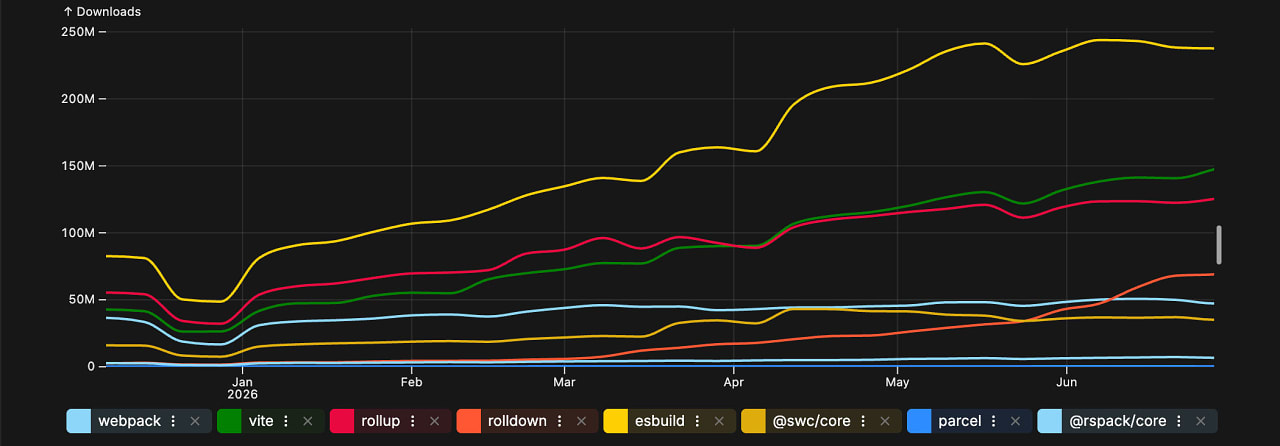
For developers attempting to navigate this fragmented landscape, TanStack has introduced a new suite of npm Package Download Charts. This tool serves as a diagnostic instrument for the community, allowing developers to track the rise and fall of libraries in real-time. By comparing frameworks, build tools, and component libraries, the data provides a clear picture of shifting developer sentiment.
Data reveals that while legacy tools maintain massive footprints, modern alternatives—such as those found in the ChatGPT stack—are seeing accelerated adoption. The usage of tools like TanStack Query and ProseMirror confirms that complex, state-heavy web applications are becoming the baseline expectation rather than the exception.
IV. The Philosophical Divide: Polyfills and Collaborative Editing
In Defense of Polyfills
The debate between Anne van Kesteren and Lea Verou touches on the existential question of how the web should evolve. Van Kesteren’s position—that polyfills encourage the proliferation of non-standard behavior—is countered by Verou’s "ponyfill" argument. Verou suggests that denying developers the ability to backport modern features is a recipe for stagnation. If developers cannot rely on polyfills to bridge the gap between browser support and feature availability, the barrier to innovation becomes significantly higher, forcing developers to stick to the "lowest common denominator" of web standards.
The OT vs. CRDT Standoff
Marijn Haverbeke’s release of Wordgard brings the debate over collaborative editing to the forefront. While much of the industry has pivoted toward CRDTs for distributed synchronization, Haverbeke has doubled down on Operational Transformation (OT). His decision highlights a pragmatic engineering choice: OT, while notoriously difficult to implement correctly, offers specific performance and architectural advantages in his use case. By rejecting pull requests and maintaining a "no LLM" policy, Haverbeke is taking a firm stance against the current trend of automated, community-heavy development, favoring instead a deliberate, artisan-led approach to library creation.
V. Official Responses and Industry Implications
The implications of these developments are far-reaching. The move by Bun to embrace Rust suggests that, despite the elegance of languages like Zig, the maturity and tooling of the Rust ecosystem are currently unmatched for building systems-level infrastructure. The $165,000 investment in AI-assisted porting also serves as a case study for future software engineering: we are entering an age where capital-intensive AI usage can dramatically accelerate core infrastructure development.

Furthermore, the reverse engineering of ChatGPT’s stack by Dennis Brotzky offers a masterclass in modern web architecture. It confirms that even at the scale of OpenAI, developers are relying on robust, community-tested abstractions like TanStack Query and Radix. This provides a level of validation for open-source maintainers: the tools built by the community are the same ones powering the largest AI platforms on the planet.
VI. Looking Forward: Emerging Trends
As we look toward the remainder of the year, several trends appear inevitable:
- The Rise of "Tiny" Runtimes: With the arrival of projects like Ant, we are likely to see a shift away from the "heaviness" of standard browsers/runtimes. As edge computing demands faster execution, the 9MB-binary runtime will likely become a competitive benchmark.
- AI-Assisted Infrastructure: The success of the Bun/Rust port will likely trigger a wave of similar projects. We expect to see more legacy JavaScript infrastructure rewritten in memory-safe, high-performance languages, accelerated by large-scale LLM usage.
- Standardization vs. Polyfilling: The debate over polyfills will likely intensify as browsers continue to implement features at varying speeds. Expect to see new tools emerging that automate the "ponyfill" process, allowing developers to use modern standards without the perceived risks of traditional global polyfilling.
- The Persistence of Human-Led Craft: As seen with the Wordgard release, there remains a strong appetite for software that is clearly the product of human design. In a world saturated with AI-generated code, the "hand-crafted" label may soon become a hallmark of quality and maintainability.
Conclusion
The JavaScript ecosystem is currently experiencing a "great pruning." We are discarding the inefficient and the unmaintainable, opting instead for higher-performance runtimes, more robust state management, and a more pragmatic approach to browser compatibility. Whether it is through the aggressive rewriting of core runtimes or the stubborn, brilliant maintenance of text-editing primitives, the developers driving these changes are ensuring that the web remains the most dynamic and capable platform for application development.
The next few months, specifically the release of Bun 1.4, will be a litmus test for these shifts. As the community digests these changes, the focus must remain on interoperability and the long-term health of the open-source projects that underpin our digital infrastructure. As always, the best way to keep pace is to observe the data, engage with the debates, and, perhaps most importantly, build with the tools that prioritize the end-user experience above all else.