









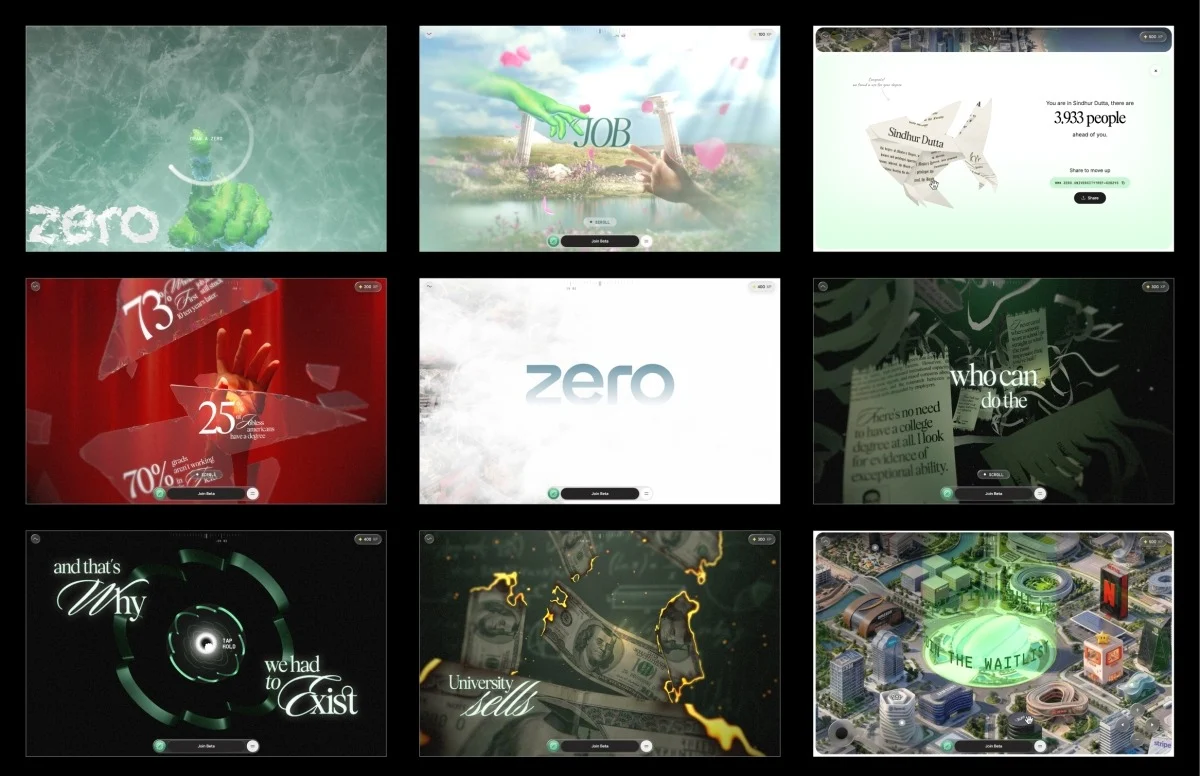
In the landscape of modern web development, the boundary between a standard landing page and an immersive narrative experience is narrowing. The latest project to push these limits is ZERO, a defiant interactive narrative demo that demands more than a simple click from its audience. From the moment a user arrives, they are greeted by a blank, locked screen. There is no traditional "Enter" button; instead, the site prompts the visitor to draw a zero. As the circular stroke closes, frost begins to spiderweb from the line, gradually peeling back the veil on a sophisticated, scroll-driven digital world.
This project, built over four months by a dedicated team, represents a triumph of WebGL engineering. By transforming over a gigabyte of high-fidelity source assets into a sub-10MB experience that maintains 60 frames per second (fps) on budget Android hardware, the team behind ZERO has set a new benchmark for web performance and storytelling.
The Genesis: A Proof of Concept Over a Pitch Deck
The project began not with a slide deck, but with a proof of concept. Atul Khola’s team recognized that to challenge the traditional degree path—the core theme of the ZERO narrative—they needed an interface that felt as disruptive as the message itself.

"We pitched with a functional prototype," the team notes. Within 48 hours, they had successfully implemented the ‘draw-a-zero’ interaction, proving that the concept wasn’t just viable, but deeply engaging. This rapid iteration was fueled by an AI-assisted development workflow. Rather than spending weeks drafting initial boilerplate code, the developers used AI to generate early versions of their ideas, allowing them to pivot immediately to the most crucial phase: refinement.
By the time the project was greenlit, the team had already tested multiple versions of the "burning money" effect and various shader timings. The initial code was merely the skeleton; the real labor was the meticulous polishing of every interaction to ensure the experience felt both tactile and responsive.
Narrative Architecture: Six Stages, Five Gates
ZERO is structured as a continuous, scrolling narrative that defies the static nature of standard web pages. The experience is divided into six distinct stages, bridged by five "interactive gates."

- The Promise: The story begins with the traditional path—study hard, get the grades, secure the corporate role.
- The Shattering: At the first gate, the promise of the degree is physically shattered, revealing raw unemployment statistics.
- The Discard: Certificates are shredded, money burns, and the user is funneled through a tunnel shaped like the ZERO logo.
- The Skyline: Emerging above the clouds, the user discovers a city built from the headquarters of real-world corporations.
- The Exploration: The final stage hands control back to the user, allowing for a free-roaming exploration of an interactive map.
To manage this complex flow, the team eschewed traditional browser scrolling. Instead, they built a custom virtual scroll engine. By treating every segment as a self-contained lifecycle, the code remains maintainable and robust. If a user jumps to a specific section of the site, the engine replays the preceding lifecycles, ensuring the 3D state is always perfectly initialized.
Technical Foundations: The Art of Optimization
The most impressive aspect of ZERO is its lean footprint. Managing a gigabyte of source data—including 8K textures and baked animations—is a daunting task for any web-based project.
Asset Compression and Pipeline
The team prioritized KTX2/Basis Universal compression for textures, as it allows assets to remain compressed directly on the GPU, significantly reducing VRAM usage. A critical realization during development was the danger of external dependencies: after a failure caused by a third-party CDN hosting their decoders, the team moved all DRACO and KTX2 decoders to local hosting.

To solve the "black box" nature of KTX2 compression, they built an internal conversion dashboard. This tool allowed for side-by-side comparisons of compressed and uncompressed assets, enabling them to apply aggressive compression to non-essential elements while preserving high-fidelity detail for hero assets.
Solving the "Hitch" Problem
Texture uploading is often the silent killer of 60fps performance. A single large texture uploaded to the GPU can cause a 50ms frame drop—a stutter that ruins the illusion of fluidity. To solve this, the team implemented a clever "drainUploads" function. By leveraging requestIdleCallback, the site identifies windows of idle time to push textures to the GPU. During critical transitions, the team forces these uploads synchronously, ensuring that when a new stage appears, it is already cached and ready for render.
The Shader Pipeline: Precision and Purpose
The visual fidelity of ZERO relies on a series of custom shaders, each refined through extensive testing.

- The Frost Unlock: The initial "draw-a-zero" interaction utilizes a ping-pong buffer that propagates pixel brightness in an octagonal growth pattern, mimicking crystalline frost.
- The Burn Effect: The burning money sequence uses a noise-driven distance field. By discarding fragments that haven’t reached the burn threshold early, the team kept the effect performant despite its visual complexity.
- The Shredding Logic: Certificates are handled by storing vertex strip indices. Each strip falls independently, with gravity calculated analytically to avoid the need for complex, heavy physics engines.
- Mobile Precision: A recurring challenge was the difference in float precision between desktop and mobile GPUs. Many shaders had to be explicitly set to
highp floatto ensure that features like the certificate shredding didn’t fall apart on mobile browsers.
Implications for Web Development
The success of ZERO underscores a fundamental shift in how developers should approach the "modern web." The era of relying on heavy frameworks and CDN-bloated asset pipelines is being challenged by a new wave of engineering-first development.
Key Takeaways for Future Projects:
- Custom Scroll Engines: Moving away from DOM-based scrolling provides total control over synchronization and performance.
- Self-Hosted Decoders: Never outsource your critical infrastructure; if your pipeline relies on someone else’s server, your performance is out of your hands.
- Adaptive Quality Management: Building a site that monitors its own frame times and adjusts quality tiers (pixel ratio, blur samples) ensures the experience remains accessible on both high-end workstations and budget smartphones.
- The AI Role: As demonstrated by the ZERO team, AI is not a replacement for engineering, but a force multiplier. It excels at rapid prototyping, while the final polish remains the province of human intuition and rigorous profiling.
Conclusion: The Path Forward
ZERO is more than a demo; it is a blueprint for the next generation of web-based storytelling. By treating the browser as a high-performance engine rather than a document viewer, the team behind ZERO has managed to craft an experience that is both technically audacious and narratively poignant.

The project proves that with the right tools—custom shaders, smart asset compression, and a disciplined approach to GPU lifecycle management—the web can be a home for truly immersive, cinematic experiences. As the digital landscape continues to evolve, the lessons learned from this project, particularly regarding performance profiling and adaptive quality, will undoubtedly become standard practice for developers aiming to bridge the gap between static web content and fully realized virtual environments.
Credits
- Creative Direction: Atul Khola
- Lead Engineering: [Team Names]
- Art & Animation: [Studio Names]
- Sound Design: [Designer Name]
The ZERO experience is now live, serving as a reminder that when technology is pushed to its limits, the results can be nothing short of breathtaking.