









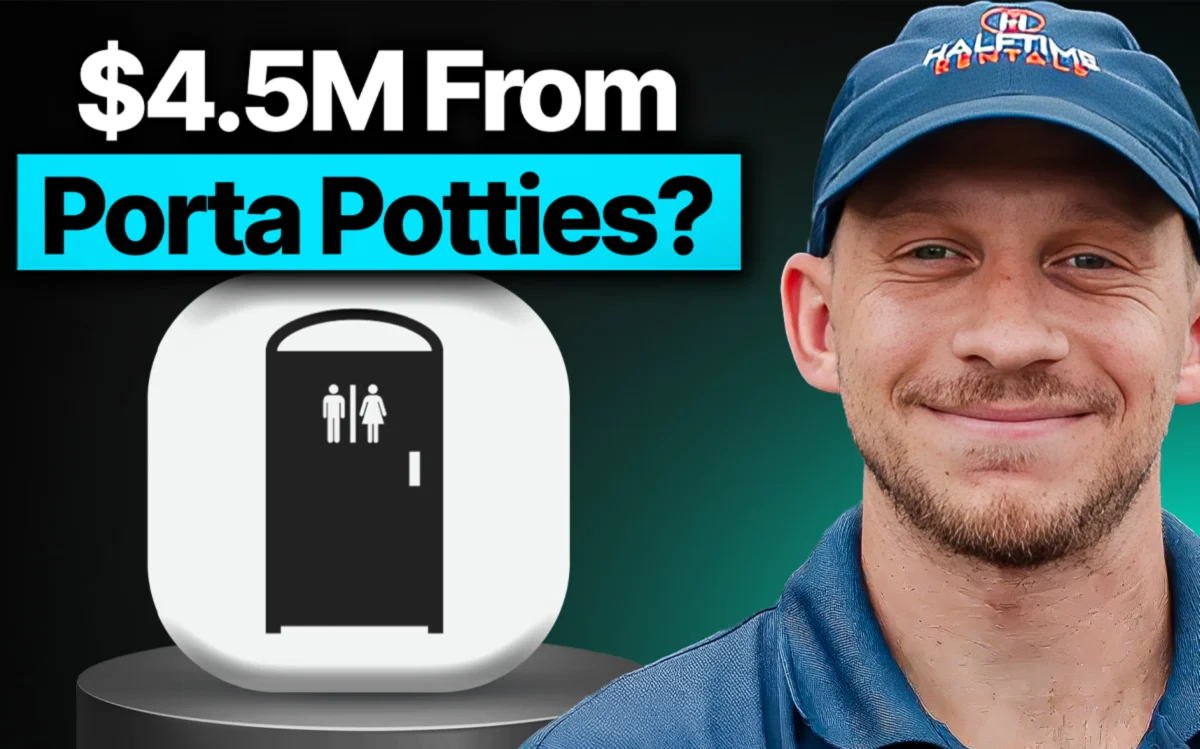
In the modern landscape of entrepreneurship, the allure of "high-tech" startups often overshadows the immense wealth-generating potential of traditional, blue-collar service industries. However, few stories illustrate the power of tactical execution in a "boring" business as effectively as that of Chad Howard. In under two years, Howard has transitioned from a ten-year career at Procter & Gamble to the helm of Halftime Rentals, a portable sanitation powerhouse currently pacing toward an annual revenue of $4.5 million.
Howard’s trajectory—from managing corporate processes to navigating the grit and chaos of a logistics-heavy service company—serves as a masterclass in how to disrupt a fragmented industry through operational excellence, rapid decision-making, and a culture of radical customer service.
The Genesis of a Bold Transition
For over a decade, Chad Howard followed the classic corporate roadmap. His tenure at Procter & Gamble spanned multiple states and various departments, providing him with a structured, high-level view of business operations. Yet, despite his career stability, Howard felt the persistent itch of entrepreneurial ambition.
The catalyst for his shift was his business partner, Austin, a professional well-versed in search-fund mechanics. Austin had spent considerable time analyzing the portable sanitation industry—a market characterized by recurring revenue, essential demand, and surprisingly robust EBITDA margins. Despite Austin’s consistent encouragement, Howard was initially hesitant. Leaving a lucrative corporate position for a business model defined by physical labor and logistics felt like an extreme leap of faith.
Ultimately, the decision was driven by a combination of personal introspection and external counsel. Howard recognized that his personality was ill-suited for the "side-hustle" mentality; he required total immersion. Furthermore, conversations with mentors over the age of 50 yielded a recurring theme: the regret of inaction. Realizing that the risks of staying in his comfort zone outweighed the risks of starting anew, Howard committed. By early 2024, he had secured capital from friends and family, relocated to Charlotte, North Carolina, and formally launched Halftime Rentals.
Chronology of Rapid Scaling
Howard’s launch was not characterized by a "soft opening." He approached the business with the intensity of an enterprise-level operation from day one.
- The Preparation Phase (Late 2023 – Early 2024): Before opening his doors, Howard spent six months laying the groundwork. This included securing supplier contracts, developing routing software, and establishing safety protocols. This pre-launch rigor meant that when the "Go" signal was given, he could operationalize the company within a single week.
- The Early Grind (Spring 2024): The initial months were defined by total labor involvement. Howard was not merely the CEO; he was a delivery driver, a technician, and a salesperson. He operated with minimal safety net, forced to build systems for scheduling and equipment maintenance on the fly.
- The Catalyst (Hurricane Helene): In a pivotal moment for the company, Hurricane Helene devastated western North Carolina. While still a nascent firm with roughly 100 units, Halftime Rentals received an emergency call from Home Depot. The retailer required urgent sanitation support for stores in the Asheville region to facilitate disaster recovery.
- The Expansion (Post-Helene to Present): Howard’s decision to accept the challenge—despite the immense logistical hurdles—transformed the company. The massive influx of revenue allowed him to finance dozens of new trucks and hundreds of units, effectively fast-tracking the business by years in a matter of weeks.
Operational Data and Financial Health
The statistics behind Halftime Rentals are as impressive as they are unexpected for a portable sanitation company. As of late 2024, the business manages nearly 1,900 units under lease. The company employs 15 full-time staff members and maintains a fleet of 9 service trucks.
Perhaps most telling is the company’s financial efficiency. Over the past six months, Halftime Rentals has maintained an average EBITDA margin of approximately 30%. This profitability is a direct result of Howard’s focus on high-density routing and the strategic acquisition of equipment. By leveraging the surge in demand during the hurricane response, Howard was able to reinvest profits directly into capital assets, allowing the company to cash-flow its own expansion without crippling debt.
The "Human Capital" Philosophy: Official Perspectives
Howard’s management style is rooted in the belief that the driver’s seat is the most important position in the company. In the eyes of the customer, the driver is the brand.

To maintain service standards, Howard implemented a dual-incentive program. First, to drive local SEO, he introduced a $25 Amazon gift card incentive for drivers whose names are mentioned in positive Google reviews. This program has proven so successful that some employees have earned over $3,000 in bonuses, turning the workforce into a highly motivated marketing engine.
Second, he introduced a "drop-in" inspection program. If a unit passes a surprise quality check, the driver earns a $50 daily bonus. This ensures that the quality of service remains high even when the CEO is not on-site. Howard’s approach to personnel is clear: "I wanted people to succeed so badly that I ignored what I already knew." His current focus is on a high-velocity hiring process, ensuring that the company culture is protected by only retaining those who align with the firm’s high standards for grit and reliability.
Strategic Implications: Redefining the "Boring" Business
The success of Halftime Rentals holds significant implications for the broader small-business ecosystem.
1. The Myth of the "Boring" Business:
Howard’s experience underscores that there is no such thing as a boring business—only boring execution. By applying corporate-level rigor to an industry often ignored by tech-focused entrepreneurs, Howard has created a defensible moat. The demand for portable toilets is non-discretionary, driven by construction, infrastructure projects, and public events.
2. The Power of "Yes":
The company’s growth was defined by Howard’s shift to a "default yes" mindset. During the Hurricane Helene crisis, many competitors were either closed or unable to mobilize. By remaining "Open 24/7" on Google Maps and possessing the courage to tackle complex, emergency logistics, Halftime Rentals secured long-term relationships with national retailers, including several household-name brands.
3. Marketing as Utility:
Howard’s marketing strategy is remarkably lean. By focusing on Google Maps visibility and creating a memorable brand identity—typified by their "Get Sh*t Done" apparel—he has achieved a level of local brand recognition that competitors with larger budgets fail to attain.
Future Outlook: Beyond Charlotte
As Halftime Rentals cements its dominance in the Charlotte market, Howard is looking toward the future. While the immediate goal is to double or triple the company’s footprint within the next three years, he is also considering a decentralized growth model. He expressed interest in mentoring and financing other corporate professionals who are looking to make the leap into entrepreneurship, potentially replicating the Halftime Rentals model in other Southeast markets.
The success of the company is a testament to the fact that modern entrepreneurship does not always require a revolutionary product or a complex software stack. Sometimes, the most significant business opportunities are the ones staring us in the face—hidden in plain sight, requiring only the grit to pick up the phone, the speed to act on an opportunity, and the discipline to execute the basics better than everyone else.
Chad Howard’s journey from Procter & Gamble to the leader of a $4.5 million sanitation business serves as a compelling reminder: success is rarely about the industry you choose, but rather the intensity with which you approach it.