The Anatomy of Misalignment: What a New Study of 500+ Professionals Reveals About Sales and Marketing Disconnects
By Josh Gallant Updated July 21, 2026 14-minute read
Sales and marketing misalignment rarely presents itself as a clear, easily identifiable strategy problem. Instead, it manifests insidiously: "qualified" leads generated by marketing that sales openly distrusts; campaign messaging that sales representatives know little about; and a pipeline that looks exceptionally healthy on the surface until actual closed revenue begins to slow down.
To uncover what is truly happening inside small-to-medium-sized business (SMB) go-to-market (GTM) teams, Unbounce surveyed over 500 SMB GTM professionals for their comprehensive 2026 report, The Anatomy of Aligned Go-to-Market Teams.
The headline finding is stark: 87% of teams expect better sales and marketing alignment to directly lift performance, yet only 56% describe themselves as highly aligned.
This report unpacks where GTM alignment breaks down, the hidden operational costs of these fractures, and the distinct behaviors separating top-performing organizations from the rest.
Main Facts: The Core Findings of the 2026 GTM Report
A superficial glance at modern business metrics often suggests that revenue teams are functioning smoothly. However, deeper investigation reveals a pervasive disconnect between executive perception and on-the-ground reality.
The Expectation-Reality Gap: While nearly nine out of ten professionals (87%) believe alignment supercharges performance, barely over half (56%) feel their organizations have achieved high alignment.
The Executive Blind Spot: There is a profound perception gap within organizations. 69% of executives report strong sales and marketing alignment, whereas only 47% of non-executives agree.
Intra-Departmental Divides: Marketing and sales teams view their integration differently. Roughly 62% of sales personnel feel highly aligned, compared to just 53% of marketing professionals.
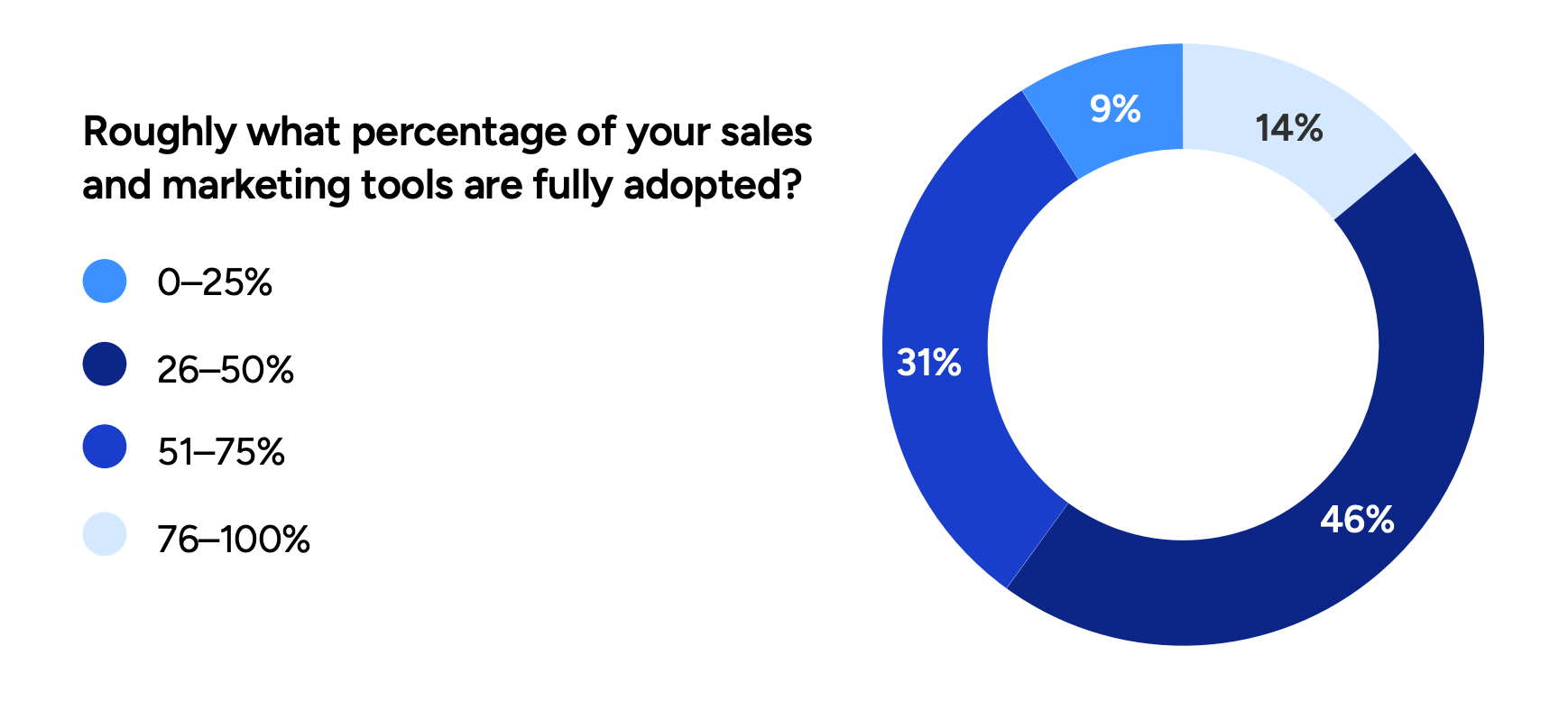
The Tool Bloat Trap: Over half (56%) of GTM professionals admit tool bloat is a major issue, with 60% utilizing less than half of their available software stack. Conversely, teams that actively consolidate their tech stacks are twice as likely to rate lead quality as "excellent" (55% vs. 20%).
Chronology and Evolution: From Meeting Cadences to Structural Breakdowns
Historically, companies attempted to solve revenue friction by introducing more meetings—forcing sales and marketing leaders into weekly syncs to review lagging conversion numbers.
Phase 1: The Communication Band-Aid
Years ago, organizational leaders diagnosed misalignment as a simple lack of communication. Consequently, the standard prescription was to increase meeting frequency. Today, 54% of GTM teams still put communication frequency first. However, data shows that adding meetings without fixing the underlying operating model merely broadcasts structural dysfunction rather than curing it. Teams communicate more often, but they continue to disagree fundamentally on lead definitions, follow-up timelines, and attribution credit.
Phase 2: The Emergence of the Perception Gap
As organizations scaled through the early 2020s, a divide widened between the boardroom and the front lines. Executives looked at strategy decks and recurring calendar invites and assumed alignment was achieved. Meanwhile, non-executives grappled with data inconsistencies, siloed communication, and departmental friction. By 2026, this information lag has compounded, leaving everyday reps to navigate broken handoffs while leadership remains insulated by rosy analytics dashboards.
Supporting Data: The True Cost of Misalignment
When misalignment is dismissed as a vague "culture problem," organizations fail to account for its compounding operational costs. According to the Unbounce report, employee frustration tops the list of consequences at 29%, closely followed by severe revenue leaks.
The Breakdown of Operational Friction
Delayed Follow-Ups: Marketers bear the brunt of this frustration; 32% of marketing professionals flag delayed follow-up as a primary issue, compared to just 22% of sales reps.
Unclear Ideal Customer Profiles (ICPs): 29% of marketers cite unclear target customer definitions as a major blocker, versus only 16% of sales personnel.
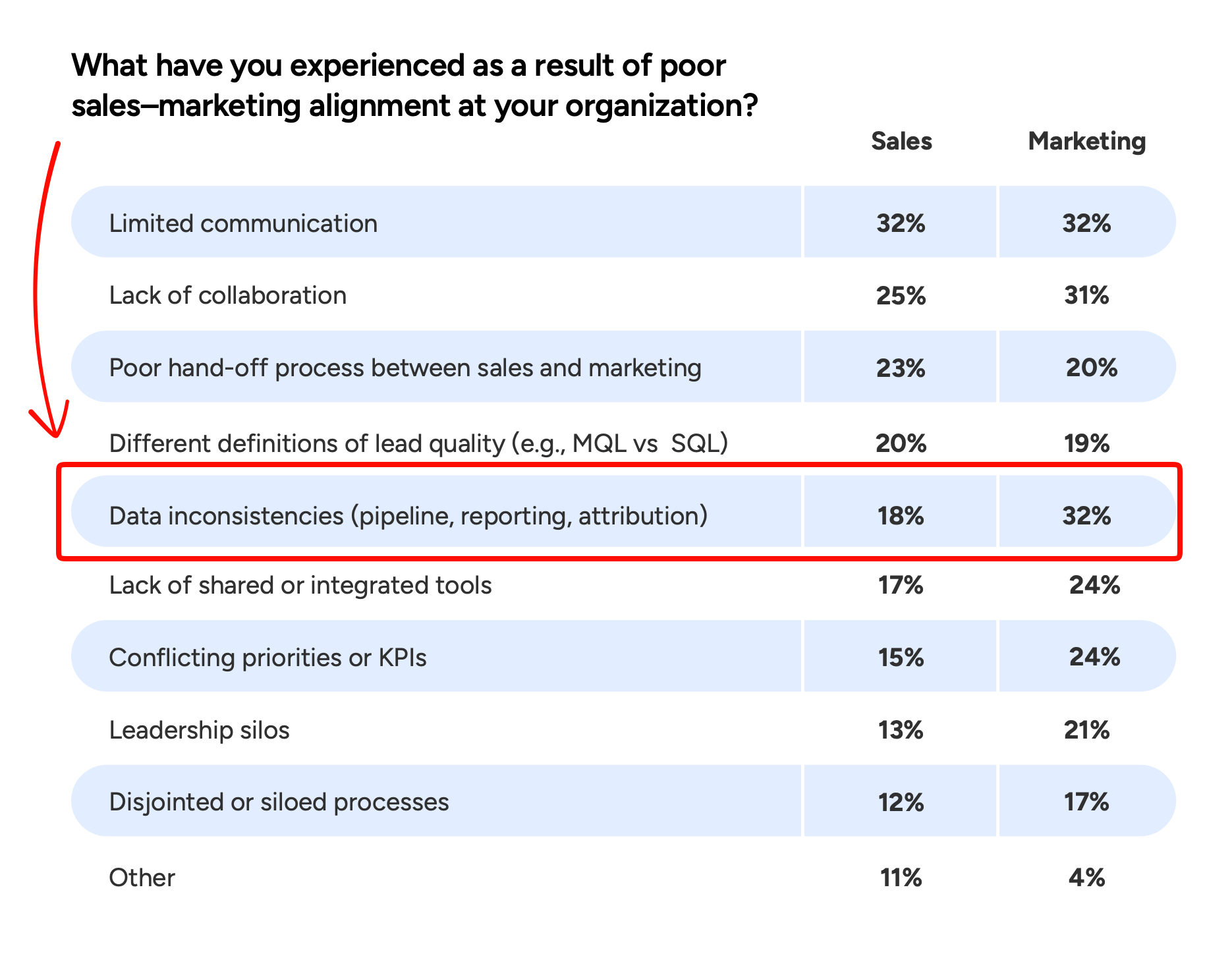
The MQL vs. SQL Stalemate: 20% of sales and 19% of marketing teams cite conflicting definitions of lead quality as a daily barrier. Both departments frequently maintain these silos to protect their individual metrics.
The report highlights a striking paradox regarding data. While 40% of GTM teams report excellent cross-functional data sharing, 68% concurrently encounter regular data inconsistencies.
This tension is felt most acutely by marketing teams: 32% of marketers cite data inconsistencies as a barrier, compared to just 18% of sales reps. This represents the widest functional split in the entire report. Marketing relies on multi-channel attribution and shared CRM data, whereas sales often tracks progress via individual, rep-owned pipeline signals. They simply are not looking at the same numerical reality.
Official Responses and Insights from GTM Leadership
Industry leaders and operational consultants emphasize that true alignment is measurable, mechanical, and deeply tied to core incentives.
Josh Gallant, founder of Backstage SEO and author of the underlying research, notes that businesses frequently fall into the trap of buying their way out of alignment.
"Tool bloat is the alignment problem teams keep buying their way into," Gallant explains. "When marketing automation platforms aren’t shared or adopted consistently, demand generation strategies run in isolation from what sales is actually executing. The instinct when alignment fails is to buy another tool—a new CRM module, another automation layer. But leaner stacks with higher adoption consistently outperform bloated tool collections."
Furthermore, experts point to the fundamental flaw of misaligned incentives. When marketing is rewarded purely on lead volume and sales is evaluated strictly on closed revenue, agreeing on shared KPIs becomes a hollow philosophical exercise. As economic theorist Charlie Munger famously observed: "Show me the incentive and I’ll show you the outcome." Until compensation structures reflect shared revenue goals, departmental friction will persist.
Implications: What Highly Aligned Teams Do Differently
The Unbounce study evaluated the 56% of organizations classified as "highly aligned" to determine the actionable behaviors that separate them from struggling peers. Their success comes down to three operational shifts:
1. Radical Data Unification
Aligned teams are 3.5 times more likely to maintain strong cross-functional data sharing (59% vs. 16%). Rather than translating disparate metrics across departmental boundaries, they pull customer data, pipeline definitions, and conversion signals from a single, unified source of truth.
2. Streamlined Tech Stacks
Lean operations win over sprawling software ecosystems. 30% of aligned teams maintain lean, focused tech stacks, compared to just 15% of misaligned organizations. By pruning unused applications—remember that 60% of teams use less than half their tools—these businesses eliminate data silos and boost daily user adoption.
3. Synchronized Handoff SLAs
High-performing teams establish rigid Service Level Agreements (SLAs) governing lead handoffs. Instead of tossing raw inquiries over a conceptual fence, they enforce:
Strict qualification criteria agreed upon mutually by sales and marketing.
Defined follow-up windows that eliminate the dead zones where leads decay.
Continuous feedback loops that allow sales reps to inform marketing about real-time buyer objections discovered on live calls.
Frequently Asked Questions
What is sales and marketing alignment?
Sales and marketing alignment is the operational synchronization of goals, data, processes, and buyer definitions. It ensures that every marketing campaign, sales handoff, and customer interaction moves fluidly toward shared revenue targets.
How does sales-marketing alignment differ from broader GTM alignment?
Go-to-market (GTM) alignment is an overarching operating model that encompasses sales and marketing alongside product development, customer success, and operations. Sales-marketing alignment is a vital subset of this broader framework; a company can have strong sales-marketing cohesion while experiencing severe GTM friction if product or customer success teams remain siloed.
Why do communication-focused alignment programs fail?
Relying solely on "more meetings" treats alignment as a communication issue rather than an operating model problem. Without shared data, unified KPIs, and agreed-upon lead definitions, recurring sync calls merely broadcast departmental disagreements rather than resolving them.
What metrics best measure sales and marketing alignment?
Four core metrics gauge alignment success:
Lead-to-Opportunity Conversion Rate: Measuring how many marketing leads successfully transform into actionable sales pipeline.
Customer Acquisition Cost (CAC): Tracking total spend required to acquire a customer across unified departmental budgets.
Pipeline Velocity: Monitoring the speed at which a prospect moves from initial touchpoint to closed-won revenue.
Win Rate by Lead Source: Evaluating which marketing channels produce deals that sales actually closes.
To explore the complete dataset, benchmark your organization against 500+ SMB peers, and identify the specific operational gaps costing your revenue team momentum, access the full Unbounce Go-to-Market Alignment Report.