From Digital Wallet to AI-Powered Financial Titan: The Strategic Evolution of Paytm
By Financial Tech Desk | Published in Partnership with Datalabs
Main Facts: At a Crossroads of Profitability and Innovation
Paytm, one of India’s most prominent digital financial services pioneers, has firmly stepped into a new era of growth. Having successfully clawed its way back to profitability following the regulatory turmoil surrounding Paytm Payments Bank, the company has completed a massive structural pivot. Once a cash-burning digital wallet and payments behemoth, Paytm has transformed into a high-margin financial services distributor and merchant solutions provider.
As of Q1 FY27, the company reported a robust operating revenue of INR 2,448 Cr—a 28% year-on-year increase—and firmly stretched its profitability following a net profit of INR 552 Cr in FY26 (rebounding dramatically from a net loss of INR 663 Cr in FY25).
However, the fintech giant now stands at a critical strategic crossroads. While credit and loan distribution have fueled its recent revival, potential changes to the Merchant Discount Rate (MDR) for Unified Payments Interface (UPI) transactions threaten to thrust payment processing back into the spotlight as a primary growth engine. Compounding this shift is CEO and founder Vijay Shekhar Sharma’s aggressive new bet on Artificial Intelligence (AI) and software-led solutions, branded under initiatives like "Paytm Intelligence" (PI).
As Paytm navigates stiff competition from heavyweights like PhonePe, Google Pay, and BharatPe, its future will depend on how effectively it can leverage its vast merchant and user ecosystems to monetize deeper financial relationships without compromising its hard-won operational discipline.
Chronology: The Journey from Wallet to Lending to AI
To understand Paytm’s current market position, one must trace its evolution across several distinct operational phases over the past half-decade:
The Early Payments Era (FY21): Paytm operated primarily as a consumer-facing digital wallet and payments gateway. In FY21, payment services generated INR 1,981 Cr, accounting for roughly 71% of its total operating revenue of INR 2,802 Cr. Financial services distribution, by contrast, contributed a paltry INR 128 Cr (under 5%).
The Super App Ambitions and Regulatory Stumbles (2022–2024): Paytm expanded aggressively into diverse consumer verticals, including entertainment ticketing and e-commerce, while attempting to build a comprehensive "super app." However, regulatory actions by the Reserve Bank of India (RBI) against Paytm Payments Bank in January 2024 forced a drastic scaling back of operations, compelling the company to throttle its super app dreams and pivot inward.
The Lending Pivot and Recovery (FY25–FY26): To survive the regulatory bruising, Paytm aggressively slowed its pure-play payments expansion and transformed into a lending distribution company. By partnering with banks and non-banking financial companies (NBFCs), Paytm shifted its focus to distributing credit and loan products to its extensive merchant network. This shift paid off: by FY26, financial services distribution had surged to INR 2,594 Cr, representing 31% of the company’s INR 8,437 Cr topline.
The AI and Software Horizon (September 2026 and Beyond): At its 26th Annual General Meeting (AGM) in September 2026, Paytm formally unveiled its vision for AI integration. The company outlined plans to evolve its ubiquitous Soundbox hardware into a comprehensive small business engagement platform, while developing enterprise software capabilities designed to support an "agentic workforce" by FY28.
Supporting Data: Financial Metamorphosis in Numbers
A granular look at Paytm’s financial statements reveals how thoroughly the company has inverted its revenue mix since the COVID-19 pandemic.
Revenue Mix Inversion (FY21 vs. FY26)
Financial Services Distribution: Experienced an astronomical 83% Compound Annual Growth Rate (CAGR), leaping from a meager baseline under INR 128 Cr in FY21 to INR 2,594 Cr in FY26. It now commands 31% of Paytm’s total topline.
Payment Services: Remains the single largest revenue pillar at 58% (generating INR 4,891 Cr in FY26), but grew at a comparatively sluggish 19% CAGR over the same five-year period. While down from its peak of INR 6,236 Cr in FY24, the payments segment has demonstrated substantial recovery following the 2024 regulatory crackdown.
Recent Performance Metrics (Q1 FY27)
Operating Revenue: Rose 28% year-on-year to INR 2,448 Cr.
Subscription Deployments: Reached 1.57 Cr storefronts, with payment processing margins remaining healthily above four basis points.
Consumer Engagement: Monthly Transacting Users (MTUs) stood at 8 Cr, with consumer UPI transaction values expanding by 45% year-on-year to INR 5.9 Lakh Cr (outpacing the wider industry’s 20% growth rate).
Workforce and Cost Trajectories
Sales Workforce: Reached 40,512 employees in Q4 FY26, up from 36,724 previously.
Employee Costs: Quarterly sales employee expenses increased by 30% year-on-year to INR 317 Cr.
Payment Processing Charges: Incurred INR 2,573 Cr in FY26, compared to INR 2,125 Cr the prior year.
Official Responses and Strategic Perspectives
Paytm’s leadership has been vocal about the deliberate nature of the company’s turnaround, emphasizing quality and sustainable engagement over raw volume acquisition.
During the Q4 FY26 earnings call, CEO and founder Vijay Shekhar Sharma addressed the drivers behind the company’s metrics:
"GMV growth is accelerating not just because MTUs (monthly transacting users) grew, but because usage per customer did. We focus on customer quality, product quality, and engagement, not just volume."
Addressing concerns regarding capital capacity and macroeconomic headwinds in the lending ecosystem following RBI risk-weight modifications, Sharma maintained that capital availability from lending partners is not a bottleneck. Instead, the primary corporate focus remains on cultivating profitable credit demand. Furthermore, by positioning itself strictly as a distribution channel rather than a direct lender, Paytm successfully insulates its balance sheet from the direct cost pressures of higher repo rates.
Regarding future tech integrations, Sharma emphasized that shareholders will begin seeing AI-specific revenues formally reflected in financial disclosures under commerce and cloud verticals by FY28. The company’s internal AI deployments already span product engineering, merchant sales, automated loan collections, and customer retention workflows.
Market Implications: Navigating the MDR Debate and Competitive Landscapes
The Zero-MDR Dilemma and Merchant-Centric Playbooks
Unlike competitors such as PhonePe—which engaged in aggressive consumer-facing user acquisition blitzes to capture market share—Paytm built its moat on the merchant side. The introduction of the ubiquitous Paytm Soundbox set a market benchmark, prioritizing a merchant-first strategy mirrored by players like BharatPe.
However, the structural challenge of India’s zero-MDR (Merchant Discount Rate) regime remains unresolved. Because scanning standard UPI QR codes generates negligible direct processing fees, Paytm has historically relied on cross-selling downstream services—such as merchant loans, insurance, and device subscriptions—to monetize its acquired merchant base.
While government proposals to implement a modest 0.4% MDR on select high-value UPI transactions have faced retail pushback and subsequent deferrals, Paytm’s robust merchant GMV gives it the financial cushion needed to weather the regulatory waiting game.
Competitive Pressures Across Verticals
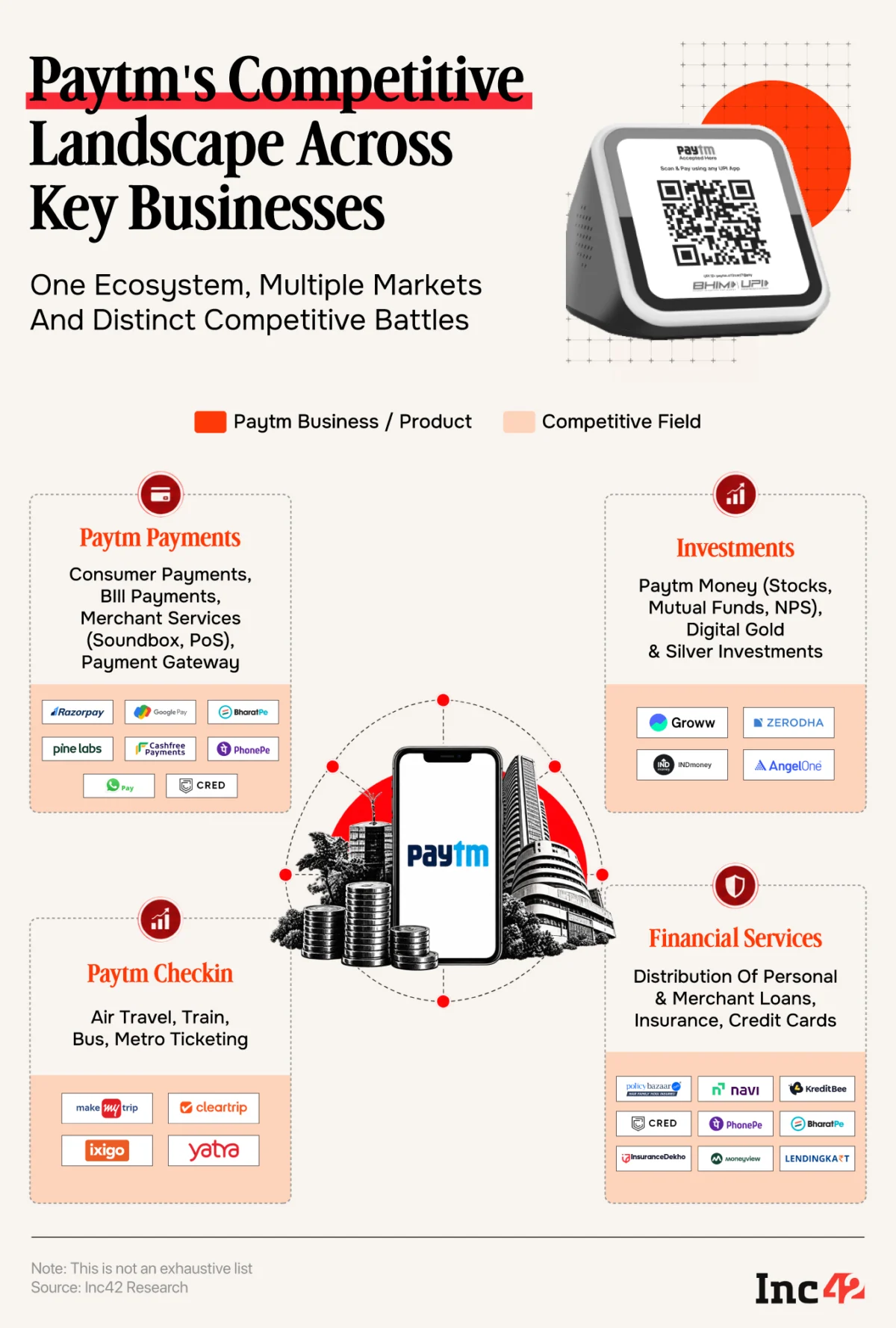
Paytm operates in a hyper-competitive multi-front war:
Consumer UPI: Paytm remains a distant challenger in terms of raw volume share. As of August 2026, Paytm held an 8.03% volume share, significantly trailing market leaders PhonePe (45.64%) and Google Pay (32.26%).
Merchant Services: It faces intense competition from PhonePe, Google Pay, BharatPe, CRED, Pine Labs, and Razorpay.
Investment & Wealth Management: While Paytm Money once held high aspirations, wealth tech sectors are currently dominated by specialized brokers like Groww, Zerodha, and Angel One.
The AI Imperative
To break past these competitive stalemates, Paytm’s pivot toward AI—manifested through the proposed Paytm Intelligence (PI) framework—seeks to redefine the Soundbox from a simple payment confirmation tool into an advanced small-business management hub. By offering localized commerce tools, customer notifications, and automated workflow agents, Paytm hopes to bind merchants tighter to its software ecosystem.
Conclusion
With its current profitability trajectory secured, Paytm possesses a vital 12-to-15-month runway. Whether this financial breathing room will allow Vijay Shekhar Sharma to successfully execute his dual vision of a high-margin credit distributor and an AI-driven software enterprise remains one of the most compelling storylines in global financial technology.