In the rapidly evolving landscape of artificial intelligence, the "best" model for a business is a moving target. As frontier models advance at a breakneck pace, organizations are finding themselves trapped between the need for innovation and the risk of technical debt. If an enterprise builds its entire infrastructure around a single model, it risks obsolescence the moment a superior technology emerges.
Microsoft Foundry has emerged as the definitive solution to this dilemma, offering a model-agnostic foundation that empowers businesses to build and scale AI agents without locking their architecture into any specific provider. By decoupling the agentic foundation from the underlying model, Microsoft is enabling a new era of "agile AI," where teams can swap models, refine tools, and optimize performance as their needs evolve—all while maintaining the integrity of their existing enterprise systems.
The Shift Toward Model-Agnostic Foundations
Historically, deploying an AI agent meant making a high-stakes bet on a specific model provider. If that model became outdated or proved inefficient for a specific workload, the migration path was often costly and disruptive.
Microsoft Foundry breaks this cycle by providing a "harness-agnostic" environment. This means that as cutting-edge models are released, teams can adopt them immediately—whether they are from OpenAI, Anthropic, or other industry leaders—without rebuilding their core agent logic, knowledge base, or governance controls. This flexibility is not just a convenience; it is a strategic necessity. A model optimized for high-volume customer service inquiries may be entirely unsuitable for complex legal research or real-time coding assistance. Foundry allows enterprises to match the right model to the right workload at the right time.
A New Frontier: GPT-6 and Claude Opus 5.5
The industry’s momentum is currently defined by the speed of innovation. This week, Microsoft solidified its commitment to breadth and choice by integrating the full GPT-6 family from OpenAI—including the specialized GPT-6 Sol and GPT-6 Luna—and Anthropic’s Claude Opus 5.5 directly into the Microsoft Foundry ecosystem.
For the modern enterprise, model choice is no longer a "day one" decision; it is a continuous competitive advantage. By surfacing these frontier models alongside existing options in an open, unified platform, Foundry enables developers to conduct rigorous comparative testing. Teams can evaluate these models against their proprietary data to measure performance tradeoffs across three critical vectors: quality, latency, and cost. This empirical approach ensures that production environments are always powered by the most capable and efficient models available.
The "Hill-Climbing" Philosophy of Continuous Improvement
Adopting a model is merely the starting point of an agent’s lifecycle. The true challenge lies in the "day two" operations—the ongoing refinement of instructions, tool selection, and behavioral tuning.
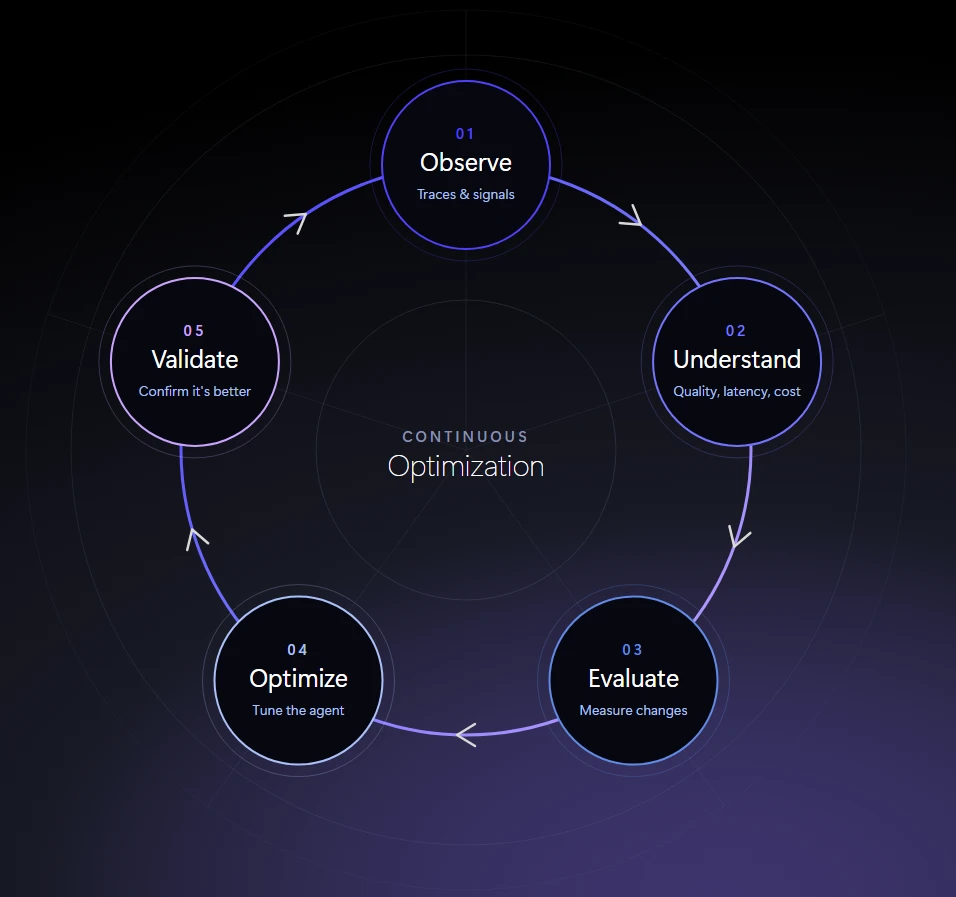
Microsoft Foundry champions a "hill-climbing" approach to development: observe, evaluate, optimize, validate, and repeat. This cyclical process ensures that agents do not stagnate. By leveraging production traces, Foundry provides developers with the data necessary to identify where an agent is failing, why it is consuming excess compute, or how its latency can be reduced. This isn’t about black-box automation; it is about putting people in control of the agent’s evolution, ensuring that business value increases with every iteration.
Voice as a Native Agent Experience
One of the most significant barriers to AI adoption has been the friction of interface. Until recently, many "voice agents" were merely text-based agents retrofitted with speech-to-text layers, resulting in disjointed, high-latency experiences.
With the introduction of Voice Agents in Foundry Agent Service (now in public preview), voice has become a native, first-class citizen of the agent architecture. These agents are built, deployed, and monitored through the same APIs and SDKs as text-based agents, allowing developers to leverage existing tools and enterprise knowledge bases.
This new service supports a variety of industry-leading voice models—such as GPT Realtime and Azure Realtime—allowing teams to balance reasoning depth against cost. Beyond mere interaction, these voice agents are designed for the nuances of human communication, featuring:
- Natural turn-taking and graceful recovery: Agents that understand interruptions and flow like a human conversation.
- Multilingual support: Capabilities spanning 80+ languages and 140+ locales.
- Brand Identity: The ability to fine-tune custom speech, create unique synthetic voices, and even integrate video avatars for a cohesive brand experience.
Case Study: Fashable’s Digital Revolution
The impact of these tools is already being felt in the fashion industry. Fashable, a pioneer in AI-driven design, utilizes Microsoft Foundry to bridge the gap between abstract trends and tangible production. By connecting Foundry’s agentic capabilities with their existing design workflows, Fashable has reported a dramatic reduction in development cycles—moving from months to weeks.
"People don’t think in prompts, they think in conversations," says Orlando Ribas Fernandes, CEO of Fashable. By integrating voice-first agents, Fashable is enabling a more natural, accessible interface for fashion brands to iterate on designs, virtual try-ons, and campaign imagery. The result? A 60% reduction in the budget required for physical samples, proving that the right AI architecture can directly impact the bottom line.
Long-Running Resilience and Technical Sophistication
Enterprise workflows rarely occur in a single, atomic request. They are often long-running, multi-stage processes that require interaction with legacy systems, human approvals, and complex research tasks.
To address this, Microsoft has introduced Long-running resilience in Foundry Agent Service. If an agent is interrupted—whether due to a network disconnect or a process failure—the system can now recover from its last durable checkpoint. This, combined with the Microsoft Agent Framework, allows for:
- Episodic Procedural Memory: Enabling agents to reuse successful patterns from past tasks.
- Isolated Code Execution: Using Hyperlight containers to ensure that code-heavy agent tasks are executed safely and predictably.
- Simplified Tooling: The new Foundry dev pack for Visual Studio Code streamlines the entire developer experience, allowing teams to go from local experimentation to resilient, production-ready agents with minimal configuration.
Governance: Security as a Foundation, Not an Afterthought
As agents take on more autonomous tasks, they must be managed as enterprise assets. Microsoft Foundry is setting the standard for AI governance by integrating directly with Microsoft Entra and Agent 365.
Key governance features include:
- Identity and Lifecycle Management: Policies regarding blocking, disabling, or reassigning agents are enforced directly at the runtime level.
- Network Egress Controls: Teams can now define strict allow/deny rules for outbound traffic, ensuring that agents cannot access unauthorized external resources.
- AI Gateway Integration: The upcoming October preview of the AI Gateway tier within Azure API Management will allow for a "hub-and-spoke" governance model. Platform teams can centrally manage model access, ensuring that developers only interact with approved, compliant, and cost-optimized models.
Furthermore, the new run-assert-eval Skill automates the verification process. By running a series of open-source safety and quality tests, this skill ensures that improvements to an agent do not introduce regressions or violate safety policies. It essentially automates the compliance audit, providing definitive evidence that the agent is performing exactly as intended.
The Path Forward
The latest updates to Microsoft Foundry represent a fundamental shift in how enterprises approach artificial intelligence. By moving away from brittle, monolithic architectures and toward a flexible, governed, and highly observable platform, Microsoft is helping developers spend less time "plumbing" infrastructure and more time building transformative applications.
For the CIO or lead developer, the message is clear: the future of AI is not in choosing the right model today, but in building a system that can adapt to the models of tomorrow. With Foundry, the "hill-climbing" loop of continuous improvement, combined with enterprise-grade governance and a native voice-first experience, provides a robust, future-proof foundation for the next generation of business intelligence.
As we look toward the remainder of the year and beyond, the focus will undoubtedly shift from the novelty of AI to the reliability of agents. Microsoft Foundry stands at the center of that transition, turning the promise of agentic AI into a measurable, scalable, and secure reality.