Main Facts
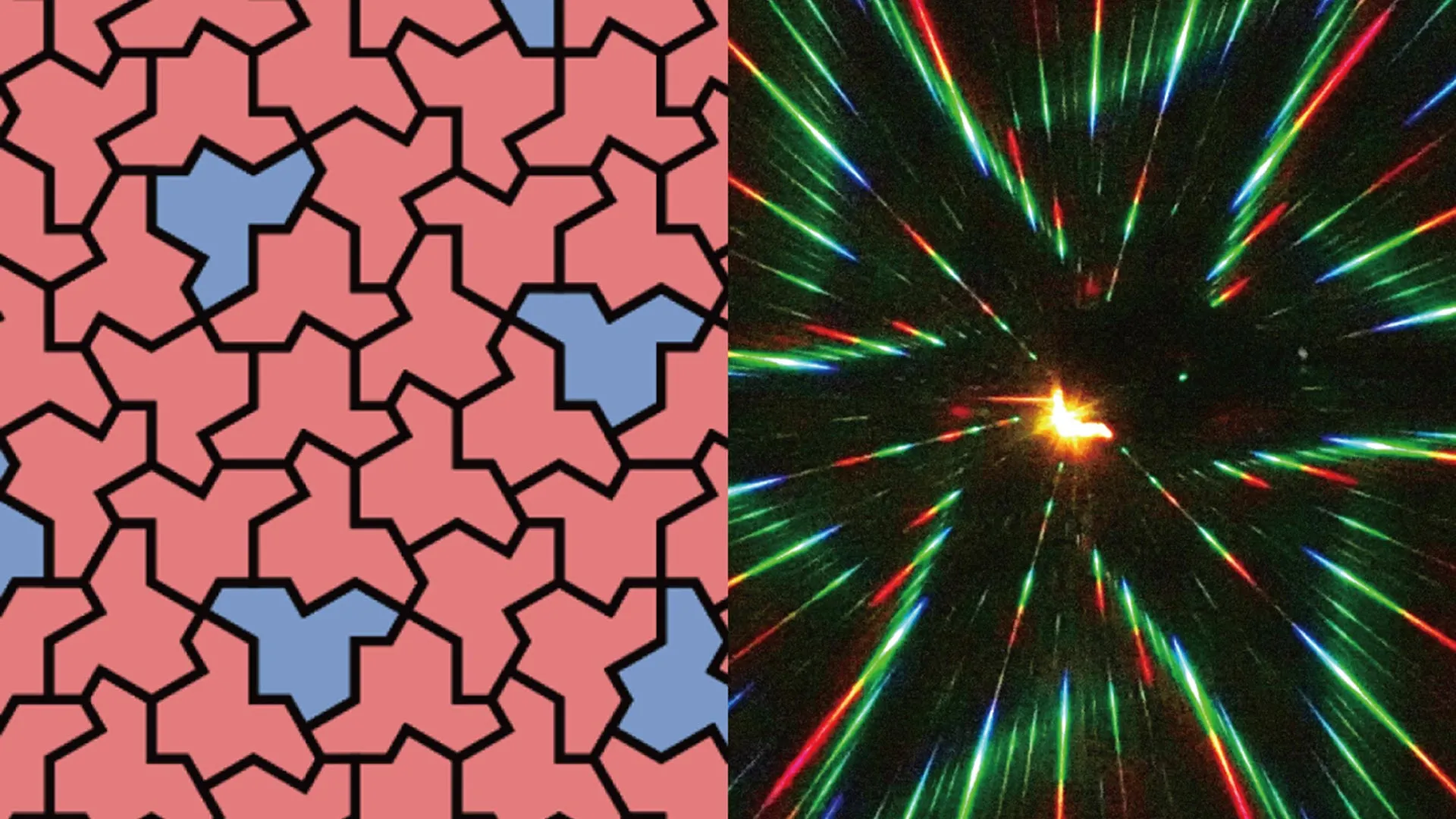
In a groundbreaking interdisciplinary study published in Nature Communications, researchers from the Institute of Industrial Science at The University of Tokyo, alongside international collaborators, have uncovered an unexpected and profound connection between abstract mathematics and modern optical physics. The team successfully translated the "Smith hat"—the revolutionary shape that solved a decades-old mathematical conundrum known as the "Einstein problem"—into nanoscale physical structures.
When illuminated with laser light, these microscopic silicon nitride structures force light to behave in ways never before observed in conventional quasicrystals. Specifically, the aperiodic, non-repeating geometry of the Smith hat generates distinct, pinwheel-like diffraction patterns that exhibit pronounced optical chirality, or "handedness." This phenomenon occurs because the underlying structural pattern entirely lacks mirror symmetry.
The implications of this discovery stretch far beyond theoretical physics. By demonstrating that complex, non-repeating mathematical tilings can fundamentally dictate the optical response of light—influencing everything from diffraction pathways to polarization sensitivity—the research opens an entirely new frontier in material science. It provides scientists with a novel platform to manipulate light at the nanoscale, potentially paving the way for next-generation optical devices, advanced polarization controllers, and highly specialized photonic circuits. What began as a pure exercise in tiling geometry has now blossomed into a tangible physical tool for bending and shaping light through the strict rules of aperiodic order.
Chronology of Discovery: From the 1960s Puzzle to Optical Nanostructures
To understand the magnitude of the recent breakthrough at The University of Tokyo, it is essential to trace the historical timeline that led from abstract geometry to nanoscale optics.
The Quest for the Aperiodic Monotile (1960s–2023)
For decades, mathematicians wrestled with what became known as the "Einstein problem"—named not after the famous physicist, but derived from the German ein Stein, meaning "one stone." The core question was deceptively simple: Could a single, distinct geometrical shape (a monotile) tile an infinite two-dimensional surface entirely without ever creating a repeating, periodic pattern?
While mathematicians had long known how to use multiple shapes to create aperiodic patterns—most famously demonstrated by Roger Penrose in the 1970s with his "Penrose tilings"—finding a single shape that could achieve this feat remained an elusive Holy Grail. Traditional tiles, such as squares, rectangles, and regular hexagons, naturally form periodic lattices like checkerboards and honeycombs, where the pattern repeats identically at regular intervals.
That decades-long drought ended in 2023, when a team of mathematicians and amateur geometry enthusiasts discovered the "Smith hat." This thirteen-sided polygonal monotile proved capable of covering an infinite plane aperiodically without ever settling into a repetitive arrangement. The mathematical world celebrated the find as a monumental breakthrough, solving a problem that had baffled theorists for generations.
The Pivot to Physics (2024–Present)
Shortly after the mathematical community digested the implications of the Smith hat, physicists began asking whether this abstract geometrical curiosity possessed physical utility. Recognizing that the hat tile’s unique aperiodicity sat somewhere between highly ordered crystals and completely random amorphous materials, researchers at the Institute of Industrial Science wondered how physical waves—specifically light—would interact with structures built upon this specific tiling.
Using advanced microfabrication techniques, the team moved from paper and digital models to the cleanroom. By employing electron beam lithography, they etched nanoscale versions of the Smith hat pattern onto thin films of silicon nitride.
When these physical structures were subjected to laser illumination, they did not scatter light in the uniform, predictable manner of standard crystals or the radially symmetric patterns of typical quasicrystals. Instead, the diffracted light organized itself into striking, asymmetric pinwheel formations. This critical experiment bridged the gap between a 2023 mathematical paper and a 2024–2025 physics breakthrough, proving that abstract topological rules can directly dictate optical behavior.
Supporting Data and Technical Methodology
The rigorous methodology behind the Nature Communications study highlights the precision required to translate mathematical theory into physical optics.
Fabrication and Nanoscale Engineering
To test the optical properties of the Smith hat, the researchers required structures operating on the scale of visible and near-infrared light wavelengths. They utilized electron beam lithography (EBL), a high-resolution nanofabrication technique capable of drawing features measuring only a few hundred nanometers across.
The patterns were etched onto silicon nitride ($textSi_3textN_4$) films, a material widely favored in integrated photonics due to its wide bandgap, high refractive index, and low optical loss. The resulting arrays accurately reproduced the intricate, interlocking boundaries of the Smith hat monotile across microscopic surfaces.
Optical Characterization and Diffraction
Once fabricated, the silicon nitride structures were mounted on an optical bench and illuminated with a coherent laser source. The resulting diffraction patterns were captured using high-resolution camera sensors and analyzed for symmetry, intensity distribution, and phase characteristics.
- Pinwheel Diffraction Symmetry: Unlike conventional periodic lattices that yield symmetrical point-grid diffraction spots, or standard quasicrystals that display rotational symmetries (such as tenfold or twelvefold symmetry), the Smith hat arrays produced chiral, pinwheel-like diffraction signatures.
- Dependence on Angle and Polarization: Quantitative data revealed that the diffracted light’s morphology shifted predictably depending on the angle of incidence and the polarization state of the incoming laser beam.
- Mirror-Image Reversal: When the research team analyzed fabricated structures that were physical mirror images of the original Smith hat tiling, the resulting optical diffraction patterns inverted symmetrically. This confirmed that the optical response was intrinsically hardwired to the geometrical chirality of the underlying spatial arrangement.
| Parameter | Conventional Quasicrystal | Smith Hat Aperiodic Structure |
|---|---|---|
| Underlying Geometry | Multi-tile sets or rotationally symmetric aperiodic tiles | Single aperiodic monotile (derived from honeycomb lattice) |
| Mirror Symmetry | Typically possesses mirror planes | Lacks mirror symmetry ($C_1$ or low point group symmetry) |
| Optical Diffraction Response | Symmetric, radially balanced patterns | Asymmetric, pinwheel-shaped chiral patterns |
| Polarization Sensitivity | Standard polarization dependence | High sensitivity coupled with structural handedness |
Official Responses and Expert Insights
The interdisciplinary nature of the research drew commentary from the primary architects of the study, who emphasized the philosophical and practical weight of merging pure mathematics with applied optics.
Lead author Yuto Moritake pointed out the surprising structural origin of the hat tile during initial analysis:
"What is especially fascinating about the hat tile is that, although the resulting pattern appears irregular at first glance, it is actually constructed from the honeycomb lattice. We wanted to see whether this unique shape could also produce any unexpected physical phenomena."
Moritake further underscored the broader significance of the findings for future scientific investigations, noting:
"These results open a new direction of research on the fusion of quasiperiodic order and chirality. Monotile patterns provide a platform for exploring optical phenomena that emerge from the interplay of symmetry, chirality, and aperiodicity."
Senior author Masaya Notomi elaborated on the precise physical mechanism driving the unusual optical response:
"We found that the diffraction patterns themselves become chiral because the structure lacks mirror symmetry. This kind of optical response is fundamentally different from that observed in conventional quasicrystalline materials."
Notomi’s assessment highlights a critical shift in how nanophotonics researchers view spatial symmetry. By demonstrating that the absence of mirror symmetry in an aperiodic monotile can systematically force light into chiral pathways, the team has provided physicists with a powerful new knob to turn when designing optical metamaterials.
Implications for Future Technology and Physics
The revelation that the Smith hat can dictate optical behavior carries profound implications across multiple scientific and engineering domains.
1. Advanced Nanophotonics and Light Manipulation
Traditional optical devices—such as lenses, gratings, and waveplates—rely heavily on periodic structures (like photonic crystals) or homogeneous bulk materials to bend, filter, or polarize light. The incorporation of aperiodic monotile geometries introduces an entirely new design paradigm. Because these patterns never repeat yet maintain strict, long-range order, they can manipulate light across multiple spatial frequencies simultaneously. This capability could lead to ultra-compact optical components capable of performing complex wave-front shaping that would be difficult or impossible to achieve with traditional periodic lattices.
2. Tailored Polarization Control and Chirality
Chirality is of paramount importance in fields ranging from telecommunications to biochemistry, where molecules or light waves interact based on their "handedness" (left-handed versus right-handed). By leveraging structures that lack mirror symmetry at the nanoscale, engineers can design specialized optical filters that selectively transmit, reflect, or rotate specific polarizations of light. The Smith hat-inspired structures offer a blueprint for creating robust, artificially chiral optical media without relying on inherently toxic or expensive chiral chemical compounds.
3. The Unreasonable Effectiveness of Mathematics in Physics
On a fundamental level, the discovery reinforces a concept famously pondered by physicist Eugene Wigner: the unreasonable effectiveness of mathematics in the natural sciences. The Smith hat was conceived purely as an exercise in abstract geometry—a solution to a spatial puzzle regarding how shapes fit together on a flat plane. That this exact geometry should inherently possess the capacity to sort, twist, and diffract light waves demonstrates the deep, underlying unity connecting abstract topology to the physical laws of electromagnetism.
Summary of Future Research Horizons
- Multilayered and Three-Dimensional Tilings: Researchers are now investigating whether three-dimensional analogues of the Smith hat can exert similar control over acoustic waves, thermal radiation, or electrons in solid-state materials.
- Active Tunability: Future iterations aim to integrate active materials (such as liquid crystals or phase-change materials) into the monotile arrays, allowing real-time electronic control over the chiral diffraction patterns.
- Integrated Photonic Circuits: Scaling these structures down for integration into silicon photonics chips could revolutionize on-chip optical computing and quantum communication pathways.
Ultimately, the journey of the Smith hat—from a mathematical curiosity scrawled on digital canvases to a dynamic instrument for controlling laser light—signals a vibrant new chapter in the ongoing convergence of geometry, physics, and advanced technology.