










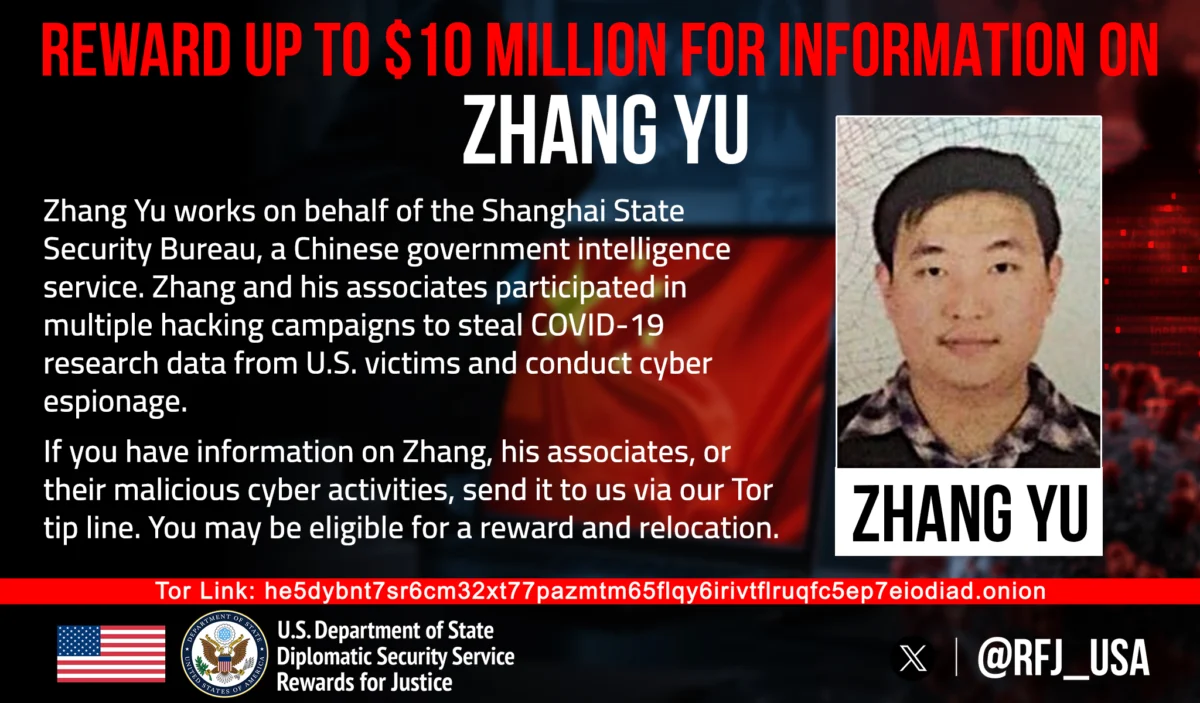
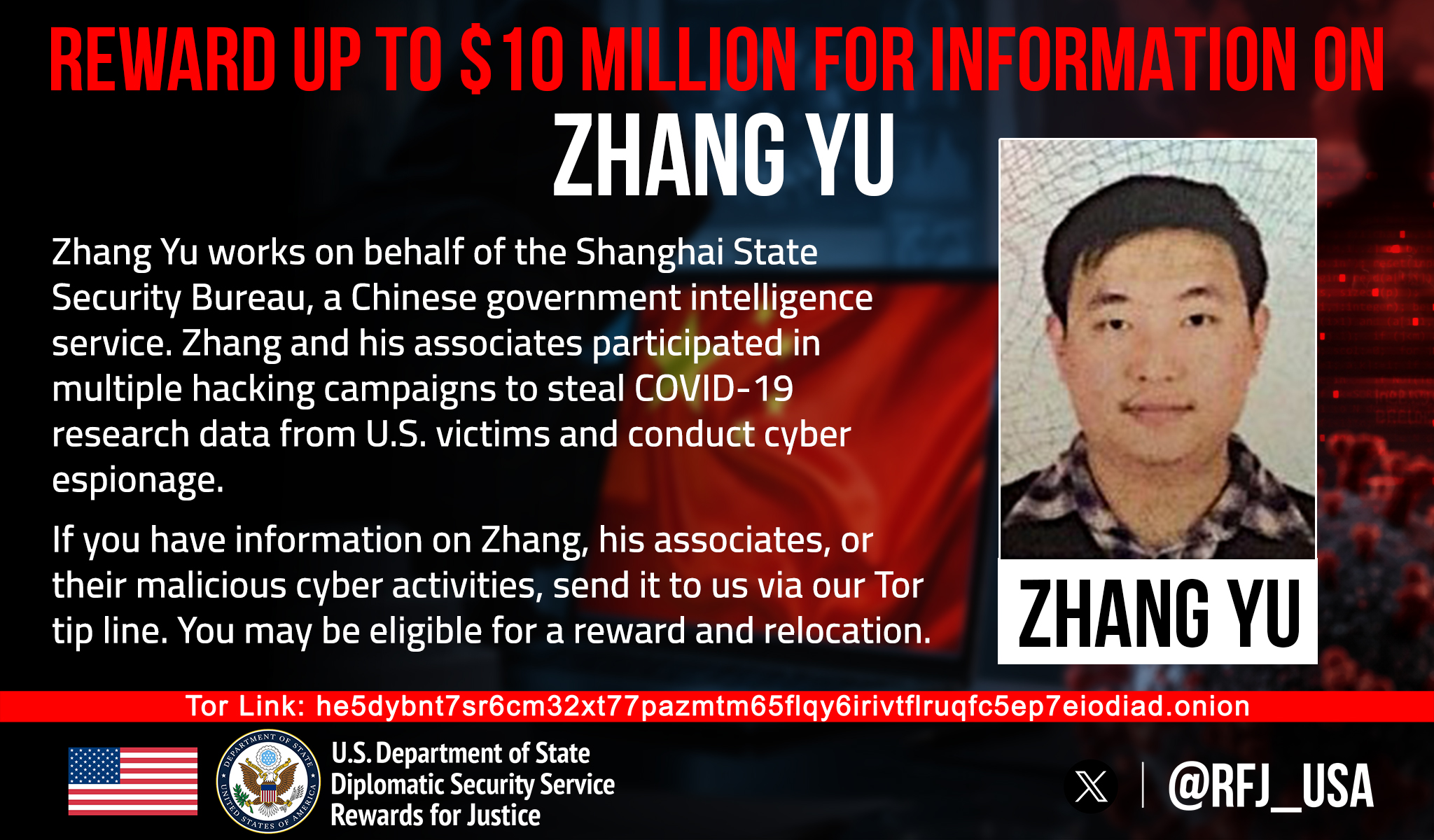
In a significant escalation of its efforts to combat state-sponsored cyberespionage, the United States Department of State has placed a $10 million bounty on the head of Zhang Yu. A Chinese national and executive at Shanghai Firetech Information Science and Technology, Zhang is accused of orchestrating some of the most disruptive cyber campaigns of the last decade, most notably the 2021 HAFNIUM operation that paralyzed thousands of Microsoft Exchange servers globally.
The reward, offered through the U.S. State Department’s "Rewards for Justice" (RFJ) program, underscores the growing desperation and resolve of American authorities to bring overseas threat actors to justice. As geopolitical tensions in the digital domain continue to simmer, the targeting of a specific corporate executive highlights a strategic shift: the U.S. is no longer just chasing elusive hackers; it is dismantling the corporate-state ecosystem that provides them with cover.
Main Facts: The Allegations Against Zhang Yu
According to federal indictments and official government disclosures, Zhang Yu served as a pivotal link between the Chinese private sector and the nation’s intelligence apparatus. As a director at Shanghai Firetech, Zhang allegedly managed a cadre of hackers tasked with fulfilling the objectives of the Shanghai State Security Bureau (SSSB), a regional branch of China’s formidable Ministry of State Security (MSS).
The indictment alleges that Zhang did not act as a rogue agent but rather as a handler. He is accused of supervising employees at Firetech and coordinating closely with his associate, Xu Zewei—a former general manager at Shanghai Powerock Network Co. Ltd. Together, the duo functioned as an outsourced cyber-espionage unit. By utilizing private companies as a "buffer," the MSS sought to maintain plausible deniability, masking state-sponsored aggression as private-sector industrial activity.
The charges against Zhang include:
- Conspiracy to commit computer fraud: Specifically targeting U.S. critical infrastructure.
- Theft of sensitive research: Exploiting university networks to pilfer proprietary data.
- Orchestration of the HAFNIUM campaign: Utilizing zero-day vulnerabilities in Microsoft Exchange to facilitate mass intrusions.
Chronology of a Global Cyber Crisis
The activities attributed to Zhang and his associates represent a multi-year campaign of intrusion that evolved in both complexity and scale.
2020: The COVID-19 Espionage Phase
The saga began in early 2020, as the world braced for the impacts of the COVID-19 pandemic. While scientists across the globe scrambled to understand the virus and develop vaccines, Zhang and Xu allegedly pivoted their operations to exploit this vulnerability. Prosecutors claim the duo gained unauthorized access to the networks of prestigious U.S. universities and research institutions. Their objective was clear: to steal sensitive data from leading immunologists and virologists working on the front lines of the pandemic response.
2021: The HAFNIUM Outbreak
By 2021, the operation reached a fever pitch. The group began exploiting critical flaws in Microsoft Exchange Server. The resulting campaign, dubbed "HAFNIUM," became one of the most significant security events in modern history. The exploit chain allowed attackers to gain persistent access to email accounts and deploy web shells, enabling them to exfiltrate data from government agencies, law firms, and private corporations. The FBI has since confirmed that the HAFNIUM campaign compromised more than 12,700 organizations within the United States alone, with the global impact reaching hundreds of thousands of victims.
2025: The Turning Point
The pursuit of these individuals transitioned from digital tracking to physical interdiction in the summer of 2025. On July 3, 2025, Italian authorities—acting on a U.S. warrant—arrested Xu Zewei at Milan’s Malpensa Airport as he arrived on a flight from China. His subsequent extradition to the United States in April 2026 provided the FBI with a wealth of intelligence regarding the operational structure of the SSSB’s cyber division. Unlike his associate, Zhang Yu remains at large, and the current reward offer is a direct attempt to leverage the $10 million incentive to track his location and facilitate a similar apprehension.
Supporting Data: The Scale of Destruction
The sheer magnitude of the HAFNIUM campaign is what elevates Zhang Yu to the status of a "most wanted" cyber criminal. Security analysts often point to the 12,700 U.S. organizations hit as a conservative estimate of the damage.
The modus operandi involved in these attacks highlights a sophisticated understanding of network architecture. By compromising Microsoft Exchange, the attackers gained access to a "gold mine" of organizational communication. This allowed for the mapping of internal hierarchies, the theft of intellectual property, and the establishment of "persistence"—a technique that ensures hackers remain inside a network even after initial patches are applied.
Furthermore, the relationship between Zhang and Xu provides a rare, documented look into the "contractor" model of state-sponsored hacking. In one instance cited by prosecutors, Xu reported directly to Zhang after successfully breaching a Texas university. This granular level of reporting confirms that these hackers were not working independently; they were fulfilling "orders" from handlers who reported to the MSS.
Official Responses and Strategic Implications
The U.S. Department of State’s decision to offer a $10 million reward is a calculated move designed to achieve two goals: disruption and deterrence.
The Rewards for Justice (RFJ) Mandate
Established in 1984, the RFJ program was originally conceived to combat international terrorism. However, its evolution to include "malicious cyber activity" reflects the changing nature of national security. With over $250 million paid out to more than 125 sources over the decades, the program has proven to be a highly effective, if unconventional, tool for the Bureau of Diplomatic Security. By putting a price on Zhang Yu, the U.S. is essentially signaling to other cyber-actors that the walls of the "private sector buffer" are crumbling.
The Diplomatic Fallout
This case places significant strain on the already fragile U.S.-China bilateral relationship. By naming specific individuals and linking them directly to the Shanghai State Security Bureau, the Department of Justice is making a definitive statement about the source of the attacks. It forces the international community to acknowledge that the distinction between private Chinese tech firms and state intelligence agencies is, in many cases, nonexistent.
Implications: The Future of Cyber-Attribution
The pursuit of Zhang Yu represents a paradigm shift in how the United States handles state-sponsored cyber warfare.
- End of Anonymity: Historically, state-sponsored hackers operated in a gray zone where they were known by codenames or threat actor group names (e.g., APT-xx). By identifying individuals like Zhang Yu and Xu Zewei, the U.S. is stripping away the anonymity that these hackers rely on to travel and participate in the global economy.
- The Extradition Precedent: The successful arrest and extradition of Xu Zewei from Italy proves that hackers are no longer safe just because they are outside of U.S. jurisdiction. The web of international cooperation against cyber-espionage is tightening, and the "safe havens" are disappearing.
- The "Buffer" Strategy: The indictment of these individuals forces foreign governments to reconsider the cost of using private companies to conduct espionage. If the U.S. continues to pursue the directors of these "front" companies, it will likely increase the overhead for China to maintain its current cyber-operations.
As the investigation continues, the focus remains on the $10 million bounty. For those in Zhang’s inner circle, the reward represents a life-changing sum of money. For the U.S. government, it represents a necessary investment in national security.
The capture of Zhang Yu would be a watershed moment for global cybersecurity. It would not only provide a closure to the HAFNIUM investigation but would also serve as a stark warning to those who believe that the digital battlefield offers total impunity. As the digital and physical worlds continue to collide, the manhunt for Zhang Yu serves as a reminder that in the eyes of the law, the keyboard is no longer a shield.



